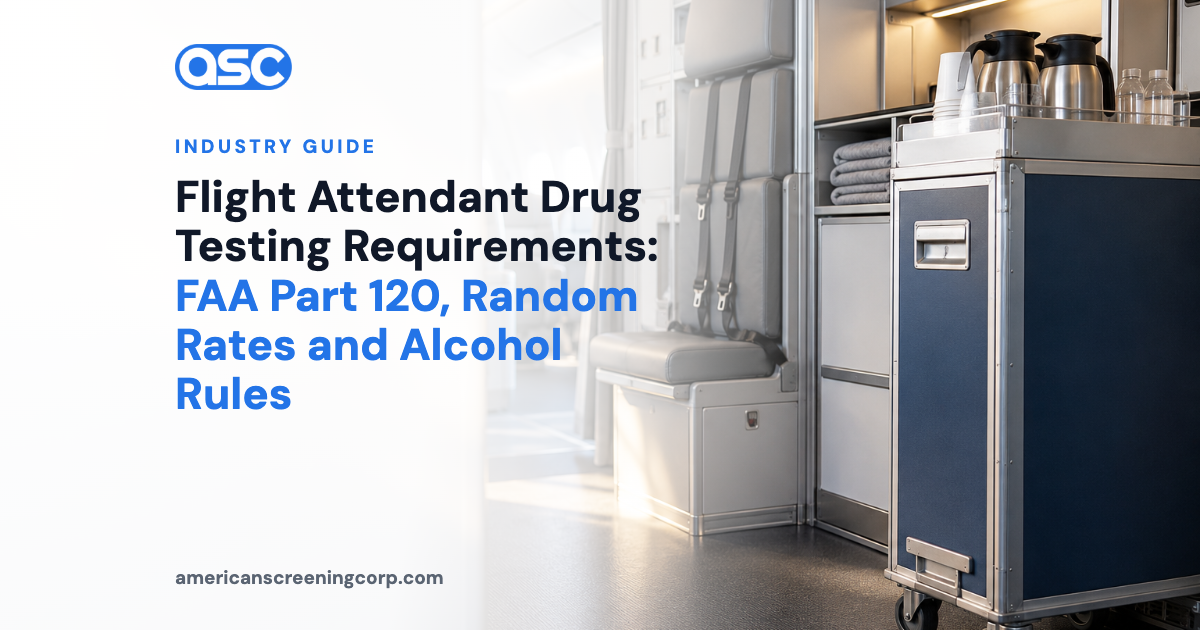
Flight attendants are classified as safety sensitive employees under federal aviation rules, which puts them in the same drug and alcohol testing structure as pilots, dispatchers and aircraft mechanics. The program is not something an individual airline invented. It is built from a federal regulation, a federal procedure manual and an annual rate the Federal Aviation Administration publishes for the whole industry. This post walks through what the rule actually requires, who sets the testing rate, what gets tested for, and what happens after a positive or refused test.
Why flight attendants are tested at all
The legal basis is 14 CFR Part 120, the FAA's drug and alcohol testing program for aviation. Part 120 lists the job categories covered as "safety sensitive function," and flight attendant duties performed on an aircraft are named directly in the regulation alongside flight crewmembers, flight instructors, aircraft dispatchers, maintenance personnel and ground security coordinators. An air carrier operating under 14 CFR Part 121 or certain Part 135 operations must have an anti drug and alcohol misuse prevention program covering every employee who performs one of those functions, whether the person is a direct employee or works for a contractor providing crew to the carrier.
The testing procedures themselves, meaning collection, chain of custody, laboratory analysis and the review of results, are not written inside Part 120. Part 120 points to 49 CFR Part 40, the Department of Transportation's single procedures rule that every DOT mode (aviation, trucking, rail, transit, pipeline) must follow. This is why a flight attendant's drug test looks procedurally similar to a commercial driver's DOT test even though the authorizing rule is different.
What triggers a test
Subpart E of Part 120 lays out the testing events a covered airline must run:
| Testing event | When it applies |
|---|---|
| Pre employment | Before a person first performs a safety sensitive function for the carrier; a verified negative result is required before working unsupervised |
| Random | Unannounced, spread through the year on a schedule the employee cannot predict, at a rate the FAA sets annually |
| Post accident | After an accident meeting the regulation's definition, as soon as practicable |
| Reasonable suspicion / reasonable cause | Based on specific, contemporaneous, documented observations by a trained supervisor |
| Return to duty | Before returning to safety sensitive duty after a violation |
| Follow up | Unannounced testing for a period set by the Substance Abuse Professional after a return to duty |
The random testing rate
The FAA does not let each airline pick its own random testing percentage. The agency reviews the aviation industry's positive rate each year and publishes a minimum annual random testing rate for drugs and a separate minimum rate for alcohol in the Federal Register random rate notice. Under the rule, if the industry wide positive rate for a testing category stays below 1.0 percent for a set number of consecutive years, the FAA can lower the minimum random drug testing rate to 25 percent of safety sensitive employees per year; if it rises, the agency can raise the rate back toward 50 percent. Carriers must test at least the published minimum, and many build their program to exceed it. The random alcohol testing minimum follows the same federal notice process. Because the number changes periodically, an airline's compliance department or safety office should check the current year's Federal Register notice rather than relying on a number from a previous year.
What the test screens for
The required drug panel for DOT regulated safety sensitive testing, including flight attendants, is defined in 49 CFR Part 40 and covers marijuana metabolite, cocaine metabolite, amphetamines (including methamphetamine and MDMA), opioids and phencyclidine (PCP). The opioid category was expanded by DOT rulemaking to add semi synthetic opioids, meaning hydrocodone, hydromorphone, oxycodone and oxymorphone, alongside the original codeine and morphine analytes, which is why carriers and testing vendors sometimes describe the federal panel as the DOT 5 panel with expanded opioids rather than the older standard 5 panel. A nonnegative screening result is always sent for confirmation by gas chromatography mass spectrometry or liquid chromatography mass spectrometry at an HHS certified laboratory before it is reported as positive; a screening immunoassay alone is never the final word under the federal program.
Alcohol testing rules
Part 40 also sets the alcohol standard that applies to flight attendants and other covered aviation employees. A breath alcohol concentration of 0.04 or greater is a violation requiring immediate removal from safety sensitive duty. A result between 0.02 and 0.039 does not count as a Part 40 violation but still requires the employee to be removed from safety sensitive duty for at least eight hours or until a retest shows below 0.02, whichever comes first. Separately, 14 CFR Part 120 carries the aviation specific "8 hour bottle to throttle" rule, which prohibits performing a safety sensitive function within 8 hours after consuming alcohol, while under the influence, or with a breath alcohol concentration of 0.04 or greater, and prohibits having or using alcohol while on duty or within 4 hours of reporting for a safety sensitive function. Carriers may set a stricter company policy than these federal minimums, and many airline alcohol policies require a longer abstinence window than 8 hours.
Medical review, documentation and prescriptions
Any nonnegative confirmed drug result goes to a Medical Review Officer before it is reported to the employer as positive. The MRO is a licensed physician trained under Part 40 who contacts the employee, reviews any current prescription or medical explanation, and verifies the result as positive, negative or, when a legitimate medical explanation applies, as a verified negative. A flight attendant who is taking a prescribed medication that could explain a nonnegative screen should be ready to provide the MRO with the prescription information so the MRO can make that determination directly; the employer and the collection site are not the ones who decide whether a prescription explains a result.
Return to duty and the SAP process
An employee who has a verified positive drug test, a confirmed alcohol violation, or who refuses a required test cannot return to a safety sensitive function on their own. Subpart O of Part 40 requires evaluation by a Substance Abuse Professional (SAP), who recommends an education or treatment plan, confirms compliance before a return to duty test can be scheduled, and sets the follow up testing schedule for at least the first 12 months back on the job. Only a verified negative return to duty result allows the employee back into a safety sensitive function, and the carrier, not the employee, arranges the return to duty test with a DOT collector.
State law and company policy
Because this program runs under federal transportation law, it generally preempts conflicting state drug testing procedural requirements for the safety sensitive positions it covers, but employment law questions outside the testing procedure itself, such as leave, discipline and accommodation, can still be shaped by state law and company policy. Airlines should confirm current obligations with counsel and with their Department of Transportation Office of Drug and Alcohol Policy and Compliance program documentation rather than relying on general guidance. The FAA Drug Abatement Division program page and SAMHSA's workplace resources are useful starting points for program design questions that fall outside the strict regulatory text.
Building a compliant collection site
Airlines and the contracted collection sites that serve them need DOT certified collectors, chain of custody forms, and supplies built for defensible, lab confirmed testing rather than instant only results, since every nonnegative DOT screen must go to confirmation at a certified laboratory. Programs that also run non DOT testing for ground staff or contractors sometimes add a broader panel for those roles; see our guide to the DOT 5 panel rules for employers for how the federal panel compares to an expanded workplace panel, and our overview of aircraft mechanic drug testing for how another Part 120 covered role is handled. Collection sites sourcing cups, dip cards and confirmation testing services can review options at our drug test cup collection, and distributors building a testing supply business can see wholesale account options at wholesale.americanscreeningcorp.com.
Frequently asked questions
Are all flight attendants subject to FAA drug and alcohol testing?
Flight attendants performing safety sensitive duties for an air carrier operating under the applicable FAA rules are covered under 14 CFR Part 120. Coverage is tied to the function performed and the type of operation, so an airline's compliance program determines exactly which positions and operations are included.
How often are flight attendants randomly tested?
The FAA sets a minimum annual random testing rate each year in a Federal Register notice, historically ranging between 25 and 50 percent of covered employees for drugs, with a separate minimum rate for alcohol. Individual airlines may test at or above that minimum.
What happens if a flight attendant tests positive?
A nonnegative screening result goes to a Medical Review Officer for review and verification before it is ever reported as positive. A verified positive result or a refusal to test requires removal from safety sensitive duty, evaluation by a Substance Abuse Professional, and a verified negative return to duty test, followed by a federally required follow up testing schedule, before the employee can resume safety sensitive work.
What is the alcohol limit for flight attendants?
Under 49 CFR Part 40, a confirmed breath alcohol concentration of 0.04 or greater is a DOT violation. 14 CFR Part 120 separately prohibits performing a safety sensitive function within 8 hours of consuming alcohol, and company policy may set a longer window than the federal minimum.
Does a prescription medication automatically excuse a positive result?
Not automatically. A current, legitimate prescription is reviewed by the Medical Review Officer, who decides whether it explains a nonnegative result. Employees should be ready to provide prescription documentation to the MRO directly rather than to the employer or collection site.
Can a flight attendant request a different panel or skip the test?
No. The required panel, procedures and testing events are set by federal regulation for covered safety sensitive employees, and refusing a required test is treated the same as a verified positive result under 49 CFR Part 40.
This article is general information about federal aviation drug and alcohol testing rules, not legal advice. Airlines and employees should confirm current requirements with their own compliance office, counsel, or the applicable federal agency.