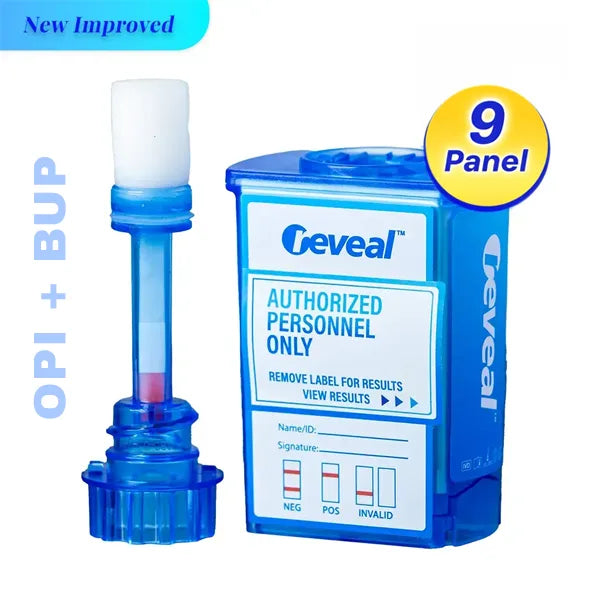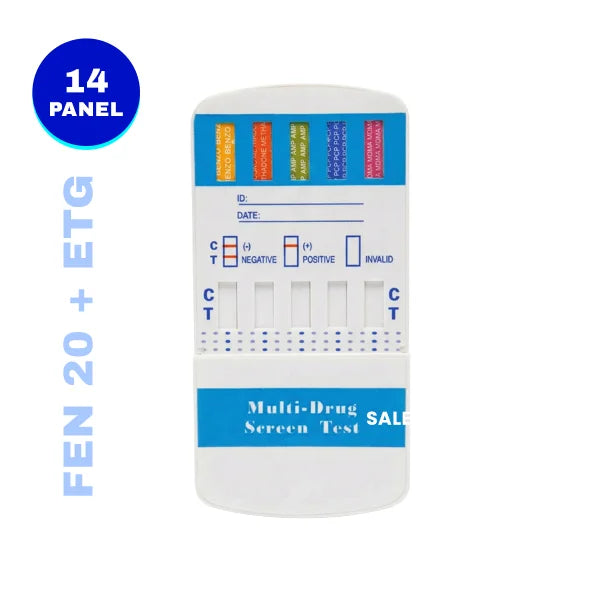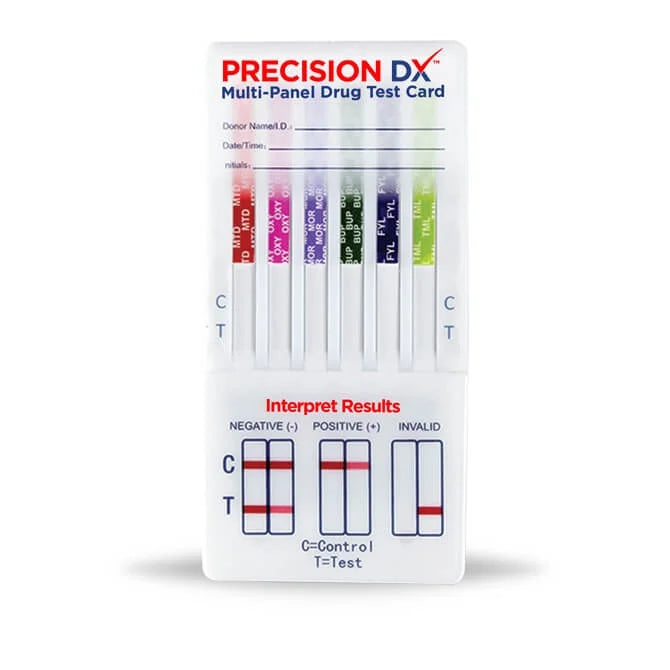
Quick answer: Sometimes. A standard 10-panel urine test does not always include MDMA. Many panels screen only for amphetamines, which MDMA may trigger inconsistently, while others add a dedicated MDMA (ecstasy) strip, often with a 500 ng/mL cutoff. Check the panel's drug list and cutoffs before buying.
- "10-panel" is not a fixed standard; the drug list varies by manufacturer, so MDMA coverage must be confirmed on the product insert.
- MDMA is typically detectable in urine for roughly 1 to 3 days after use, depending on dose, metabolism and cutoff.
- Any non-negative screen should go to laboratory confirmation (GC-MS or LC-MS/MS) before action is taken.
Does a 10-panel test detect MDMA?
It depends on which 10 drugs the panel covers. Unlike the federal 5-panel, the 10-panel has no single regulated definition. Common configurations include amphetamines, barbiturates, benzodiazepines, cocaine, methadone, opiates, oxycodone, PCP, THC, and either methamphetamine, MDMA, propoxyphene or buprenorphine as the remaining slots.
Need drug tests for your clinic, program or workplace?
American Screening Corp has supplied FDA-cleared, CLIA-waived tests at wholesale pricing since 2004. Popular options:
- 10-panel drug test cups and dip cards
- 12-panel drug test cups
- all drug test cups (wholesale pricing)
Ordering 100+ tests? Request volume pricing.
If MDMA is a listed analyte, the test detects it directly. If it is not, MDMA may or may not trigger the amphetamine line, because immunoassay antibodies vary in how strongly they react with MDMA. A negative result on a panel without MDMA is not proof of no use.
How MDMA is detected: cutoffs and cross-reactivity
Instant urine tests are immunoassays. They produce a presumptive result by comparing drug concentration to a cutoff level in ng/mL. Federal workplace programs treat MDMA as part of the amphetamine class: under the HHS Mandatory Guidelines used for DOT testing (49 CFR Part 40, U.S. DOT), the initial amphetamines test cutoff is 500 ng/mL, and laboratory confirmation uses a 250 ng/mL cutoff for MDMA, MDA and MDEA, among others.
Non-regulated panels often use different cutoffs, commonly 1,000 ng/mL for amphetamines and 500 ng/mL for a dedicated MDMA strip. A higher cutoff means a shorter window and more missed low-level use.
How to read results
- Read at the time stated in the instructions, usually about 5 minutes, and do not read after the stated window.
- A line in the test region means negative for that drug; no line means a non-negative (presumptive positive) result. Any faint line counts as present.
- If no control line appears, the test is invalid; repeat with a new device.
- Send non-negative specimens for laboratory confirmation.
Panel comparison: what to buy for MDMA coverage
| Option | MDMA coverage | Best for | Consideration |
|---|---|---|---|
| 10-panel with amphetamine only | Indirect; cross-reactivity varies | General screening where MDMA is low priority | May miss MDMA use |
| 10-panel with dedicated MDMA strip | Direct, often 500 ng/mL | Treatment centers, probation, clinics | Verify exact cutoff on insert |
| Federal-style panel with lab testing | Direct under amphetamine class, 250 ng/mL confirmation | DOT-regulated and compliance programs | Requires certified lab and chain of custody |
| Lab-based confirmation (GC-MS or LC-MS/MS) | Definitive identification | Disputed or legal-consequence results | Longer turnaround |
Detection window for MDMA
The NIDA DrugFacts page on MDMA notes that the drug's effects last several hours, but metabolites remain in the body longer. In urine, MDMA is generally detectable for about 1 to 3 days, and heavier or repeated use can extend that. Oral fluid windows are usually shorter, and hair testing is longer. Treat these as estimates, not guarantees, because pH, hydration, dose and kidney function all affect results.
Checklist: verifying a panel before you buy
- Confirm MDMA (ecstasy) is listed as its own analyte on the product insert.
- Record the cutoff in ng/mL for MDMA and for amphetamines.
- Check that the device is FDA 510(k) cleared or otherwise legally marketed for your use case, and review its CLIA-waived status where applicable.
- Look for built-in specimen validity checks such as temperature strips and adulterant pads.
- Match the format to your workflow: drug test cups for integrated collection, or drug test dip cards for lower-cost, high-volume screening.
- Set a written policy for non-negative results, including lab confirmation and a medical review step.
- Document chain of custody if results may be used in legal or employment decisions.
Policy and compliance considerations
For DOT-regulated employees, only the federally specified panel and certified laboratories are valid under 49 CFR Part 40. Non-DOT employers, courts and treatment programs can choose broader panels, but should apply them consistently and follow state law. The FDA's guidance on drugs-of-abuse tests clarifies that instant tests are screening tools, which is why confirmation matters before any adverse action.
Employers pairing testing with pre-hire screening can coordinate with Reveal Background, ASC's sister division, for employment background checks. For help selecting a panel with MDMA coverage, ASC's team can advise through its contact page.
Frequently asked questions
Does MDMA show up on a standard 10-panel drug test?
Only if the panel lists MDMA or its amphetamine assay cross-reacts. Always check the insert, because 10-panel configurations differ.
How long does MDMA stay in urine?
Typically about 1 to 3 days, longer with heavy or repeated use. Cutoff level and individual metabolism change the window.
Can MDMA cause a false positive for amphetamines?
MDMA can cause a presumptive positive on an amphetamine assay due to structural similarity. Laboratory confirmation distinguishes MDMA from other amphetamines.
Is MDMA part of the DOT drug test?
Yes. Under the DOT and HHS rules, MDMA, MDA and MDEA are included in the amphetamines class and are identified at confirmation using a 250 ng/mL cutoff.
Sources
- U.S. DOT Office of Drug and Alcohol Policy and Compliance: 49 CFR Part 40
- NIDA: MDMA (Ecstasy/Molly) DrugFacts
- FDA: Drugs of Abuse Tests
This article is general information, not legal or medical advice.