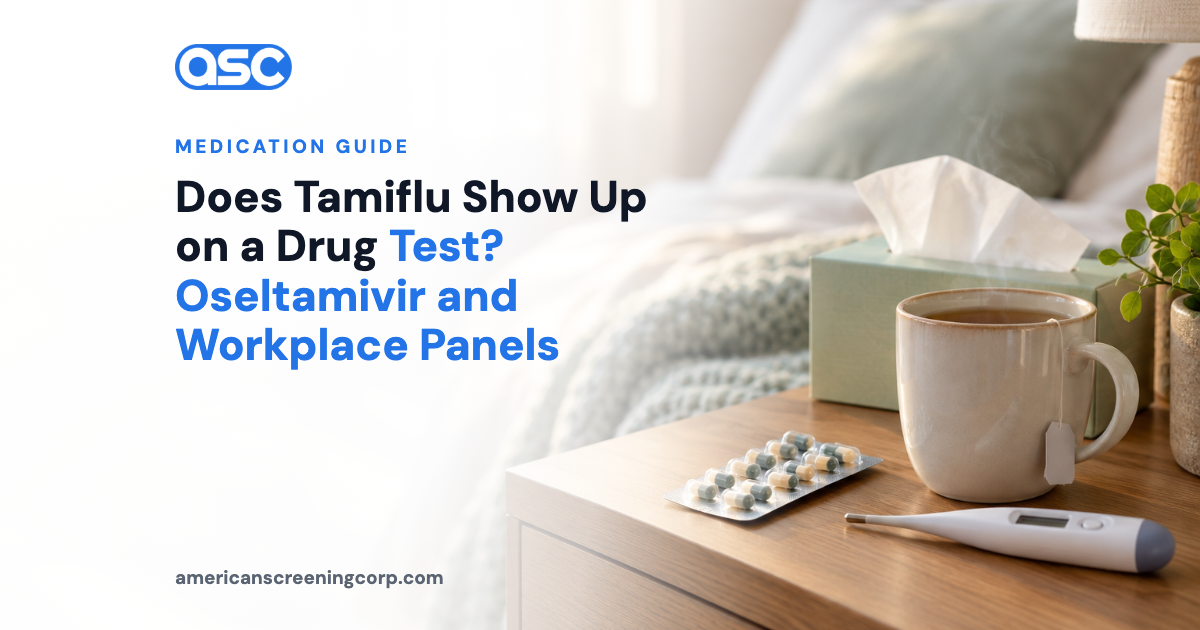
Tamiflu is the brand name for oseltamivir phosphate, an antiviral medication prescribed for influenza. Employees and parents sometimes ask whether a course of Tamiflu could show up on a workplace drug test or trigger a false positive. The short answer is no. Oseltamivir is not a controlled substance, it is not one of the analytes that any standard immunoassay drug test panel is designed to detect, and there is no credible published evidence of cross reactivity between oseltamivir and the drug classes screened by employer or DOT testing programs.
This article explains how screening and confirmation testing actually work, which drug classes a standard panel targets, where oseltamivir fits (and does not fit) relative to those classes, and what an employee or a program administrator should do if a flu prescription comes up during a test. It does not offer medical advice, dosing guidance, or legal advice.
What a workplace drug test is actually looking for
Most employer and federally regulated drug testing programs use a two step process. The first step is an immunoassay screen, run on a urine, oral fluid, or similar specimen. Immunoassay screens work by using antibodies that bind to a target drug or drug metabolite; if enough of that target (or a closely related molecule) is present above a cutoff concentration, the test reads positive. The second step, required whenever a screen is non negative, is confirmation testing, typically gas chromatography mass spectrometry (GC/MS) or liquid chromatography tandem mass spectrometry (LC/MS/MS). Confirmation testing identifies the exact molecule present rather than relying on antibody cross reactivity, which is why it is treated as the legally defensible result in regulated testing.
The Mandatory Guidelines that federal workplace programs follow, and the Medical Review Officer (MRO) verification process that sits on top of both screening and confirmation, are described by the Substance Abuse and Mental Health Services Administration (SAMHSA), which runs the federal workplace drug testing program and oversight of certified laboratories, and by the Department of Transportation's testing procedure rule at 49 CFR Part 40. SAMHSA's workplace programs resources describe how federal agencies and DOT regulated employers structure their testing, including the role of certified laboratories and MROs in reviewing results before they are reported to an employer.
Where oseltamivir fits (it does not fit any panel class)
Standard workplace panels, whether a 5 panel urine cup or a federally mandated DOT panel, are built around specific drug classes: amphetamines, cocaine metabolite, marijuana metabolite (THC), opiates, and phencyclidine (PCP) on the core federal panel, with some employer panels adding benzodiazepines, barbiturates, methadone, propoxyphene, or synthetic opioids. Oseltamivir is a neuraminidase inhibitor, a class of antiviral drug that works by blocking an enzyme the influenza virus needs to spread between cells. It has no chemical or pharmacological relationship to amphetamines, opioids, cannabinoids, cocaine, PCP, or benzodiazepines.
The FDA's drug class information on influenza antiviral medications describes oseltamivir and the other approved flu antivirals strictly in terms of their antiviral mechanism and approved uses for treatment and prophylaxis of influenza; see the FDA's influenza antiviral drug class page. The full prescribing information for Tamiflu, available through the National Library of Medicine's DailyMed database, describes its pharmacology, metabolism, and clinical pharmacology without any mention of interference with drug of abuse immunoassays; review the DailyMed label for Tamiflu (oseltamivir phosphate) directly. There is no published cross reactivity data linking oseltamivir, or its active metabolite oseltamivir carboxylate, to a false positive result on any standard immunoassay panel class. If a testing program or laboratory has specific information to the contrary, that determination should come from the certified laboratory or the MRO reviewing the individual result, not from general information online.
Panel classes and where oseltamivir stands
| Panel class typically screened | Target drug or metabolite | Does oseltamivir relate to this class |
|---|---|---|
| Amphetamines | Amphetamine, methamphetamine | No chemical relationship |
| Opiates / opioids | Morphine, codeine, synthetic opioid metabolites | No chemical relationship |
| Cannabinoids | THC metabolite | No chemical relationship |
| Cocaine metabolite | Benzoylecgonine | No chemical relationship |
| PCP | Phencyclidine | No chemical relationship |
| Benzodiazepines / barbiturates (employer add on panels) | Various sedative hypnotics | No chemical relationship |
| Oseltamivir (Tamiflu) | Not a target of any standard panel | Antiviral, not a controlled substance |
What to do if a flu prescription comes up during testing
Because oseltamivir is not a controlled substance, an employee does not need to disclose a Tamiflu prescription to pass a standard drug test the way they would disclose, for example, a prescribed opioid or a prescribed stimulant. If a non negative screening result does occur for an unrelated reason while someone happens to be taking Tamiflu, the correct path is the same as for any non negative result: the laboratory sends the specimen to confirmation testing, and if confirmation is also non negative, the MRO contacts the individual directly to review current medications and any prescriptions before a final result is reported to the employer. This interview step, and the MRO's authority to verify a result as positive, negative, or refusal to test, is set out in the MRO procedures at 49 CFR Part 40, Subpart G. Employees should keep a copy of any active prescription or a pharmacy record in case an MRO interview happens to occur for an unrelated finding, not because oseltamivir itself is expected to cause one.
Programs and specimen collectors should never treat a flu diagnosis or antiviral prescription as a reason to delay, cancel, or alter a scheduled test. A respiratory illness does not change DOT or employer testing obligations, and oseltamivir use has no documented effect on specimen validity testing (the creatinine, specific gravity, and pH checks used to detect diluted or substituted specimens).
Choosing the right panel for a workplace program
Employers building or maintaining a testing program should select a panel configuration based on their regulatory category (DOT covered safety sensitive positions versus non regulated employment), their industry risk profile, and documented guidance from SAMHSA and, where applicable, their state licensing requirements. A program is not more protective by screening for medications that are not drugs of abuse; it is more defensible when it screens for the correct analytes and routes every non negative screen through confirmation and MRO review before any employment action is taken.
American Screening Corporation supplies urine drug test cups, dip cards, and oral fluid tests used in employer and clinical testing programs, available in bulk through the drug test cup collection. Related reading on how other common medications interact with standard panels is available in Does Amantadine Show Up on a Drug Test? Antiviral and Parkinson Medication Screens and in Does NyQuil Cause a False Positive Drug Test? Dextromethorphan, Doxylamine and PCP Screens, which covers an over the counter cold and flu remedy that does have documented cross reactivity concerns, unlike prescription oseltamivir.
Frequently asked questions
Does Tamiflu show up as a positive result on a drug test?
No. Oseltamivir is not a controlled substance and is not a target analyte on any standard immunoassay panel, so taking Tamiflu as prescribed is not expected to produce a positive screening result.
Is there any published evidence that oseltamivir causes a false positive?
No credible published cross reactivity data links oseltamivir or its active metabolite to a false positive on amphetamine, opiate, cannabinoid, cocaine, PCP, or benzodiazepine panels. The DailyMed prescribing information does not describe any such interaction.
Do I need to tell my employer or the lab that I am taking Tamiflu?
Oseltamivir is not a controlled substance, so it does not need to be disclosed the way a prescribed opioid or stimulant would be. If a medical review officer contacts you about an unrelated non negative result, you can mention any current medication at that time.
Can a flu diagnosis delay or cancel a scheduled drug test?
A flu diagnosis or antiviral prescription does not change DOT or employer testing requirements on its own. Scheduling accommodations, if any, are a matter for the employer's policy and the collection site, not a basis to skip required testing.
What happens if a test comes back non negative for an unrelated reason while I am on Tamiflu?
The standard process applies: the laboratory confirms any non negative screen with GC/MS or LC/MS/MS, and a medical review officer reviews the confirmed result and interviews the individual about current prescriptions before reporting a final verified result to the employer, under the process described in 49 CFR Part 40.
Which panel classes should employers actually screen for in a flu season workplace program?
Panel selection should be based on DOT or state requirements and documented program design, generally the core classes such as amphetamines, cannabinoids, cocaine, opiates, and PCP, plus any employer added classes; oseltamivir and other antivirals are not part of any standard panel and do not need special accommodation.
This article is general information about drug testing science and workplace programs. It is not medical advice, legal advice, or a substitute for guidance from a medical review officer, a treating clinician, or qualified counsel.