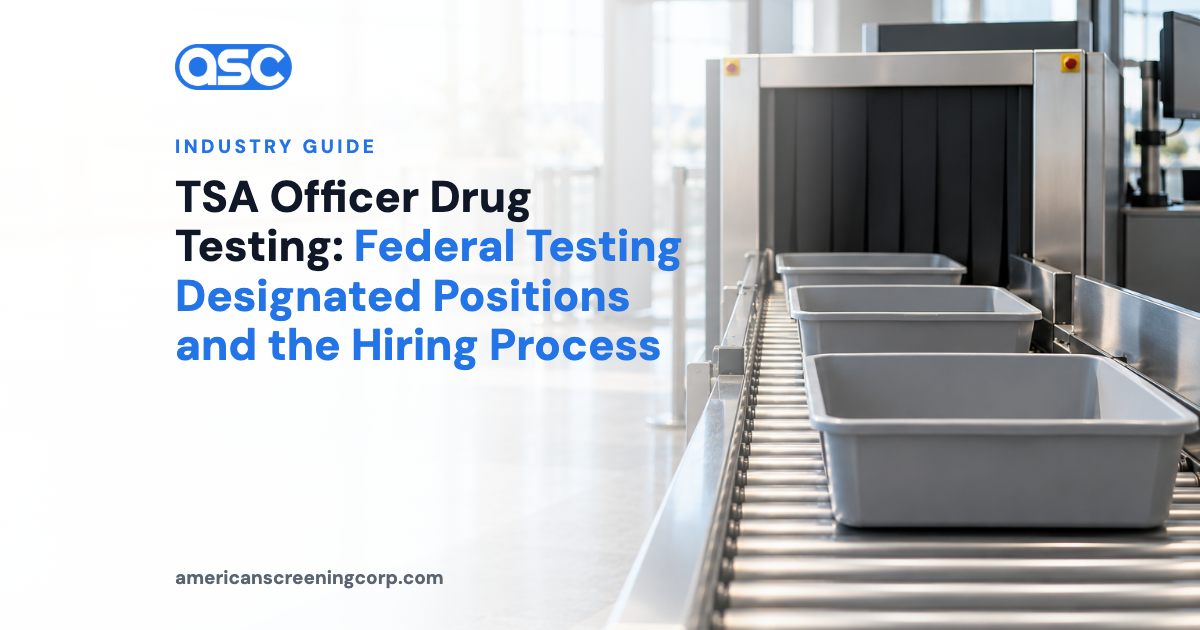
A Transportation Security Officer, often shortened to TSO, is a federal employee of the Department of Homeland Security who works for the Transportation Security Administration. Because the job involves screening passengers and baggage for weapons and explosives, TSA treats these roles as what federal drug testing policy calls a testing designated position. That classification carries specific drug testing obligations that exist separately from any state law and that apply before hire, during the probationary period, and throughout a career. This article explains where the rule comes from, how testing works at each stage, what the federal testing panel covers, and why marijuana use remains a disqualifying issue for this category of federal hiring even in states that have legalized it.
Why TSA officer positions require drug testing
The federal drug free workplace program began with Executive Order 12564, which directs executive branch agencies to maintain a drug free workplace and to test employees in positions that affect public health, safety, or national security. Each federal agency, including DHS, is required to identify its own testing designated positions and to publish a drug free workplace plan describing when and how it tests. TSA has historically identified security screening roles, including Transportation Security Officer and related screening and law enforcement positions, as testing designated because the job requires carrying out safety sensitive duties at the screening checkpoint. The TSA careers site notes that applicants go through a structured hiring process that includes medical and suitability screening, of which drug testing is one component.
The legal framework behind the requirement
Federal employee drug testing rests on a few layers of authority rather than one single statute. The President's general authority to regulate the conduct of federal employees comes from 5 U.S.C. 7301, which Executive Order 12564 relies on. Suitability regulations at 5 CFR 731.202 list illegal drug use as a factor that can make a person unsuitable for federal employment, which is why current illegal drug use, including marijuana use that is lawful under state law, generally makes an applicant ineligible for a position like TSO. The technical side of testing, meaning how specimens are collected, which laboratories may run the tests, and what cutoff levels apply, is governed by the HHS Mandatory Guidelines for Federal Workplace Drug Testing Programs, most recently revised in the notice published at 2017 Federal Register notice 2017-00979. SAMHSA's workplace programs page explains how those guidelines apply across federal agencies and links to additional employer resources for agencies running a federal testing program.
Stages of testing in the TSO hiring and employment cycle
Testing designated positions are not tested only once. The table below summarizes the testing events that typically apply to a federal security screening role such as TSO, based on standard federal drug free workplace program design described in the sources above. Specific scheduling and selection procedures are set by each agency's own plan, so an applicant or employee should confirm current details with TSA human resources rather than relying on any outside summary.
| Testing event | When it generally applies | Purpose |
|---|---|---|
| Pre employment | After a conditional offer, before entry on duty | Confirms the candidate meets the suitability standard before placement in a testing designated position |
| Random | Throughout employment, on an unannounced and statistically random basis | Deters and detects use among employees already holding a testing designated position |
| Reasonable suspicion | When a supervisor documents specific, contemporaneous observations suggesting possible impairment or drug use | Addresses a specific safety or conduct concern rather than a routine check |
| Follow up or return to duty | After a verified positive result or a referral to an Employee Assistance Program | Confirms compliance with any conditions set for continued employment |
Each of these events follows the collection, chain of custody, and laboratory confirmation steps set out in the HHS Mandatory Guidelines rather than a simplified commercial testing process. A certified laboratory confirms any initial positive screen before a Medical Review Officer, a licensed physician trained in this specific review role, contacts the employee to ask about prescriptions or other legitimate explanations and makes the final determination of whether a result is reported as positive.
What the federal testing panel looks for
The HHS Mandatory Guidelines specify the drug classes a federal urine test must screen for and confirm. The panel used across executive branch agencies, including DHS components, currently covers marijuana metabolites, cocaine metabolites, phencyclidine, amphetamines and methamphetamine, opiates, and, since the 2017 expansion referenced above, additional semi synthetic opioids such as hydrocodone, hydromorphone, oxycodone, and oxymorphone, plus MDMA. A federal specimen collection also screens for specimen validity, meaning the laboratory checks for signs of dilution, substitution, or adulteration before a result is accepted as a valid test. Because marijuana metabolites remain part of this federal panel, legal access to marijuana under a state medical or recreational program does not change how a positive result is treated for a federal testing designated position. An applicant or employee who has questions about a prescribed medication should raise it with the Medical Review Officer through the prescription documentation process rather than assuming any particular drug class is excluded.
Marijuana and state law
Several states have legalized marijuana for medical or adult use, and state employment law in those states increasingly limits what private employers may do with a positive marijuana test. None of that changes federal hiring policy for a position like TSO. Federal employment operates under its own suitability framework, and marijuana remains classified as a controlled substance for purposes of federal workplace drug testing regardless of state law. Applicants who are unsure how a particular state law interacts with a federal application should direct that question to TSA human resources or qualified counsel rather than assume state decriminalization carries over to a federal hiring decision.
How this compares to other aviation and security testing programs
TSA officer testing is a federal employee program under Executive Order 12564 and is distinct from the testing that applies to airline and airport contractor employees under separate FAA rules, and from the driver testing that applies under DOT rules for certain commercial transportation roles. A broader look at how airport badging and ground operations staff are tested is covered in our related post on airport employee drug testing, and a general overview of how federal drug testing law is structured across agencies is in our federal drug testing law overview. Those posts are useful context but describe different populations and different legal authorities than the TSO program discussed here.
What agencies and testing administrators should keep in mind
Agencies and the contractors that support a federal testing designated position program generally need collection supplies that match HHS specimen requirements, including tamper evident features and split specimen collection where required, along with a documented chain of custody process. Organizations sourcing supplies in volume for a compliant collection program can review bulk options through our drug test cup collection, and agencies or distributors buying at scale can also check current account options on our wholesale portal. Supply selection does not replace the requirement to follow the HHS Mandatory Guidelines collection procedure exactly, and any program design question should still be confirmed against the current SAMHSA guidance linked above.
Frequently asked questions
Is a Transportation Security Officer a federal employee subject to federal drug testing rules?
Yes. TSOs are DHS employees, and TSA has historically identified screening positions as testing designated positions under the framework set out in Executive Order 12564 and the related suitability regulations.
Does TSA test applicants before they start the job?
Federal testing designated position programs generally include a pre employment test after a conditional offer and before entry on duty, in addition to testing during employment. Applicants should confirm the current process with TSA human resources.
Will legal marijuana use in my state affect a TSA application?
State legalization does not change federal hiring policy. Current illegal drug use under federal law, including marijuana, generally makes an applicant unsuitable for a federal testing designated position under 5 CFR 731.202, regardless of state law.
What drugs does the federal testing panel cover?
The HHS Mandatory Guidelines panel used across federal agencies covers marijuana metabolites, cocaine metabolites, phencyclidine, amphetamines and methamphetamine, opiates, and, since 2017, additional semi synthetic opioids and MDMA, along with specimen validity testing.
What happens if a federal employee tests positive after a prescribed medication?
A certified laboratory confirmed positive result goes to a Medical Review Officer, who reviews prescription documentation and other medical information before making a final determination. This process is handled through the MRO, not through the employee's supervisor.
Is random testing used for TSA officers after hire?
Random testing is a standard feature of federal testing designated position programs described in agency drug free workplace plans under Executive Order 12564. Selection procedures and frequency are set by the agency's own plan.
This article is general information about federal drug testing policy and is not legal advice. Applicants and employees with questions about a specific TSA hiring decision should contact TSA human resources or consult qualified counsel.