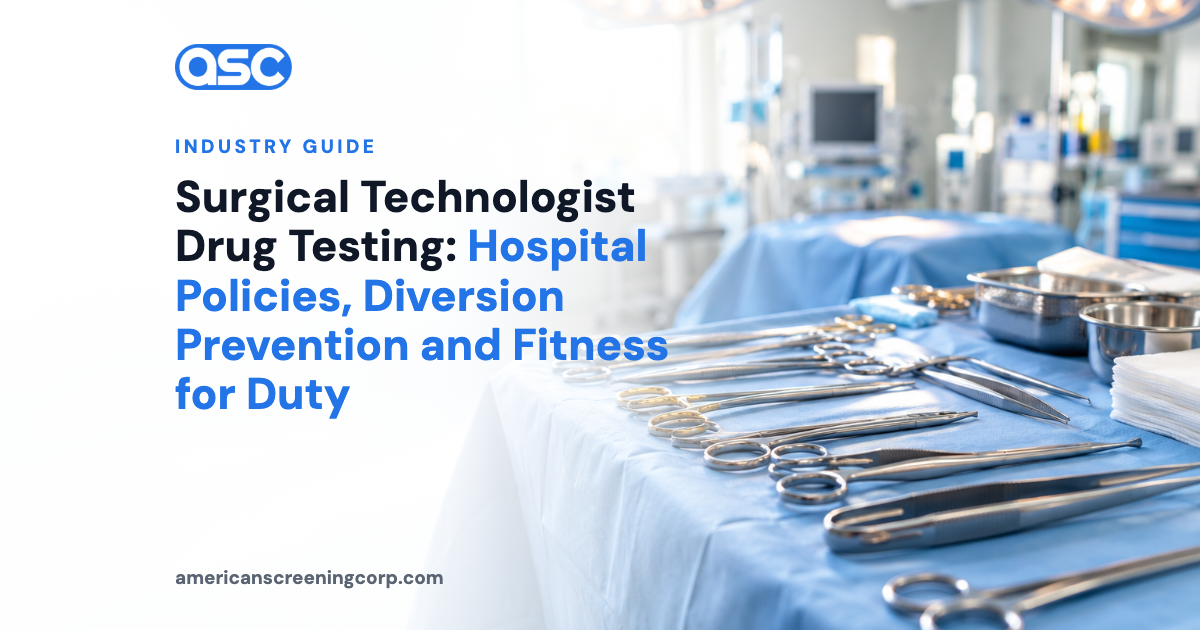
Surgical technologists work inside the sterile field during operations, and in many facilities they also handle, count, waste, or witness the handling of controlled substances used in anesthesia and pain control. That proximity to opioids, sedatives, and other scheduled drugs is why hospitals build drug testing, diversion monitoring, and fitness for duty policies specifically around the operating room staff, not just a generic new hire screen. This article explains how those programs are typically structured, what federal and state rules actually require, and where the gaps are that employers still have to fill with their own policy.
Why the operating room gets extra scrutiny
Operating rooms are one of the highest risk areas in a hospital for drug diversion, the theft or substitution of controlled substances by someone with legitimate access to them. Surgical technologists are not typically the ones who administer anesthesia, but depending on facility workflow they may be present for drawing up, counting, wasting, or transporting controlled substances, and they work for extended hours in close proximity to anesthesia carts and medication stock. The Drug Enforcement Administration's Diversion Control Division publishes guidance for registrants on recognizing and reporting diversion risks inside hospitals, and it treats the perioperative area as a recurring source of loss reports. DEA Diversion Control Division maintains registrant resources and the drug registration program that governs who may handle scheduled substances and under what recordkeeping obligations.
Hospitals that participate in Medicare and Medicaid are also bound by the Centers for Medicare and Medicaid Services Conditions of Participation, which require, among other things, that a hospital maintain a pharmacy or drug storage system with adequate controls and accountability over controlled substances. The Conditions of Participation for hospitals are codified at 42 CFR Part 482, and the pharmaceutical services requirements there are a major driver of why hospitals build layered diversion monitoring, including automated dispensing cabinet reconciliation, waste witnessing, and staff screening policies that reach into the surgical services department. 42 CFR Part 482, Conditions of Participation for Hospitals sets the baseline that accreditation surveyors check against.
Is drug testing for surgical technologists federally required
No federal rule specifically requires drug testing of surgical technologists as a job category. There is no equivalent of the Department of Transportation testing mandate for this role. What exists instead is a set of overlapping incentives. CMS Conditions of Participation require hospitals to control access to and accountability for controlled substances, which in practice pushes facilities toward screening, monitoring, and for cause testing policies for anyone who touches the medication chain, surgical technologists included. OSHA does not mandate pre employment or random drug testing either, but its recordkeeping rule limits when an employer may require post incident drug testing, so any testing tied to a workplace injury or needlestick in the OR has to be administered in a way that does not discourage injury reporting. OSHA 29 CFR 1904.35 covers that employee involvement and anti-retaliation limit on post incident testing.
Because there is no federal testing mandate specific to this role, the actual requirement, if any, comes from state law, hospital bylaws, accreditation standards, and the employer's own policy. That means the panel, the testing triggers, and the consequences can vary significantly from one hospital system to the next, and a surgical technologist moving between states or between a hospital and an ambulatory surgery center should expect different rules at each stop.
How hospital surgical services testing programs are usually built
| Testing stage | Typical trigger | Common panel or method |
|---|---|---|
| Pre employment | Conditional job offer before OR credentialing | Urine panel, sometimes oral fluid, standard 5 to 10 panel plus facility specific additions |
| Random | Computer generated selection, often facility wide or department specific | Urine or oral fluid, unannounced collection window |
| Reasonable suspicion or for cause | Observed behavior, documented performance change, or a reported discrepancy | Urine collection with chain of custody, confirmation testing on any non negative screen |
| Diversion related | Automated dispensing cabinet discrepancy, waste witnessing mismatch, or controlled substance audit flag | Immediate for cause collection plus internal diversion investigation |
| Post incident | Needlestick, medication error, or injury during a case | Collection consistent with OSHA recordkeeping limits on post incident testing |
A positive screen on an immunoassay is not a final result. Confirmation by gas chromatography mass spectrometry or liquid chromatography mass spectrometry is the standard next step before any adverse action, and any result consistent with a prescribed medication should be routed through a medical review officer who reviews documentation before the result is reported to the employer. This is the same structure used across healthcare employers; it is covered in more depth in American Screening Corporation's guides to nurse drug testing requirements and hospital employee drug testing programs, both of which describe the same panel and confirmation logic applied across other clinical roles.
State registration and certification rules vary
Most states do not license surgical technologists at all, and practice is governed instead by hospital credentialing, professional certification such as the Certified Surgical Technologist credential, and facility policy. A smaller number of states have adopted title protection or registration requirements that touch this role. South Carolina, for example, regulates surgical technology and surgical assisting through its Department of Labor, Licensing and Regulation, and Virginia's Department of Health Professions addresses surgical technology registration requirements under its Board of Medicine framework. Because the regulatory landscape is inconsistent, an employer or a surgical technologist relocating between states should check the current rule in that specific state rather than assume the same registration or testing requirement applies everywhere. South Carolina LLR, Surgical Technology and Surgical Assisting and Virginia Department of Health Professions, Surgical Technology are examples of state specific pages, not a national standard.
Where a state has no registration statute for surgical technologists, the controlling rules are the employer's bylaws, the hospital's medical staff and pharmacy policies tied to its CMS Conditions of Participation obligations, and any accreditation body requirements the facility has agreed to follow. Employers should not assume a lack of state licensure means a lack of any testing or monitoring obligation; it typically means the obligation sits entirely with internal policy instead of a state board.
Diversion monitoring beyond the drug test
A drug test only catches a surgical technologist who has already used a substance recently enough to appear in the chosen specimen window. It does not by itself catch someone who is diverting medication without using it, or who is diverting for resale. That is why hospital diversion programs built around CMS Conditions of Participation expectations layer in automated dispensing cabinet transaction review, controlled substance waste witnessing by a second clinician, pharmacy reconciliation audits, and behavioral monitoring, with drug testing as one tool among several rather than the sole control. The Substance Abuse and Mental Health Services Administration's workplace resources describe this layered approach to substance misuse prevention in safety sensitive healthcare settings. SAMHSA Workplace Substance Use resources provide background on program design that employers can adapt.
Fitness for duty and reporting
Fitness for duty in the OR is broader than a drug test result. A surgical technologist who appears impaired, fatigued to the point of unsafe performance, or who is involved in a documented diversion incident should generally be removed from the sterile field pending evaluation, consistent with the facility's own policy and any applicable state board or employee assistance referral process. Hospitals typically document the specific observations that triggered removal, the clinical and human resources steps taken, and whether a referral to a professional health or peer assistance program applies, since many state boards for the health professions that do cover related surgical roles tie continued practice to completion of a monitoring agreement rather than automatic termination. Any legal determination about continued employment, licensure, or registration status should go through the employer's counsel and the applicable state board rather than being decided solely on a single test result.
Program design considerations for employers
- Define the panel in writing, including whether the panel is extended beyond the standard opioids to cover fentanyl analogs commonly used in anesthesia, since a standard panel does not automatically detect every anesthetic agent.
- Set a clear, non discriminatory process for selecting random testing pools that includes surgical technologists alongside other controlled substance access roles, not just nursing and pharmacy staff.
- Route every non negative screening result through a medical review officer before any employment action, and document prescription verification separately from the lab result.
- Keep post incident testing consistent with OSHA's recordkeeping anti-retaliation limits so injury reporting is not discouraged.
- Pair testing with diversion specific controls, waste witnessing, automated dispensing cabinet audits, and a defined escalation path, since testing alone will not catch every diversion pattern.
- Check the current rule in the specific state of practice before assuming a registration or testing requirement does or does not apply.
American Screening Corporation supplies drug test cups, dip cards, and oral fluid tests that hospital surgical services departments can build into pre employment, random, and for cause testing programs, available through the drug test cup collection. Facilities and distributors sourcing in volume can also review options on the wholesale portal.
Frequently asked questions
Does federal law require drug testing for surgical technologists?
No. There is no federal mandate specific to this job title. Testing requirements, if any, come from state law, hospital policy, and the facility's accreditation and CMS Conditions of Participation obligations around controlled substance accountability.
Do surgical technologists need a state license or registration?
Most states do not license or register surgical technologists. A few states, including South Carolina and Virginia, have adopted specific registration or title protection frameworks. The rule varies by state, so check the current requirement where the technologist will practice.
What happens after a positive drug screen for a surgical technologist?
A non negative immunoassay screen is generally sent for confirmation testing by gas chromatography mass spectrometry or liquid chromatography mass spectrometry, and a medical review officer reviews the result and any prescription documentation before it is reported to the employer as positive.
Can drug testing alone prevent diversion of controlled substances in the OR?
No. Drug testing only identifies recent use within a detection window. Hospitals typically pair testing with automated dispensing cabinet audits, waste witnessing, and pharmacy reconciliation to address diversion that testing alone would miss.
Does OSHA regulate drug testing for surgical technologists?
OSHA does not mandate pre employment or random drug testing, but its recordkeeping rule at 29 CFR 1904.35 limits how post incident drug testing may be used so that it does not discourage employees from reporting workplace injuries.
Who decides whether a surgical technologist is fit for duty after an incident?
That determination generally follows the employer's own fitness for duty policy, any applicable state board process, and consultation with counsel or an employee assistance or professional health program, rather than being based on a single test result alone.
This article is general information for employer and workforce planning purposes, not legal or medical advice. Consult qualified counsel and your facility's medical and compliance leadership before adopting or changing a testing or diversion policy.