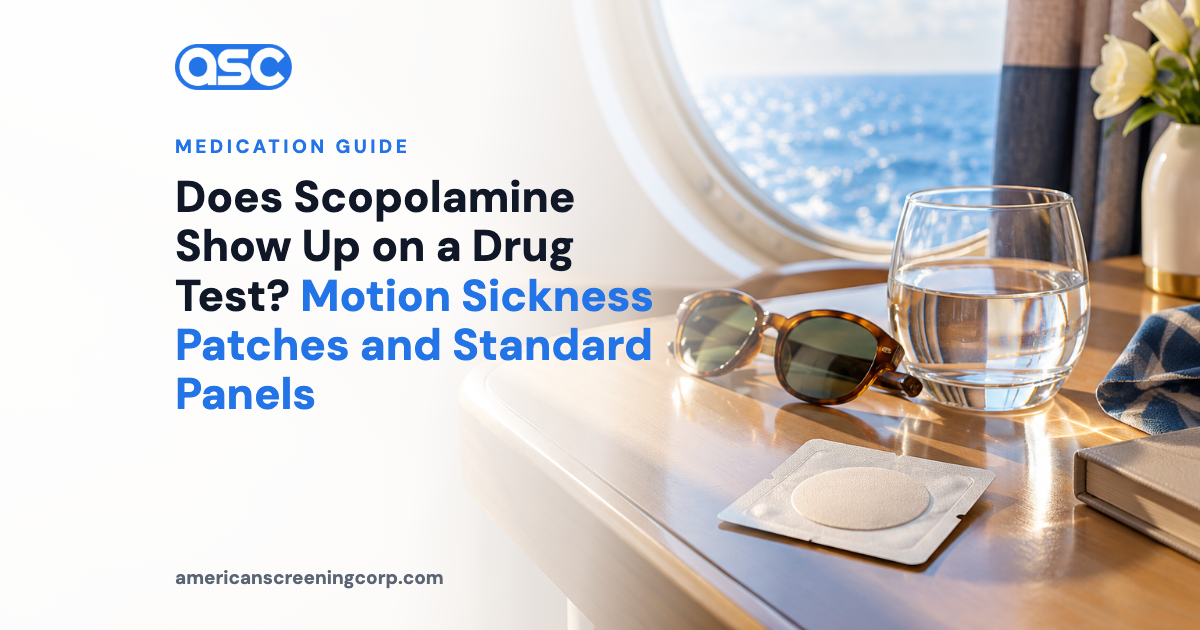
Scopolamine is an anticholinergic medication best known as the small patch worn behind the ear for motion sickness and, in a hospital setting, for prevention of postoperative nausea and vomiting. The branded transdermal product sold in the United States is Transderm Scop, and its prescribing information is published on DailyMed, the National Library of Medicine label repository. Employers, patients, and clinic staff sometimes ask whether wearing this patch could affect the outcome of a workplace or clinical drug screen. The short answer is that scopolamine is not one of the substances that standard drug test panels are built to detect, and there is no published evidence that it cross reacts with the immunoassay screens used for those panels.
This article explains how standard panels are built, which drug classes they actually target, why an anticholinergic like scopolamine is not one of them, what side effects can look like impairment even though they are not, and how a documented prescription should be handled if it ever comes up during a review.
How a Standard Drug Test Panel Actually Works
A workplace or clinical drug test almost always starts with a screening immunoassay. This is the method used in urine cups, dip cards, and oral fluid devices. The immunoassay is a fast, inexpensive chemical reaction designed to flag specimens that contain a target drug or its metabolites above a set cutoff concentration. It is a screen, not a final determination. Any specimen that screens positive is supposed to move to a confirmation test, typically gas chromatography mass spectrometry (GC/MS) or liquid chromatography tandem mass spectrometry (LC/MS), which identifies the exact molecule present rather than reacting to a family of chemically similar compounds.
Both steps only work for substances the panel was designed around. A 5 panel or extended panel immunoassay is built to react to specific drug classes, such as amphetamines, cocaine metabolites, opiates, phencyclidine, and THC metabolites, along with whatever additional classes an employer adds for an extended panel (commonly benzodiazepines, barbiturates, methadone, or synthetic opioids). Scopolamine is a belladonna alkaloid in the anticholinergic class. It is chemically unrelated to any of those target classes, so there is no reagent in a standard immunoassay that it would react with.
| Panel class on a standard screen | Chemical relationship to scopolamine | Expected result from scopolamine use |
|---|---|---|
| Amphetamines / methamphetamine | Unrelated structure | No expected reaction |
| Cocaine metabolites | Unrelated structure | No expected reaction |
| Opiates / opioids | Unrelated structure | No expected reaction |
| Phencyclidine (PCP) | Unrelated structure | No expected reaction |
| THC metabolites | Unrelated structure | No expected reaction |
| Benzodiazepines / barbiturates (extended panels) | Unrelated structure | No expected reaction |
Because scopolamine does not belong to any of the classes those reagents target, there is no credible, published cross reactivity evidence tying scopolamine to a false positive screen on a standard immunoassay panel. If a clinic wants to look for scopolamine itself, that requires a separate, targeted confirmation method aimed specifically at anticholinergic alkaloids, which is not part of a routine workplace panel.
Why the Patch Does Not Trigger a Standard Screen
The Transderm Scop label on DailyMed describes the drug as a belladonna alkaloid anticholinergic delivered through the skin over roughly three days, with the drug and its metabolites cleared through ordinary elimination pathways. Nothing in that labeled chemistry overlaps with the amphetamine, opioid, cannabinoid, cocaine, or PCP immunoassay reagents used in standard cups and cards. MedlinePlus, the National Library of Medicine consumer drug information resource, describes the same patch as a prescription or pharmacist-provided product used for nausea prevention, and it does not list drug screening interactions among its cautions, which is consistent with there being no established cross reactivity pattern to flag.
That does not mean scopolamine is undetectable by any method. A toxicology lab that is specifically asked to look for anticholinergic alkaloids can do so with targeted mass spectrometry. It simply is not one of the drug classes a standard employment or regulatory panel is screening for in the first place.
Side Effects That Can Look Like Impairment
The more practical issue with scopolamine in a workplace setting is not the drug test result, it is the side effect profile. According to the DailyMed label, the most common adverse reactions associated with the patch include dry mouth, drowsiness, blurred vision, and dilation of the pupils, and the label also warns about psychiatric and cognitive effects, confusion, and anticholinergic symptoms that can appear even after the patch is removed. An employee who is drowsy, has blurred vision, or seems confused for reasons related to a legitimately prescribed or recommended patch can look, on the surface, like someone who is impaired for other reasons. A supervisor who is concerned about on the job performance should treat that as a reason to have a documented medical conversation, not as evidence of illegal drug use, since the two are unrelated and a drug screen targeting controlled substance classes is not going to confirm or rule out scopolamine use either way.
What an MRO Does When a Prescription Is in the Picture
Every verified positive result on a regulated or well run workplace testing program is reviewed by a medical review officer (MRO), a licensed physician trained to interpret laboratory results in light of legitimate medical explanations. The MRO process, along with the duties of employers, collectors, and laboratories, is set out in 49 CFR Part 40, the federal rule that governs transportation workplace drug and alcohol testing programs and is widely used as the model for non-DOT programs as well. Under that framework, an employee with a verified positive for a regulated drug class is given the chance to provide a legitimate medical explanation, such as a prescription, and the MRO decides whether that explanation accounts for the result.
Scopolamine itself would not generate a positive on the drug classes those programs test for, so there is ordinarily nothing for an MRO to verify against a scopolamine prescription. What does matter is that any employee using a prescribed or over the counter anticholinergic patch should keep documentation of why it was prescribed or recommended and be ready to share that with a reviewing physician or medical provider if a question ever comes up about side effects, fitness for duty, or an unrelated positive result for a different substance. The Substance Abuse and Mental Health Services Administration (SAMHSA) publishes drug testing program resources, including guidance used by federal workplace programs, that describe how legitimate medical explanations are documented and reviewed.
If a Question Comes Up Anyway
Because panels and cutoffs vary by employer and by state, and because some extended panels test for substances beyond the federal five, an employer or clinic that is unsure whether a specific device includes a class relevant to a given situation should confirm directly with the testing program or the laboratory rather than assume. The safest approach for any unexpected or disputed result, regardless of the substance involved, is the same: route it through the MRO or reviewing physician, keep prescription and recommendation records on file, and let the laboratory's confirmation method, not the initial screen, settle the question. A standard screening cup or card is a first pass tool, and 49 CFR Part 40 subpart G specifically describes what MROs are and are not permitted to do when they review a result and a stated medical explanation.
For employers building or maintaining a testing program, American Screening Corporation's drug test cups are built around the standard federal panel classes described above. Related reading on this site covers other over the counter and prescription medications that raise similar questions, including whether Dramamine shows up on a drug test and whether hydroxyzine triggers a false positive screen.
Frequently asked questions
Does scopolamine show up as a positive on a standard drug test panel?
No. Scopolamine is an anticholinergic, not an amphetamine, opioid, cannabinoid, cocaine metabolite, or PCP, so it is not a target of the immunoassay reagents used in standard 5 panel or extended panel screens, and there is no published cross reactivity evidence linking it to a false positive on those panels.
Can the motion sickness patch be detected by any lab test?
A laboratory can detect scopolamine with a targeted confirmation method such as mass spectrometry if it is specifically asked to look for anticholinergic alkaloids, but that is not part of a routine workplace or clinical panel, which screens for a different, predefined list of drug classes.
Could the side effects of scopolamine be mistaken for drug impairment?
The drowsiness, dry mouth, blurred vision, and confusion listed on the product label can resemble signs some supervisors associate with impairment, even though the medication itself does not affect a standard drug screen. Any performance concern tied to those symptoms should go through a medical conversation rather than be treated as proof of unrelated substance use.
What should an employee do if they are using a scopolamine patch and get tested at work?
Keep documentation of the prescription or recommendation on hand. Since scopolamine is not part of the drug classes a standard panel targets, it would not generally need to be disclosed to explain a result, but having the record available is good practice if any medical question comes up separately.
Who reviews a positive drug test result if there is a legitimate medical explanation?
A medical review officer, a licensed physician trained under the framework in 49 CFR Part 40, reviews verified positive results and considers legitimate medical explanations such as a prescription before a result is reported as positive to an employer.
Does every state and employer use the same drug test panel?
No. Panel composition and which drug classes are included vary by employer policy, industry regulation, and state law. Programs should confirm exactly which classes a given cup, card, or lab test covers rather than assume it matches the federal five panel list.
Sources: DailyMed Transderm Scop (scopolamine) label, MedlinePlus scopolamine transdermal patch information, SAMHSA drug testing resources, 49 CFR Part 40, and 49 CFR 40.151 on MRO verification.
This article is general information about how drug test panels work and is not legal or medical advice. Employers and employees with specific testing or compliance questions should consult a qualified medical review officer, licensed physician, or legal counsel.