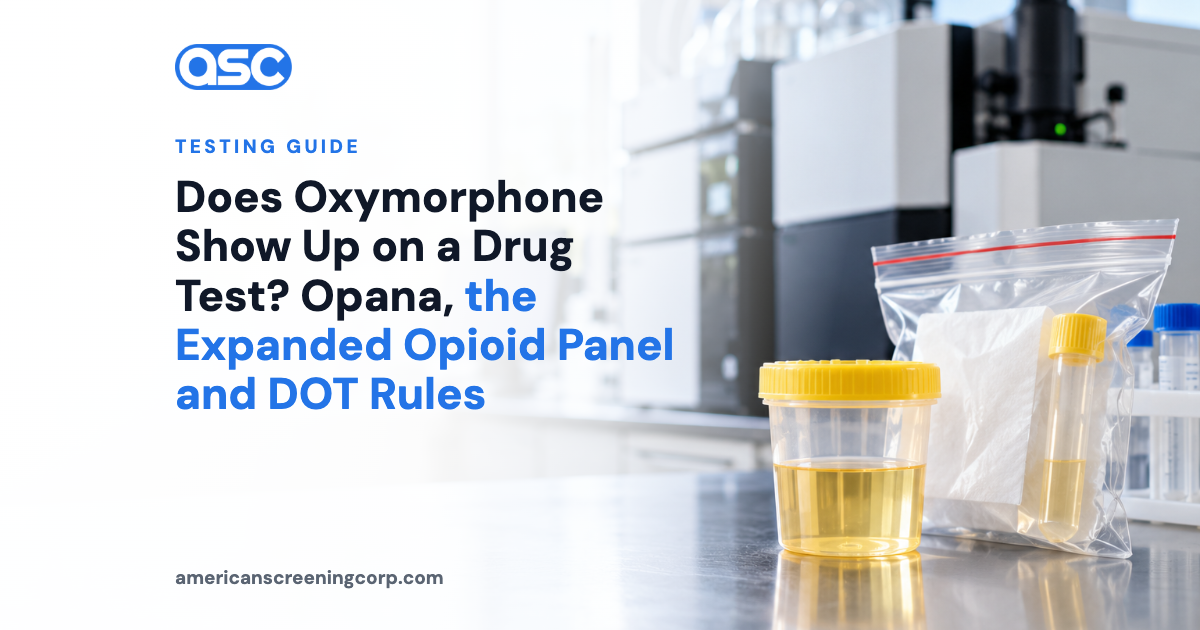
Oxymorphone is a schedule II semi synthetic opioid, sold under brand names including Opana, and it is also a metabolite the body produces when it breaks down oxycodone. Whether a workplace drug test catches oxymorphone depends entirely on which panel the employer orders. A basic opiate immunoassay, the kind built around the morphine and codeine chemistry, generally misses oxymorphone. A test designed for the expanded opioid group, including the oxycodone and oxymorphone specific assay used in DOT testing since 2018, is built to catch it. This article covers how the screening and confirmation steps work, what the DEA schedule and prescribing label say about the drug, and how the medical review officer process handles a positive result.
Oxymorphone, Opana and the opioid family
Oxymorphone is manufactured directly and also forms in the liver as a minor metabolite of oxycodone. It is listed as a schedule II controlled substance under the Controlled Substances Act, the same schedule as oxycodone, hydrocodone, and hydromorphone, because of its abuse potential and accepted medical use under supervision. The Drug Enforcement Administration's schedule II listing in 21 CFR 1308.12 places oxymorphone alongside the other major prescription opioids that employers and labs group together as the "expanded opioid" or "semi synthetic opioid" class. The prescribing information filed with the Food and Drug Administration, available through the National Library of Medicine's DailyMed label for oxymorphone, describes it as indicated for management of pain severe enough to require an opioid analgesic, under a prescriber's supervision.
Why the old opiate immunoassay misses it
The original federal opiate testing panel was built around morphine and codeine chemistry from the opium poppy. The antibodies in that immunoassay cross react well with natural opiates and, to varying degrees, with some semi synthetic opioids, but they do not reliably catch oxymorphone, oxycodone, hydrocodone, or hydromorphone at the cutoffs used for the older panel. A person taking a prescription oxymorphone product can take a standard five panel opiate screen and come back negative, not because the drug was absent from the specimen, but because the screening antibody was never designed to flag that molecule at a meaningful concentration. This is a known, documented gap in immunoassay chemistry, not a flaw unique to any single test brand. It is also the reason employers and treatment programs that want to detect this drug class have to specifically order an assay built for it.
The assay that does catch it
Laboratories address the gap with an oxycodone and oxymorphone specific immunoassay, usually run as part of what is marketed as an expanded opiate or expanded opioid panel, alongside separate antibodies tuned for hydrocodone and hydromorphone. The federal workplace testing program folded this expanded approach into the main program starting in 2018. The Substance Abuse and Mental Health Services Administration's workplace testing program sets the Mandatory Guidelines that federal agencies and, through incorporation, the Department of Transportation follow, and those guidelines moved from a narrower "opiates" panel to a broader "opioids" panel that specifically includes oxycodone and oxymorphone testing. Any employer or clinic that wants oxymorphone detection has to order that specific expanded test rather than assume a generic opiate cup or card covers it.
DOT testing and the expanded opioid panel
For safety sensitive transportation employees covered by Department of Transportation testing rules, this is not optional. The DOT drug testing procedures in 49 CFR Part 40, including the semi-annual laboratory report appendix, list hydrocodone, hydromorphone, oxycodone, and oxymorphone as part of the panel that HHS certified laboratories must test and report. That expansion took effect for DOT regulated testing beginning January 1, 2018, replacing the older opiate only panel for those drugs. A commercial driver, pipeline worker, or other DOT covered employee taking a federal regulated drug test since that date is being tested on a panel built to catch oxymorphone, not the older morphine and codeine focused screen.
Screening immunoassay versus confirmation
A positive immunoassay result, whether on a urine cup, a dip card, or an oral fluid device, is a screening result only. It tells a collector or employer that a specimen crossed a preset cutoff concentration for a drug class, not that a specific drug was definitively identified. Any non negative screen that will be used for an employment or safety decision has to go to confirmation testing by gas chromatography mass spectrometry or liquid chromatography mass spectrometry at a certified laboratory. Confirmation testing separates and identifies the exact molecule, distinguishing oxymorphone from oxycodone, hydromorphone, or other opioids in the sample, and it reports a specific quantitative result rather than a simple positive or negative flag.
This two step design exists because immunoassay antibodies are built for speed and cost at the point of collection, not for molecular level precision. An antibody that reacts to one opioid will often react to a related opioid to some degree, and a lab needs to rule out cross reactivity before anyone relies on a result. Mass spectrometry does that by physically separating compounds based on their chemical properties and matching the resulting signal against a known reference standard for oxymorphone specifically. That is also why a screening cup or card result alone, even one built for the expanded opioid panel, should never be treated as a final answer in a workplace setting. It is a flag that tells the employer and the laboratory where to look next, and the confirmation step is what turns that flag into a defensible result.
| Step | What it does | What it proves |
|---|---|---|
| Point of collection screen (cup, card, oral fluid) | Immunoassay antibody reaction against a cutoff | Presumptive result only, needs confirmation |
| Laboratory confirmation (GC/MS or LC/MS) | Separates and identifies the specific molecule present | Definitive identification and quantity |
| Medical review officer review | Compares confirmed result to prescription and medical history | Final verified result reported to the employer |
The medical review officer process
A confirmed positive result for oxymorphone, oxycodone, or related opioids does not automatically become a reportable positive to an employer. A medical review officer, a licensed physician trained in this review process, contacts the individual to ask about any legitimate medical explanation, including a current prescription. If the person has a valid prescription from a practitioner and the reported concentration and history are consistent with legitimate use, the MRO can verify the result as negative for program purposes. Keeping current prescription documentation, including the prescribing provider's name and the pharmacy that filled it, is the practical step that protects an employee going through this review. This article is not medical or legal advice, and any individual case should go through the MRO and, where needed, the employee's own physician and employer policy, rather than being resolved by guesswork about test chemistry.
What employers should order if they want this coverage
Employers who specifically want opioid analgesic misuse coverage, including oxymorphone, oxycodone, hydrocodone, and hydromorphone, should confirm with their collection supplier or laboratory that the panel ordered is the expanded opioid panel, not the legacy opiate only panel. DOT covered employers already receive this coverage by rule. Non DOT employers set their own panel configuration and should ask the question directly rather than assume a standard five panel cup includes it. American Screening Corporation's wholesale customers can review panel configurations through the wholesale portal when comparing cup, card, and oral fluid options that include expanded opioid coverage.
It also helps to be specific with a laboratory or collection site about the business reason for testing. A pain management clinic monitoring patients for medication adherence has a different goal than a safety sensitive employer screening for impairment risk, and the panel configuration, documentation workflow, and the way the MRO reviews prescriptions can all look different between those two settings. Asking a supplier to spell out, in writing, exactly which opioid analytes a given cup, card, or oral fluid device reports on avoids the common mistake of assuming any product labeled an opiate test automatically includes oxymorphone, oxycodone, hydrocodone, and hydromorphone together.
Frequently asked questions
Will a basic five panel drug test catch oxymorphone?
Usually not. The traditional opiate immunoassay used on many basic five panel cups and cards is built around morphine and codeine chemistry and does not reliably detect oxymorphone at standard cutoffs. Detecting it requires an expanded opioid panel with an assay specific to oxycodone and oxymorphone.
Is oxymorphone part of the DOT drug testing panel?
Yes. Since the expanded opioid panel took effect for DOT regulated testing on January 1, 2018, oxycodone and oxymorphone, along with hydrocodone and hydromorphone, are part of the panel that HHS certified laboratories test and report under 49 CFR Part 40.
Can a legitimate prescription explain a positive oxymorphone result?
Yes, that is exactly what the medical review officer process exists to evaluate. A confirmed positive goes to an MRO, who reviews prescription documentation and medical history before a result is reported to the employer as positive or verified negative.
Does a positive screening result mean oxymorphone was definitely in the sample?
No. A screening immunoassay result is presumptive. Any non negative screen used for an employment decision must go through laboratory confirmation by GC/MS or LC/MS, which identifies the specific drug rather than just a class level reaction.
Is oxymorphone the same thing as oxycodone?
No, they are different molecules, though oxymorphone is also one of the metabolites the body produces from oxycodone. Laboratory confirmation can distinguish between the two, which matters for interpreting a result accurately.
What schedule is oxymorphone under federal law?
Oxymorphone is a schedule II controlled substance under the Controlled Substances Act, reflecting both its accepted medical uses and its potential for misuse and dependence.
Related reading
- Does Oxycodone Show Up on a Drug Test? OXY Panels vs Standard Opiate Screens
- SAMHSA and DOT Drug Testing Cutoff Levels: 2026 Reference Table
Browse expanded opioid panel drug test cups for options that include oxycodone and oxymorphone specific testing.
This article is general information about drug testing science and federal program rules, not medical or legal advice. Employers and employees should direct specific cases to a medical review officer and consult qualified counsel for compliance questions.