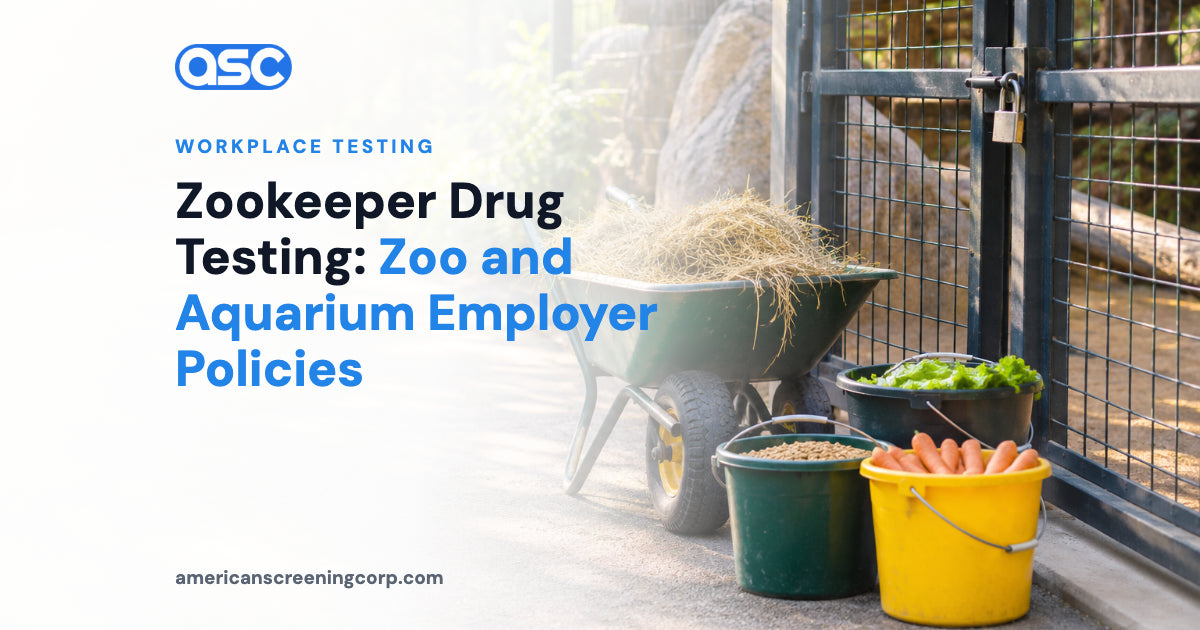
Zookeepers, aquarists, and animal care technicians spend their shifts inside enclosures with large carnivores, venomous reptiles, marine mammals, and primates. Many of the same staff also handle, transport, or assist with controlled substances during veterinary procedures, since sedating a tiger or an elephant usually calls for scheduled anesthetic drugs rather than anything available over the counter. Those two facts, dangerous animal access and controlled substance exposure, are what actually drive drug testing policy at zoos and aquariums. There is no single federal statute that requires every zookeeper in the country to submit to a drug test. Instead, the requirement comes from a mix of federal employee rules, state and local government policy, commercial driver's license obligations, and employer choice tied to animal welfare and workplace safety standards.
Who actually mandates testing
Three different sources of authority can apply to the same zoo, often at the same time, depending on who runs the facility and what each employee's job actually involves.
Federal employees at government operated zoos
A small number of zoos and aquariums are run directly by the federal government or by federally chartered institutions. Employees who are federal civilian workers fall under Executive Order 12564, the Drug-Free Federal Workplace order, which authorizes agencies to test employees in positions the agency head designates as testing designated positions, including jobs that involve public safety or access to sensitive materials. The Office of Personnel Management's drug-free workplace program guidance describes how agencies build these programs, and the original order itself is preserved in the federal register compilation available through govinfo's archived text of Executive Order 12564. An animal care role with direct contact with dangerous species, or any role with regular access to scheduled anesthetic drugs, is a plausible candidate for a testing designated position under this framework.
State and local government zoos
Most municipal and county owned zoos are staffed by public employees covered by a state or local civil service drug testing policy. These policies vary by jurisdiction, by job classification, and by whether the role is deemed safety sensitive, so a zookeeper in one state park system may face random testing while a counterpart in another city does not. There is no single government portal that lists every state's public employee drug testing rule, so employers and job seekers should check the specific state or municipal personnel policy that applies to the zoo in question rather than assume a uniform rule.
Private and nonprofit zoos and aquariums
Most zoos and aquariums in the United States are private nonprofit organizations. For these employers, drug testing is a matter of private employment policy, not a federal or state mandate, unless a specific job duty triggers a separate rule. The most common trigger is a commercial driver's license. A zoo that moves large animals between facilities, or that operates its own box trucks for feed and supply deliveries, typically requires a CDL for that driving duty, and any employee who drives a commercial motor vehicle requiring a CDL in interstate or safety sensitive service falls under the federal transportation drug and alcohol testing rule at 49 CFR Part 40, which sets the specimen collection, laboratory, and medical review officer process that applies regardless of what industry the employer is in.
Why animal care and veterinary access change the panel
The safety case for testing zoo staff is straightforward. An animal keeper working inside a big cat enclosure, a marine mammal pool, or a venomous reptile room needs full physical coordination and judgment, since a lapse can result in a serious or fatal animal attack or a dangerous escape. This is the same general workplace safety reasoning behind the general duty clause written into the Occupational Safety and Health Act, which requires employers to furnish a workplace free from recognized hazards, a duty spelled out in the United States Code text of the general duty clause and supported by the broader federal workplace safety standards collected at 29 CFR Part 1910. A positive result on a standard panel, or an on the job impairment incident, gives an employer grounds to act under its own policy, separate from any licensing requirement.
The controlled substance piece is narrower and applies mainly to the zoo veterinarian and credentialed veterinary technicians, not to every keeper on staff. Large animal anesthesia commonly uses Schedule III agents such as ketamine and the combination drug tiletamine with zolazepam, both of which are scheduled under 21 CFR Part 1308. Any staff member who orders, stores, or administers these drugs on behalf of the facility works under a veterinarian's Drug Enforcement Administration registration, governed by the registration requirements at 21 CFR Part 1301, and the registration itself is issued and tracked through the DEA Diversion Control Division registration system. Facilities that hold a controlled substance registration generally build stricter access logs, dual control over the drug safe, and more frequent testing into the roles that touch that cabinet, even when the broader keeper staff is tested less often or not at all.
Animal welfare standards add a separate layer of accountability that is not drug testing but shapes staffing decisions around it. Federal regulations implementing the Animal Welfare Act, found at 9 CFR Part 3, set minimum standards for the handling and care of regulated species, and USDA inspectors can cite a facility for handling practices that put animals or the public at risk. A documented drug testing and fitness for duty policy for animal contact staff is one way facilities demonstrate they are managing that risk, even though the Animal Welfare Act regulations themselves do not mandate employee drug screening.
Panels, specimen types, and testing triggers
Zoo and aquarium employers that do test typically use a standard urine panel for pre employment and random testing, often a 10 panel drug test cup that covers common drugs of abuse.
Facilities that need a quick result at intake or during an incident review frequently keep drug test cups on hand at the staff health office, since a cup combines collection and screening in one step.
Some employers prefer a dip card format for lower cost random testing programs.
Others choose an oral fluid test for observed collection when a facility wants to reduce the chance of a substituted sample.
Post accident testing after an animal bite, fall, or enclosure breach is common practice, and many policies pair a drug panel with an alcohol test since alcohol impairment carries the same safety risk around dangerous animals as any other drug. Employers building that pairing often stock alcohol test strips and dip cards alongside the drug panel.
A smaller number of facilities, particularly those with a longer look back need for a safety sensitive hire, use a hair follicle test during pre employment screening.
Federally run or federally affiliated zoos building a program under agency guidance may also look at federal agency drug testing kits designed to match agency chain of custody requirements.
For cause testing, meaning testing triggered by observed signs of impairment or an incident, is standard practice across nearly every version of these policies, public or private. Random testing frequency and whether marijuana is included on the panel vary widely by employer and by state marijuana law, so job applicants and hiring managers should check the specific facility's written policy rather than assume a national standard.
| Employer type | What governs testing | Typical trigger |
|---|---|---|
| Federal government zoo or aquarium | Executive Order 12564, agency testing designated position policy | Pre employment, random, reasonable suspicion |
| State or local government zoo | State or municipal civil service policy, varies by jurisdiction | Varies, often random for safety sensitive roles |
| Private nonprofit zoo or aquarium | Employer policy, no blanket federal mandate | Pre employment, post accident, reasonable suspicion |
| Any employee holding a CDL for animal or supply transport | 49 CFR Part 40, DOT testing program | Pre employment, random, post accident, return to duty |
| Veterinary staff with DEA registered controlled substance access | 21 CFR Parts 1301 and 1308, facility access controls | Pre employment, periodic, incident related to drug inventory |
Fitness for duty extends to medication use as well. A zoo veterinary technician who is lawfully prescribed a controlled medication for a personal condition is not automatically barred from working, but a positive screen for a prescribed substance should route through the medical review officer process rather than resulting in an automatic adverse action. Employers evaluating any medical information connected to a drug test should also consider the limits the Americans with Disabilities Act places on disability related inquiries, summarized in EEOC enforcement guidance on disability related inquiries and medical examinations. None of this changes the underlying safety reasoning. It only means the process for handling a positive result has to be fair and documented, not just fast.
Marijuana policy deserves its own note because it is the most likely point of friction for a zoo or aquarium hiring in a state with legal recreational or medical marijuana. State law protections for off duty marijuana use vary and generally do not override a federal requirement like DOT Part 40 testing for a CDL holder. For non federally regulated roles, an employer may be able to maintain a zero tolerance marijuana policy for safety sensitive animal contact positions, but the facility should confirm its approach against the specific state law where it operates rather than apply a one size fits all rule across locations.
Facilities that also run veterinary care on site share several policy concerns with outside veterinary clinics, including controlled substance logging and staff access tiers, which is covered in more detail in our related post on veterinary clinic employee drug testing. Facilities deciding whether ketamine specifically needs its own confirmation step for anesthesia related inventory questions can also see our explainer on how ketamine shows up on a drug test.
Frequently asked questions
Does federal law require zookeepers to take a drug test
No single federal law applies to every zookeeper nationwide. Federal civilian employees at government run zoos can be tested under Executive Order 12564 if their role is designated testing eligible, and any employee who drives a commercial motor vehicle under a CDL is covered by 49 CFR Part 40. Outside those categories, testing is a matter of state, local, or private employer policy.
Do zookeepers need a DEA registration to work with anesthesia drugs
Individual keepers generally do not hold their own DEA registration. The facility's veterinarian holds the registration under 21 CFR Part 1301, and staff who handle scheduled anesthetic drugs do so under that veterinarian's authority and the facility's internal access controls.
What drug test panel do most zoos and aquariums use
Many employers use a standard multi panel urine test, often administered with a drug test cup, for pre employment and random testing. Post accident testing frequently adds an alcohol test. Facilities with longer look back needs sometimes add a hair follicle test for new hires in safety sensitive roles.
Can a zoo fire a keeper for a positive marijuana test in a legal marijuana state
This depends on the state's specific marijuana employment protections and whether the role is considered safety sensitive. Employers generally should consult counsel before making a final decision, since state law varies and some states extend limited off duty use protections that do not apply to safety sensitive positions.
Are zoo veterinary technicians tested differently than general animal keepers
Often yes. Staff with direct access to a controlled substance cabinet or DEA registered inventory frequently face stricter screening and access controls than general animal care staff, reflecting the added accountability that comes with controlled drug access rather than a separate legal mandate.
Does the Animal Welfare Act require employee drug testing
No. The Animal Welfare Act regulations at 9 CFR Part 3 set standards for the handling and care of regulated animals but do not mandate employee drug screening. Many facilities adopt testing voluntarily as part of their broader animal handling and public safety practices.
This article is general information about employer drug testing policy and is not legal or medical advice. Employers should consult qualified counsel before adopting or changing a drug testing program.