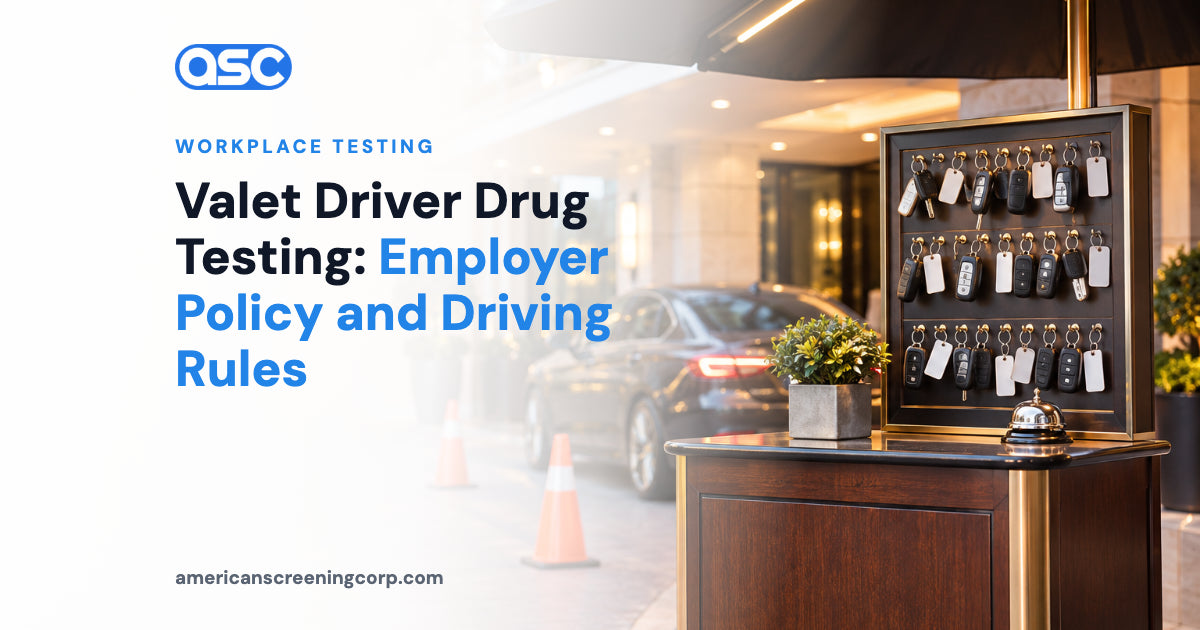
A valet attendant spends a shift taking keys from strangers and driving vehicles that are not their own, often at speed, in tight garages, and in front of the owner. That combination of access, liability, and public visibility is why hotels, restaurants, hospitals, and parking management companies build drug testing into their valet programs even when no federal rule requires it. This guide covers who actually sets the testing requirement for valet drivers, which panels and specimen types employers use, and how an accident or a supervisor's observation can trigger a test.
Does federal law require valet drivers to be drug tested?
Generally, no. The federal drug and alcohol testing program that transportation companies know best, the one built around 49 CFR Part 40 procedures, applies to drivers who operate a commercial motor vehicle and hold a commercial driver's license. The applicability rule in 49 CFR Part 382 ties that testing duty to the vehicle, not the job title, and the definition of a commercial motor vehicle in 49 CFR Part 390 sets the threshold at a gross vehicle weight rating above 10,001 pounds, a vehicle designed to carry sixteen or more passengers, or a vehicle placarded for hazardous materials. A valet driving a guest's sedan or SUV around a parking structure does not meet that threshold, so the valet is not a covered driver under the federal program, and the employer has no duty to query the FMCSA Drug and Alcohol Clearinghouse for that position. If the same company also operates a shuttle bus or a tow vehicle that does meet the commercial motor vehicle definition, the drivers assigned to that vehicle are a separate, covered category and the valet role does not automatically carry the same duty.
Outside of the federal transportation program, some states tie drug testing to workers' compensation insurance through a voluntary drug free workplace premium discount program, and some local licensing ordinances for parking and valet businesses reference a testing or background policy. Those programs and ordinances vary by state and by city, so an employer should confirm the current rule with its own state workers' compensation agency or state department of labor rather than assume a national standard applies.
Why valet companies test anyway
Even without a federal mandate, most valet and parking management companies write their own testing policy because the job carries real exposure. A valet is handed the keys to a vehicle that is often worth far more than the attendant's own car, operates it on private property where pedestrians, other vehicles, and the owner are all nearby, and frequently works at venues that serve alcohol. A single accident can mean a damaged vehicle, an injured guest, or a liability claim against the property. Insurers and garagekeepers liability carriers routinely ask whether a drug free workplace policy is in place, and many employers use that written policy, paired with a pre-employment drug test kit, as a basic condition of being handed a set of keys.
Valet staffing is also commonly contracted through a third party parking or staffing company rather than hired directly by the hotel or restaurant. Those contracted staffing arrangements are exactly where a documented, consistent screening policy matters most, since the client venue is relying on the staffing company's own staffing and employment agency drug testing program to vouch for the people it sends on site.
Panels and specimen types used for valet screening
Because valet positions are not DOT covered, the employer picks the panel. Most programs use a standard non-DOT urine panel, commonly a five panel or ten panel drug test dip card, screening for the substances most likely to impair driving and reaction time. Some employers prefer an oral fluid collection for pre-employment screening because it can be observed directly and completed in minutes, which fits a fast seasonal hiring cycle common in hospitality. An oral fluid drug test is a common choice for that reason. Whatever specimen type is chosen, any non-negative screening result on a meaningful program should go to a certified laboratory for confirmation before any employment action is taken, and a reviewing medical professional should give the employee or applicant a chance to provide a prescription explanation before a result is reported as verified positive.
| Testing trigger | Typical method | What it is meant to catch |
|---|---|---|
| Pre-employment | Urine panel or oral fluid screen | Baseline check before the person is handed vehicle keys |
| Random | Urine panel, per written policy schedule | Ongoing deterrence where the employer's policy calls for it |
| Reasonable suspicion or for cause | Urine or oral fluid panel, plus a breath or saliva alcohol test | Observed signs of impairment reported by a supervisor |
| Post-accident | Urine panel and alcohol test, collected promptly | Whether impairment was a factor in a collision or injury |
Post-accident and for-cause testing
A fender bender in a parking garage, a scrape against a pillar, or a guest reporting that their vehicle was returned damaged are the most common real-world triggers for valet drug testing. Employers should be careful here. OSHA has stated in a standard interpretation letter that a drug testing policy cannot be used in a way that discourages employees from reporting a workplace injury, and that blanket post-incident testing of every employee who reports an injury, regardless of whether drug use could plausibly have contributed to the incident, can run afoul of the injury reporting protections built into the OSHA recordkeeping rule. The safer, compliant approach is to test when there is a reasonable basis to believe impairment may have contributed to the specific incident, such as a vehicle collision, and to apply that standard evenly rather than singling out the person who reported the problem.
Reasonable suspicion testing works on a similar principle. A supervisor who observes specific, documented signs, slurred speech, the smell of alcohol, unsteady movement, or erratic driving in the lot, can direct an immediate test under the employer's written policy. That observation should be documented at the time it happens, and the test itself should follow the same chain of custody and confirmation steps as any other screening.
Alcohol testing at venues that serve alcohol
Hotels, country clubs, and restaurants with a bar add another layer of exposure, because valets often work near guests who have been drinking and sometimes near staff break areas where alcohol is accessible. A written alcohol policy paired with a breathalyzer on site for post-accident or reasonable suspicion situations gives a supervisor an objective reading rather than relying on judgment alone. Some employers also keep an instant panel on hand for pre-shift spot checks tied to the written policy, and an 5 panel drug test is a common baseline for that kind of program.
ADA, disability law, and state limits
Employers still need to apply any testing policy consistently and avoid using it as a stand-in for disability discrimination. The Americans with Disabilities Act regulations at 29 CFR Part 1630 describe how medical and disability-related inquiries must be handled, and a drug test result that leads to a question about a lawful prescription should route through the same medical review process used in any other screening program rather than an informal conversation. Employers should also remember that state law on drug testing, including rules on notice, consent, and how marijuana laws interact with a safety-sensitive driving role, varies by state, and a company operating valet locations in more than one state may be able to apply one policy in one location and a modified version elsewhere depending on that state's current rule. Legal counsel familiar with the specific state is the right source for that determination, not a general guide like this one.
Frequently asked questions
Are valet drivers required to take a DOT drug test?
Generally not. DOT testing under Part 382 applies to drivers of commercial motor vehicles who hold a commercial driver's license, and a valet driving a guest's personal passenger vehicle typically does not meet that vehicle definition, so the role is not covered by the federal program.
What drug test panel do most valet or parking companies use?
Programs vary, but a standard non-DOT five panel or ten panel urine screen, or an oral fluid screen for faster pre-employment turnaround, are both common choices. The employer's written policy sets the specific panel.
Can a valet be drug tested after a customer's car is damaged?
An employer may be able to require a post-accident test under its written policy when there is a reasonable basis to think impairment could have contributed to the incident. The test should be applied consistently and should not be used in a way that discourages injury reporting.
Do valet companies do random drug testing?
Some do, as a matter of company policy rather than federal requirement. Random testing for a non-DOT role is set entirely by the employer's own program and its documented schedule.
What happens if a valet refuses a drug test?
Refusal consequences depend on the employer's written policy, since there is no federal refusal definition for a non-DOT role the way there is under Part 40 for covered drivers. Most employer policies treat a refusal the same as a positive result.
Does a prescription medication automatically disqualify a valet applicant?
No. A legitimate prescription explanation should be reviewed through the employer's medical review process before any non-negative result is treated as a verified positive, and the applicant should have the chance to provide that documentation.
Related reading
For a comparison with another role that drives frequently but is also typically outside the federal program, see non-DOT delivery driver drug testing. For a deeper look at how an accident investigation should be handled under the OSHA recordkeeping protections discussed above, see post-accident drug testing and the OSHA rules employers get wrong. Employers building or refreshing a valet testing program can review a full line of instant drug tests for on-site collection.
This article is general information for employers and is not legal or medical advice. Drug testing policies should be reviewed with qualified legal counsel for the specific state and workplace involved.