
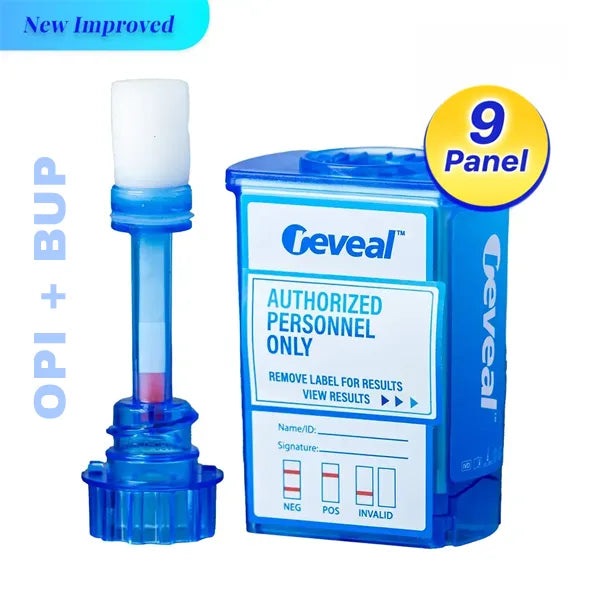
Quick answer: On most oral fluid drug tests, two lines in a drug column, one at the control line (C) and one at the test line (T), mean negative for that drug. A line only at C means preliminary positive. No line at C means invalid. American Screening Corp advises confirming every positive by GC/MS or LC-MS/MS laboratory testing.
- Two lines (C and T) = negative for that drug; any visible T line counts, even a faint one.
- One line at C only = preliminary positive; confirm by GC/MS or LC-MS/MS laboratory testing.
- No C line = invalid; discard the device and retest with a new one.
What do two lines on an oral tox drug test mean?
Two lines mean the test worked and the drug was not detected above the cutoff. The control line (C) proves enough oral fluid moved across the strip. The test line (T) appears when the drug level is below the device cutoff.
Need drug tests for your clinic, program or workplace?
American Screening Corp has supplied FDA-cleared, CLIA-waived tests at wholesale pricing since 2004. Popular options:
Ordering 100+ tests? Request volume pricing.
Oral fluid tests are competitive immunoassays, so the logic is reversed from a pregnancy test. A line in the test region means negative. A missing line in the test region means the drug was at or above the cutoff.
Always follow the package insert for your device. Layouts differ: some devices show one column per drug, and some show a combined panel. Read each drug column on its own.
How do you read each result?
| Pattern in a drug column | Result | Action |
|---|---|---|
| C line and T line visible (faint counts) | Negative for that drug | Record result; no further action for that drug |
| C line visible, no T line | Preliminary positive | Record; send specimen for GC/MS or LC-MS/MS confirmation |
| No C line (with or without T) | Invalid | Discard and retest with a new device |
A preliminary positive is not a final finding. It is a screening result only. Every positive screen is preliminary and must be confirmed by GC/MS or LC-MS/MS laboratory testing before any action is taken.
What cutoffs do oral fluid screens use?
Federal programs set initial oral fluid cutoffs in the HHS Mandatory Guidelines for Federal Workplace Drug Testing Programs Using Oral Fluid (SAMHSA, as of 2026). Many commercial devices are built around similar levels:
- Marijuana (THC): 4 ng/mL
- Cocaine (benzoylecgonine): 15 ng/mL
- Amphetamine and methamphetamine: 50 ng/mL
- MDMA: 50 ng/mL
- Opiates (codeine, morphine, hydrocodone, hydromorphone, oxycodone): 30 ng/mL; 6-acetylmorphine: 3 ng/mL
- Phencyclidine (PCP): 3 ng/mL
Your device's cutoffs are printed on its insert and may differ. Confirm them for the exact product before you set a policy.
How long can oral fluid tests detect drug use?
Oral fluid generally reflects recent use, commonly within roughly the past one to two days, depending on the drug, dose and individual. It is used to find recent use, not long-term history. Windows vary, so treat any figure as a general range and not a guarantee.
Is oral fluid testing FDA-cleared and CLIA-waived?
Status depends on the specific device. Check the product record and package insert for FDA 510(k) clearance and CLIA-waived status before you buy. Forensic-use-only devices must be labeled and used as such. Contact our team through the American Screening Corp contact page to verify the status of a product.
On-site instant oral fluid devices are not the same as DOT-regulated testing. Federally regulated DOT tests follow 49 CFR Part 40, which requires laboratory-based procedures and specific collection rules. Do not use a point-of-collection device for a DOT-required test.
Why do results get misread?
- Reading a faint T line as positive. Any visible T line is negative.
- Reading outside the time window in the insert, which can create false lines.
- Collecting right after eating, drinking, smoking or chewing gum. Follow the insert's wait period.
- Not checking the C line first.
- Using expired devices or poorly stored lots.
Checklist for a consistent oral fluid screening program
- Confirm FDA/CLIA status and cutoffs for each lot you stock.
- Write a one-page procedure covering the wait period, collection, timing and reading.
- Train two readers and require a second look at every preliminary positive.
- Record the lot number, expiry, time and the result of each drug column.
- Send the confirmation specimen to a laboratory for GC/MS or LC-MS/MS testing.
- Retest on a new device when the C line is missing.
Oral fluid, urine cup or dip card?
Oral fluid is observed, which makes it harder to adulterate, and it targets recent use. Urine testing typically detects a longer window. If your program needs a urine option, compare our drug test cups. Employers that pair screening with hiring checks can also see Reveal Background for employment screening.
FAQ
What do two lines mean on an oral drug test?
Two lines, one at control and one at test, mean negative for that drug. The device worked, and the drug was below the cutoff. Follow your package insert, since layouts vary.
What if the test line is faint?
A faint test line is still a line, so the result is negative for that drug. Read each drug column and confirm that the control line is present.
What does one line mean on an oral fluid test?
One line at the control position means a preliminary positive for that drug. It is not final. Confirm by GC/MS or LC-MS/MS laboratory testing before taking action.
What if there is no control line?
No control line means the test is invalid, whatever the test line shows. Discard the device and repeat with a new one, following the insert.
Sources
- SAMHSA, Workplace Drug Testing Resources
- eCFR, 49 CFR Part 40: Procedures for Transportation Workplace Drug and Alcohol Testing Programs
- FDA, Drugs of Abuse Tests
This article is general information, not legal or medical advice.