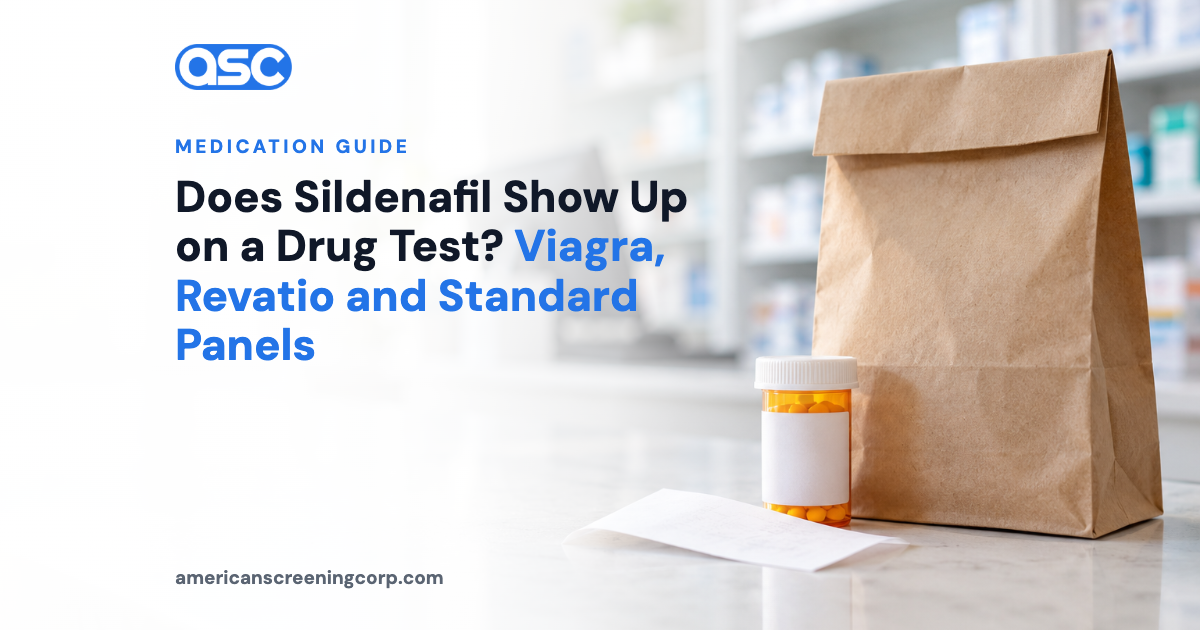
Sildenafil is the active ingredient in Viagra and Revatio, a prescription medication used to treat erectile dysfunction and pulmonary arterial hypertension. It belongs to a drug class called phosphodiesterase type 5 (PDE5) inhibitors. Employers and employees sometimes ask whether taking it could trigger a positive result on a pre employment or random workplace drug screen. The short answer is that sildenafil is not a controlled substance and it is not an analyte included on any standard or expanded drug test panel sold for workplace, clinical, or at home use. The longer answer involves understanding how screening actually works, what a panel is built to detect, and why counterfeit pills sold outside the pharmacy supply chain are a separate and real concern.
What a workplace drug test is actually built to detect
A urine, oral fluid, or hair drug test panel is designed around a fixed list of target drug classes. The device contains antibodies that react to specific drug metabolites, and the panel only flags a result for the classes it was built to catch. The federal workplace standard, often called the five panel, covers marijuana metabolites (THC), cocaine metabolites, opiates, amphetamines, and phencyclidine (PCP). Expanded panels used by many employers add classes such as benzodiazepines, barbiturates, methadone, propoxyphene, methaqualone, or synthetic opioids. Sildenafil does not share a chemical structure with any of these drug classes, so there is no antibody on a commercial panel that would cross react with it. The Substance Abuse and Mental Health Services Administration maintains program guidance for the drug classes covered under federal workplace testing rules, and sildenafil does not appear among them.
Immunoassay screening versus lab confirmation
It helps to separate the two stages of testing. The first stage is an immunoassay screen, the kind used in a dip card, cup, or oral fluid device at the point of collection. It is a fast chemical reaction built only to react to the target drug classes on that panel. The second stage, used when a screen comes back non negative or when an employer requires confirmation, is gas chromatography mass spectrometry (GC/MS) or liquid chromatography mass spectrometry (LC/MS) performed at a certified laboratory. Confirmation testing identifies the exact molecule present rather than reacting to a class of similar compounds. Because sildenafil is not a target analyte on either stage, a lab running a standard workplace panel is not looking for it and would not report it even if it were present in the specimen.
Is sildenafil a controlled substance?
No. Sildenafil is a prescription only medication regulated by the Food and Drug Administration for safety and labeling, but it does not appear on the federal schedules of controlled substances maintained under the Controlled Substances Act. Those schedules, which list every drug the Drug Enforcement Administration classifies by abuse potential, are published in the Code of Federal Regulations. Because sildenafil carries no federal control status, it is not part of the drug classes that workplace, clinical, or forensic panels are designed to detect, and a prescription for it does not create the kind of review flag that a controlled medication would.
| Panel component | Drug class detected | Does sildenafil belong here |
|---|---|---|
| THC | Marijuana metabolite | No |
| COC | Cocaine metabolite | No |
| OPI | Opiates | No |
| AMP | Amphetamines | No |
| PCP | Phencyclidine | No |
| BZO | Benzodiazepines | No |
| BAR | Barbiturates | No |
| PDE5 inhibitors (sildenafil, tadalafil, vardenafil) | Not a standard panel analyte class | No commercial panel targets this class |
What if sildenafil shows up on a lab result anyway
If a specimen is ever sent for a broader clinical toxicology workup rather than a standard workplace panel, and sildenafil is identified, the correct process is the same one used for any legitimately prescribed medication. A medical review officer (MRO), a licensed physician trained to interpret drug test results under programs such as those governed by 49 CFR Part 40, contacts the donor directly to verify a valid prescription before any result is reported to an employer as other than negative. Prescription documentation, not the test result itself, resolves the question. Employees are never expected to disclose a prescription in advance, and employers should never ask a lab or collector to flag legitimate prescription medications outside this verified MRO process.
Why the MRO process matters here
The MRO review process exists precisely because many common prescription and over the counter medications can trigger a non negative immunoassay screen on drugs sildenafil is not part of, such as certain decongestants, antihistamines, or antidepressants reacting with the amphetamine or benzodiazepine classes. Sildenafil itself is not one of those cross reactive medications, so in practice it is unlikely to ever generate a question for an MRO to resolve. The verification pathway exists as a safeguard for the donor regardless of which medication is involved.
The real concern: counterfeit and tainted pills
The more serious issue connected to sildenafil and drug testing has nothing to do with the legitimate, FDA regulated medication. It involves counterfeit erectile dysfunction products sold outside licensed pharmacies, often online or through unregulated retailers. The Food and Drug Administration has repeatedly warned that many of these products are marketed as "all natural" sexual enhancement supplements but are secretly spiked with undisclosed sildenafil, other PDE5 inhibitor analogs, or in some cases entirely different active ingredients at unknown doses. A product like this could theoretically contain an undisclosed substance that does interact with health or, in rare formulations, with other screened compounds, and the buyer has no reliable way to know what is actually in the pill because it was never reviewed through FDA drug approval. This is a product safety and labeling problem, not a workplace drug testing problem, but it is the reason some people searching this topic have reason for concern beyond the legitimate medication itself.
What this means for employers and donors
- Sildenafil, under the brand names Viagra and Revatio, is not a federally controlled substance and is not an analyte on standard five panel, expanded panel, or oral fluid workplace drug tests.
- There is no published cross reactivity evidence showing sildenafil interferes with the immunoassay classes used in commercial drug test panels.
- A prescription for sildenafil does not require advance disclosure to an employer and would not trigger a non negative result that needs MRO review under a standard panel.
- Counterfeit sexual enhancement products bought outside licensed pharmacies may contain undisclosed sildenafil or other substances at unverified doses, which is a product safety issue separate from workplace testing.
- Employers building a testing program should rely on validated panels and a certified laboratory, and route every non negative screen through an MRO rather than guessing at a cause.
For employers and clinics setting up or restocking a screening program, American Screening Corporation supplies CLIA waived drug test cups, dip cards, and oral fluid devices built around the standard panel configurations described above. The drug test cup collection on the wholesale portal lists current panel options by analyte. Related reading on how non negative results get resolved is covered in the site's guide to the medical review officer process and in the breakdown of panel composition in the 12 panel drug test guide.
Frequently asked questions
Does sildenafil show up as a positive on a standard drug test?
No. Sildenafil is not an analyte included on the standard five panel federal workplace test or on common expanded panels sold for clinical and employer use. There is no published cross reactivity evidence linking it to the drug classes those panels screen for.
Is Viagra a controlled substance?
No. Sildenafil, sold under the brand names Viagra and Revatio, is a prescription medication regulated by the Food and Drug Administration for safety and labeling, but it does not appear on the federal controlled substance schedules published in the Code of Federal Regulations.
Will a prescription for sildenafil need to be reported to an employer before a drug test?
No advance disclosure is required. Because sildenafil is not part of a standard panel and would not generate a non negative screen, there is generally nothing for a medical review officer to review in connection with this specific medication.
Can counterfeit erectile dysfunction pills affect a drug test?
Counterfeit products sold outside licensed pharmacies have been found by the Food and Drug Administration to contain undisclosed sildenafil or other unapproved substances at unverified doses. That is a product safety concern rather than a documented workplace drug test cross reactivity issue, and the buyer has no reliable way to confirm what the product actually contains.
What drug classes does a standard five panel test actually screen for?
The federal workplace standard covers marijuana metabolites, cocaine metabolites, opiates, amphetamines, and phencyclidine. Expanded panels may add classes such as benzodiazepines or barbiturates. Sildenafil is not part of any of these classes.
What should happen if a lab toxicology workup unexpectedly identifies sildenafil?
The same verification process used for any medication applies. A medical review officer contacts the donor to confirm a valid prescription under the process described in 49 CFR Part 40 before any result beyond negative is reported to an employer.
Sources: DailyMed label for Viagra (sildenafil citrate), DailyMed label for Revatio (sildenafil citrate), FDA tainted sexual enhancement products warnings, SAMHSA workplace substance use resources, and 49 CFR Part 40, procedures for transportation workplace drug testing programs.
This article is general information for employers and the public. It is not legal advice and not medical advice. Employers should consult qualified counsel and a medical review officer for decisions involving specific employees or testing programs.