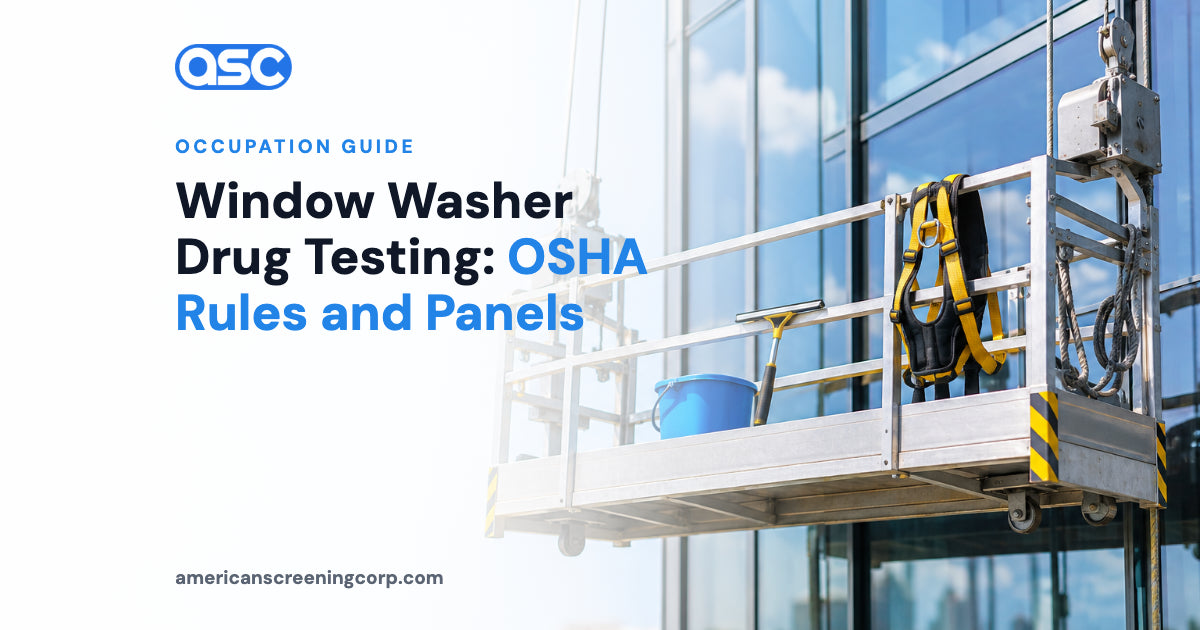
High rise window cleaning is done from suspended scaffolds, bosun chairs, and rope descent systems hundreds of feet above the street. A lapse in attention at that height has consequences that a lapse in most other jobs does not. That is the reason drug and alcohol testing comes up so often for this trade, even though no single federal law tells a window cleaning company it must test its crews.
This article explains who actually requires testing for window washers, what OSHA's suspended access standards do and do not say about drugs and alcohol, when post accident and reasonable suspicion testing apply, and which specimen types and panels field crews typically use.
Who actually requires drug testing for window washers
There is no OSHA rule and no general federal statute that mandates drug testing for window cleaners as an occupation. Testing requirements for this trade come from three places instead of one:
- Employer policy. Most window cleaning and building maintenance contractors write their own drug free workplace policy covering pre-employment, random, post accident, and reasonable suspicion testing for anyone who works on a rope, scaffold, or boom lift.
- Building owner and property manager contracts. Commercial buildings, especially high rise towers, frequently require any contractor working on the exterior, including window washing crews, to carry a drug testing program as a condition of the service contract and the certificate of insurance.
- Federal rules that apply only if the worker also drives. A window washer who also operates a commercial motor vehicle between job sites falls under the separate 49 CFR Part 40 testing procedures that apply to that driving role, not to the window cleaning work itself.
In other words, the testing a window washer encounters is almost always a company or client requirement layered on top of safety rules, not a standalone federal testing mandate for the trade.
What OSHA's suspended access rules actually require
OSHA's general industry standards for scaffolds and rope descent systems and for personal fall protection are the backbone of any high rise window washing safety program. 29 CFR 1910.27 covers scaffolds and rope descent systems, including building owner obligations to identify and maintain anchorages, and 29 CFR 1910.140 covers personal fall protection systems such as harnesses, lanyards, and descent devices. Neither section requires drug testing. What they require is equipment inspection, anchorage certification, training, and rescue planning.
Employers still point to these standards when they justify a testing policy, because the general duty to provide a workplace free of recognized hazards sits alongside personal protective equipment obligations under 29 CFR 1910.132. A worker whose judgment or coordination is impaired while rigging a descent line or working a drop is a hazard the employer has to account for, even though the regulation does not spell out a testing protocol to do it.
Post accident testing and OSHA's actual position
Employers sometimes assume OSHA bans post incident drug testing outright. It does not. OSHA's own standard interpretation on the subject clarifies that post accident drug testing is permitted as part of a legitimate safety program, as long as the employer has an objectively reasonable basis for believing drug use could have contributed to the incident and the policy is not used to punish workers for reporting injuries. That guidance is laid out in OSHA's 2018 standard interpretation letter on drug testing and injury reporting.
For a window washing crew, that typically means testing follows events like a fall arrest activation, a dropped tool or equipment failure at height, a near miss on an anchorage point, or any incident that triggers an OSHA recordable injury. A supervisor trained in reasonable suspicion indicators can also request testing based on observed behavior, slurred speech, odor, or unsafe decisions before a crew member is sent up on a line. Our related guide on post accident drug testing and the OSHA rules employers get wrong walks through how to write that trigger language correctly so it holds up if it is ever challenged.
Panels and specimen types field crews actually use
Window washing crews work from vans, roof rigging points, or ground level staging, usually without a bathroom nearby. That logistics problem shapes which specimen type a company picks.
| Specimen type | Where it fits for window washing crews | Typical use case |
|---|---|---|
| Urine cup | Office, clinic, or mobile collection site before a shift | Pre-employment and scheduled random testing |
| Oral fluid swab | On site at the job location, no bathroom required | Post accident and reasonable suspicion testing right after an incident |
| Dip card | Mobile collection vehicle or site office | Quick screening when a crew rotates between buildings during a shift |
| Breath alcohol | Immediately after an incident, at the scene | Post accident alcohol screening alongside a drug panel |
Because oral fluid collection does not require a bathroom and is observed directly, many window cleaning contractors keep an oral fluid drug test on hand specifically for post incident use at height sites. For scheduled testing at an office or job trailer, drug test cups with built in adulteration and specimen validity strips catch substituted or diluted samples. Crews that rotate across multiple buildings in a single day sometimes rely on drug test dip cards for faster turnaround between sites, and a breath alcohol test belongs in every post accident kit since fall incidents can involve both drugs and alcohol.
Any non negative rapid result should go to a certified laboratory for confirmation, and the result should pass through a medical review officer before an employer treats it as final, particularly when a worker has a valid prescription that could explain a screening result.
Building owner and property manager contract requirements
Commercial property managers that hire window cleaning contractors frequently build drug and alcohol testing language directly into the service agreement, alongside insurance, anchorage certification, and worker training requirements. This is a private contract term, not a government mandate, so the specific language varies by building, city, and property management company. A window cleaning contractor bidding on high rise work should expect to show proof of a written drug free workplace policy, and sometimes proof of recent testing records, before the contract is signed.
Companies that also do suspended scaffold and rigging work on construction sites, rather than finished buildings, often fold window washing crews into a broader site wide policy. Our related article on scaffold builder drug testing covers how OSHA site rules and employer policy interact for crews that build and work from suspended platforms, which overlaps closely with rope descent window cleaning.
State law limits on testing
State law affects how a window washing employer can run its testing program, including notice requirements, what substances a policy can screen for, and how a positive result for a legally used substance like medical cannabis is handled. These rules vary significantly by state and change over time, so a specific state's requirements should always be checked against that state's current statute or labor agency guidance rather than assumed. SAMHSA's workplace resources provide a starting point for employers building a program, and legal counsel should review the written policy before it is adopted, since a program that is legal in one state may not transfer directly to another.
Building a testing program that fits the trade
A window washing company that wants a testing program that actually holds up, rather than one that only exists on paper, generally needs a written policy that states which roles are covered, which triggers apply, how reasonable suspicion is documented, what panel and specimen type is used for each trigger, and how results move through a medical review officer. Supervisors who certify anchorages and run rigging briefings are usually the same people who need reasonable suspicion training, since they are standing next to the crew member before that person clips into a line. A construction and manufacturing drug testing program built around clear triggers, rather than blanket daily testing, tends to be both more defensible and more practical for crews that move between buildings and job sites. Employers evaluating a full program from pre-employment through random testing can review workplace drug testing solutions for employers to compare kit types before writing the policy.
Frequently asked questions
Does OSHA require drug testing for window washers?
No. OSHA's suspended access and fall protection standards cover equipment, anchorages, and training. They do not mandate drug testing. Testing comes from employer policy or building owner contract requirements instead.
Can a window washing company test after a fall or near miss?
Generally yes. OSHA's standard interpretation on drug testing and injury reporting allows post incident testing when the employer has an objectively reasonable basis to believe drug use could have contributed and the policy is not used to discourage injury reporting.
What specimen type works best for testing right after an incident at a job site?
Oral fluid swabs are commonly used for post incident testing on site because they do not require a bathroom and are collected under direct observation, which fits a job site with no restroom access.
Do building owners require window cleaning contractors to test their crews?
Many commercial property managers include drug and alcohol testing language in the service contract for exterior maintenance work, including window cleaning. This is a private contract requirement that varies by building and management company, not a government mandate.
Does a window washer who also drives a company vehicle fall under DOT testing rules?
A worker only falls under the federal DOT testing procedures in 49 CFR Part 40 for the driving duties that make them subject to those rules, such as holding a commercial driver's license for a covered vehicle. The window cleaning work itself is not covered by that federal rule.
Can a positive result for a legally used medication affect a window washer's job?
A screening result is not final on its own. A medical review officer reviews non negative results, including any valid prescription documentation, before an employer treats the result as confirmed. State law on medical cannabis and other legal substances also varies and should be checked against current state guidance.
This article is general information for employers and is not legal or medical advice. Drug testing policies should be reviewed by qualified legal counsel before adoption, and all non negative results should be confirmed and reviewed by a medical review officer.