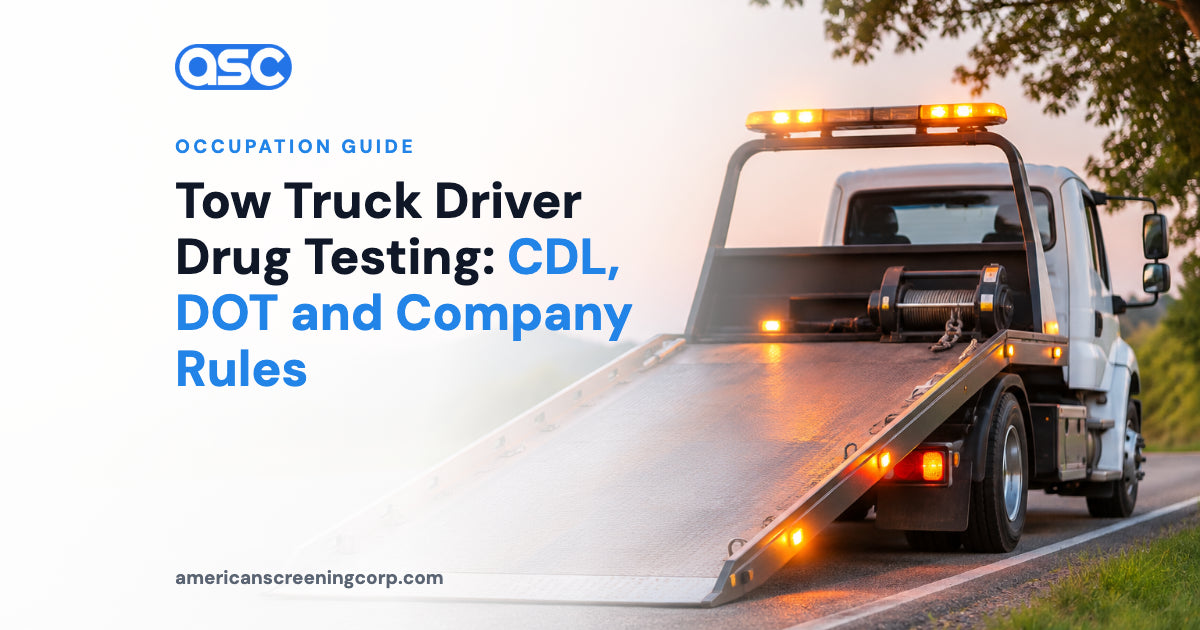
Towing companies run two very different kinds of equipment under one business name. A light duty flatbed that moves passenger cars is a different regulatory animal than a heavy wrecker that recovers a loaded tractor trailer off the shoulder of an interstate. Drug and alcohol testing rules follow that same split. Whether a tow truck driver falls under federal Department of Transportation testing or under a company's own policy depends mostly on the weight of the truck and whether the driver needs a commercial driver license to operate it.
The weight line that decides federal testing
Federal commercial driver license rules define a commercial motor vehicle in part by gross vehicle weight rating or gross combination weight rating of 26,001 pounds or more, among other criteria tied to vehicle class and what is being transported. The definitions and license group requirements are set out in the federal commercial driver license standards. A heavy duty wrecker built to recover medium and heavy trucks, or a rotator used for large recovery jobs, typically meets or exceeds that weight threshold and requires the driver to hold a Class A or Class B commercial driver license. A light duty tow truck used mainly for passenger vehicle repossession, impound, or roadside assistance calls is usually well under that line and does not require a commercial driver license at all.
That distinction matters because federal drug and alcohol testing under the Federal Motor Carrier Safety Administration applies to drivers who are required to hold a commercial driver license and who operate a commercial motor vehicle in interstate or intrastate commerce, consistent with the general applicability rules in 49 CFR Part 390. A tow operator who never drives a truck that meets the commercial motor vehicle weight definition generally falls outside that federal mandate, even if the company itself operates heavy equipment elsewhere in its fleet.
What FMCSA Part 382 requires for CDL tow truck drivers
Once a tow truck driver is classified as a commercial driver license holder operating a commercial motor vehicle, the controlling rule is 49 CFR Part 382, the Federal Motor Carrier Safety Administration's drug and alcohol testing regulation. Part 382 requires covered employers to test safety sensitive drivers before they are hired, at random throughout the year, after certain crashes, when a supervisor has reasonable suspicion, before a driver returns to duty after a violation, and on a follow up schedule afterward. The required drug panel and specimen handling procedures are governed separately by the Department of Transportation's procedural rule at 49 CFR Part 40, which sets the chain of custody, laboratory confirmation, and medical review officer process that applies across all DOT agencies, not just trucking.
Towing companies that fall under Part 382 also have to query the FMCSA Drug and Alcohol Clearinghouse before putting a new CDL driver behind the wheel, and at least once a year for every current CDL driver, through the FMCSA Clearinghouse. The Clearinghouse is a database of drug and alcohol program violations, and an employer cannot put a driver back on safety sensitive duty after a violation until that driver has completed the full return to duty process with a substance abuse professional and a qualified collector.
Heavy wrecker versus light duty: a quick comparison
| Factor | Heavy duty wrecker or rotator | Light duty tow truck |
|---|---|---|
| Typical weight | Generally at or above 26,001 lb GVWR or GCWR | Generally below the commercial motor vehicle weight threshold |
| License needed | Class A or Class B commercial driver license | Standard state driver license, no CDL |
| Federal testing authority | FMCSA Part 382, procedures under DOT Part 40 | Not federally mandated |
| Who sets the testing policy | Federal rule, administered by the employer | Company policy, state law, or client contract requirements |
| Common panel | Five panel urine test specified for DOT use | Varies, often a broader panel chosen by the employer |
| Clearinghouse query required | Yes, pre employment and annually | No |
Companies that run a mixed fleet, light duty trucks for passenger vehicle calls and heavy wreckers for commercial recovery work, often end up managing both tracks at once. A driver who is cross trained to operate both classes of truck has to be enrolled in the federal testing pool the moment the job requires operating the commercial motor vehicle, even occasionally.
Post accident testing for towing operations
Towing work carries real roadside exposure. Operators hook up disabled vehicles on active shoulders, in low visibility, and often around other traffic that is not slowing down. For CDL drivers covered by Part 382, a crash involving a fatality, or a crash resulting in a citation for a moving violation along with a disabling vehicle or a bodily injury requiring immediate medical treatment away from the scene, can trigger a mandatory post accident drug and alcohol test under the same federal rule cited above. The timing windows and conditions for that testing are specific, which is one more reason towing companies that run commercial motor vehicles keep a DOT drug test kit on hand rather than scrambling to find a collection site after an incident.
Non CDL light duty operators are not subject to that federal post accident trigger, but many towing companies apply a similar standard through company policy, especially if the driver was involved in a crash while on a call. Employers that choose to test after any vehicle incident, regardless of CDL status, generally outline that trigger clearly in a written policy so drivers know what to expect before anything happens.
State towing licensing and company policy
Beyond the federal CDL and drug testing rules, many states separately regulate towing and recovery businesses through vehicle storage, consumer protection, or public utility style licensing programs, and some require background checks or permits tied to the tow truck operator individually rather than just the business. Those requirements vary significantly by state and sometimes by city or county, so a towing company operating across state lines should confirm the licensing rules in each jurisdiction rather than assume one state's standard applies everywhere. Drug testing is not always bundled into that state licensing step, which is part of why company policy fills the gap for light duty drivers.
For the non CDL side of the business, employers typically build their own pre employment and random testing policy modeled on the DOT framework, even though it is not legally required. The reasoning is straightforward: tow truck operators work alone, late at night, around traffic, winches, chains, and sometimes the trauma of a bad accident scene. A company that wants a consistent, defensible standard across its whole fleet often tests light duty drivers with the same rigor as its CDL drivers, using a five panel drug test or a broader panel depending on the substances it wants to screen for in that market.
Specimen types and panels towing companies use
CDL drivers subject to Part 382 are tested on urine specimens using the five panel configuration and laboratory confirmation process built into DOT Part 40. Companies collecting those specimens, or acting as their own collection site for pre employment screening, commonly stock dip cards for quick in house screening ahead of a certified lab draw, along with a breath alcohol testing device for the alcohol component of a post accident or reasonable suspicion test.
For non CDL drivers, many towing companies use instant drug test cups for fast pre employment results, and some prefer oral fluid testing for random or post incident checks because an observed oral fluid collection is harder to interfere with on short notice at a dispatch yard or job site. Whichever specimen type a company chooses for its non federally mandated drivers, it should be the same type and the same cutoff standard every time, applied consistently across similar roles, so the policy holds up if it is ever questioned.
Companies building out a full compliant program for their CDL fleet, including random selection pools and the collection paperwork that goes with a DOT test, generally start from the federal program structure described in our guide to trucking company drug testing policy, and should also review the Clearinghouse query obligations in our FMCSA Clearinghouse guide for employers before dispatching a new CDL driver.
What a towing company's policy should cover either way
Regardless of which track a driver falls under, a clear written policy should state which trucks and roles require a commercial driver license, which trigger federal testing and which do not, what panel and specimen type is used for each group, and what happens after a positive result or a refusal. Employers should apply any non mandatory testing policy evenly across similar jobs to avoid the appearance of singling out individual drivers, and should keep in mind that drug testing and background screening sit under separate legal frameworks with their own notice and consent requirements. Employers generally may want to consult legal counsel when drafting or updating a testing policy, particularly where state marijuana law intersects with safety sensitive driving duties.
Frequently asked questions
Does every tow truck driver need a DOT drug test?
No. Only drivers who are required to hold a commercial driver license to operate the truck, generally because the truck meets the federal commercial motor vehicle weight threshold, fall under FMCSA Part 382 testing. Light duty operators driving under that threshold typically are not covered by the federal rule.
What weight makes a tow truck a commercial motor vehicle?
Federal commercial driver license rules generally use a gross vehicle weight rating or gross combination weight rating of 26,001 pounds or more as a key threshold, along with other factors tied to vehicle class and cargo. A heavy wrecker or rotator commonly meets that threshold; a standard light duty flatbed usually does not.
Can a towing company drug test non CDL drivers anyway?
Yes. Even when federal testing does not apply, an employer may adopt its own pre employment, random, reasonable suspicion, or post incident testing policy for non CDL staff, as long as it is applied consistently and follows applicable state law.
What triggers a post accident drug test for a CDL tow truck driver?
Under FMCSA rules, certain crashes involving a fatality, a disabling vehicle combined with a citation, or an injury requiring immediate medical treatment away from the scene can trigger mandatory post accident testing for a CDL driver. The specific conditions and timing are set out in the federal drug and alcohol testing regulation.
Do towing companies have to check the FMCSA Clearinghouse?
Employers of CDL drivers subject to Part 382 must query the FMCSA Drug and Alcohol Clearinghouse before a driver's first time performing safety sensitive duty and at least once a year afterward, to check for unresolved drug and alcohol program violations.
Does state towing licensing include a drug test requirement?
That varies by state. Some states regulate towing and recovery businesses or operators through separate licensing or permit programs, but those programs do not always include a drug testing component, so towing companies should confirm their own state's licensing requirements directly.
This article is general information for employers and is not legal or medical advice. Towing companies should confirm current federal, state, and local requirements and consult qualified counsel before adopting or changing a drug and alcohol testing policy.