
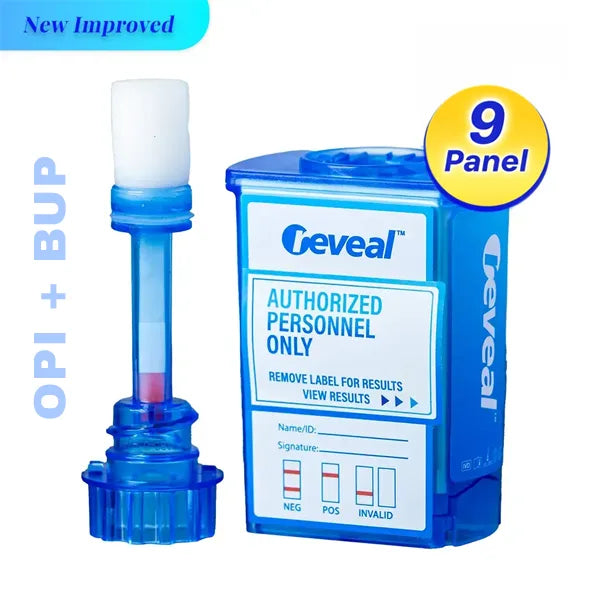
Quick answer: On most oral fluid tests, a colored line in the control region means the test worked, and a colored line in a drug's test region means negative for that drug. No line in the test region is a preliminary positive that must be confirmed by GC/MS or LC-MS/MS testing, per American Screening Corp.
- Control line present + test line present = negative for that drug.
- Control line present + no test line = preliminary positive; send for laboratory confirmation.
- No control line = invalid; discard the device and retest with a new one.
What do the colors on an oral tox test mean?
Most oral fluid screens are lateral-flow immunoassays. Saliva moves along a strip, and colored lines appear where antibodies capture dye-labeled particles. The lines are read in two regions: control (C) and test (T).
Need drug tests for your clinic, program or workplace?
American Screening Corp has supplied FDA-cleared, CLIA-waived tests at wholesale pricing since 2004. Popular options:
Ordering 100+ tests? Request volume pricing.
The control line proves the sample flowed and the reagents worked. The test line works in reverse of what many people expect: a line means the drug was not detected above the cutoff, and a missing line means it may be present.
Line color varies by device (often pink, burgundy or red). The color is not the result. Presence or absence of a line in the correct region is. Always follow the manufacturer's instructions for use for your exact device.
How do you read each result?
| Pattern | Result | Action |
|---|---|---|
| Control line + test line (any shade) | Negative for that drug | Record the result and the read time. |
| Control line, no test line | Preliminary positive | Do not act on it alone. Confirm by GC/MS or LC-MS/MS laboratory testing. |
| Faint test line | Treat as negative if visible, per the device instructions | Read in good light within the stated window. |
| No control line | Invalid | Discard and retest with a new device. |
Each drug on a multi-panel device has its own test line. A person can be negative on five drugs and preliminary positive on one, so read every line separately.
Which cutoff levels sit behind the lines?
A test line disappears only when the drug in saliva is at or above the device's cutoff concentration. For federal programs, the HHS Mandatory Guidelines for oral fluid set initial test cutoffs such as 4 ng/mL for marijuana (THC), 15 ng/mL for cocaine metabolite, 30 ng/mL for opiates such as codeine and morphine, 3 ng/mL for 6-acetylmorphine, 3 ng/mL for PCP and 25 ng/mL for amphetamines (SAMHSA, HHS Mandatory Guidelines for Federal Workplace Drug Testing Programs Using Oral Fluid).
Commercial devices may use different cutoffs. Confirm the cutoff printed on your product insert before you write a policy around it.
How long can oral fluid tests detect drugs?
Oral fluid reflects recent use. Detection generally runs from shortly after use to about one to two days, depending on the drug, dose and individual. That is shorter than urine for most substances, which is why oral fluid suits post-incident, reasonable-suspicion and observed-collection settings.
Why do reading errors happen?
Most disputed results trace back to process, not chemistry. Common causes we see in buyer support questions:
- Reading before or after the stated time window.
- Eating, drinking, smoking or chewing gum just before collection, which can dilute or contaminate the sample.
- Poor lighting that hides a faint line.
- Insufficient saliva volume, which can produce an invalid result.
- Different staff applying different rules for faint lines.
Checklist for consistent oral fluid testing
- Confirm the device's FDA and CLIA status in the product record before use.
- Observe the donor for the waiting period stated in the instructions.
- Collect the sample as directed and start the timer immediately.
- Read within the stated window, in good light, by a trained person.
- Photograph or record the result with date, time and reader initials.
- Treat every non-negative as preliminary and send the specimen for GC/MS or LC-MS/MS confirmation.
- Write a faint-line rule into your policy and apply it the same way every time.
Oral fluid or urine: which fits your program?
Oral fluid is observed easily and is hard to adulterate. Urine offers a longer window and broader panel choices. Many programs use both. Compare formats such as our drug test cups with oral fluid devices, and contact American Screening Corp for wholesale quantities, private label and lab confirmation options.
Regulated transportation testing follows different rules. DOT-regulated employers must use the procedures in 49 CFR Part 40 and cannot substitute an instant screen for a DOT collection. If you also screen candidates before hire, our sister division Reveal Background handles employment background checks.
Frequently asked questions
Does a line on an oral tox test mean positive?
No. A line in the test region means no drug was detected above the cutoff for that drug. A missing test line is a preliminary positive that requires laboratory confirmation.
What does it mean if only the control line shows?
The test is valid and the result is preliminary positive for every drug whose test line is missing. Send the specimen for GC/MS or LC-MS/MS confirmation before taking action.
What if no lines appear at all?
The result is invalid because the control line did not form. Discard the device and retest with a new one, following the collection instructions.
Does the color of the line matter?
No. Pink, red or burgundy lines all count. What matters is whether a line is present in the correct region at the correct read time.
Sources
- SAMHSA, Workplace Drug Testing and Mandatory Guidelines
- eCFR, 49 CFR Part 40, Procedures for Transportation Workplace Drug and Alcohol Testing Programs
- FDA, Drugs of Abuse Tests
This article is general information, not legal or medical advice.