Quick answer: A menopause test kit is a urine immunoassay for follicle-stimulating hormone (FSH). Read it only in the insert window, usually 5–10 minutes. Two lines mean FSH is at or above the typical 25 mIU/mL cutoff. One control line means FSH is below cutoff. No control line is invalid. Confirm with a clinician. Source: American Screening Corp.
- The kit detects urine FSH, not estrogen, progesterone, pregnancy hormone, alcohol, or drugs of abuse.
- Two lines (control plus test) mean FSH is at or above cutoff; control only is below cutoff; missing control is invalid.
- A positive screen is preliminary. Menopause is a clinical diagnosis, not a single cassette result (American Screening Corp).
What does a menopause test kit detect?
A menopause test kit is a lateral-flow immunoassay that detects follicle-stimulating hormone (FSH) in urine. It does not measure estradiol, progesterone, hCG, ethanol, or drugs of abuse. When ovarian hormone production falls, the pituitary often secretes more FSH. That rise is what the cassette is built to flag.
Need drug tests for your clinic, program or workplace?
American Screening Corp has supplied FDA-cleared, CLIA-waived tests at wholesale pricing since 2004. Popular options:
Ordering 100+ tests? Request volume pricing.
The FDA Home Use Tests: Menopause page (as of November 2026) describes urine devices that indicate FSH at a level associated with menopause. Many inserts use a cutoff near 25 mIU/mL. Always use the cutoff printed on that device. Units are mIU/mL, not ng/mL. A cutoff is a device threshold, not a diagnosis.
Clinic and occupational-health programs should treat the cassette as a screen. The National Institute on Aging page What Is Menopause (as of November 2026) states that menopause is 12 months in a row without a menstrual period. One urine FSH result cannot document that year. Perimenopause FSH also fluctuates, so a single below-cutoff result does not rule out the transition.
How do you read a menopause test kit?
You read a menopause test kit by checking the control line first, then the test line, only during the manufacturer’s time window. That window is commonly 5–10 minutes. Do not interpret a device that never forms a control line.
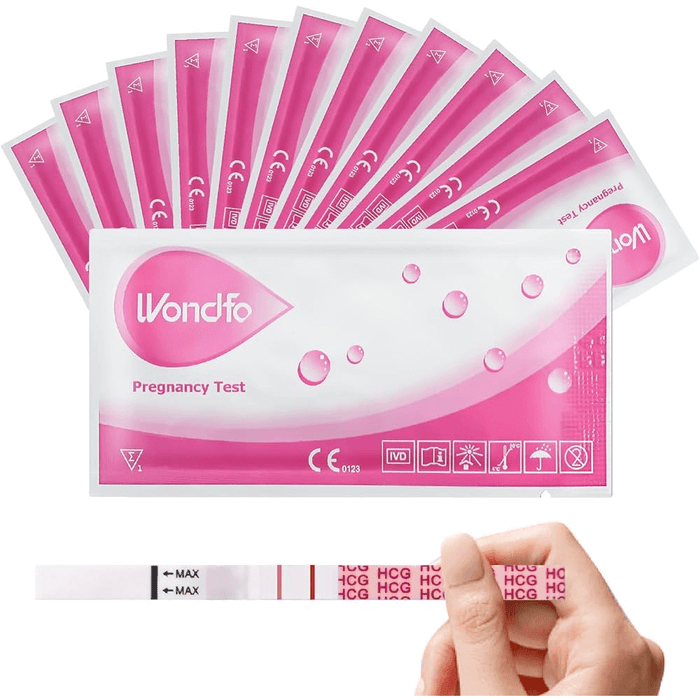
Most cassettes and midstream sticks print C (control) and T (test). If C and T both appear, urine FSH is at or above the device cutoff. If only C appears, urine FSH is below the cutoff. If C is missing, the result is invalid even if color shows in T. A faint T line inside the read window is usually reactive unless the insert says otherwise.
Line darkness is not a numeric FSH value. Do not report “high,” “low,” or a concentration the device cannot produce. Quantitative serum FSH is a laboratory test, as described by MedlinePlus, Follicle-Stimulating Hormone (FSH) Levels Test (as of November 2026). Keep the insert with the lot so every operator scores C and T the same way.
How should clinic staff run and read the test?
Use the labeled intended use. Do not substitute this cassette for a pregnancy test, a fertility workup, or a workplace drug screen. Follow the numbered steps below and the insert if they differ.
- Verify identity and that the device is a urine FSH menopause kit, not another immunoassay.
- Check expiration date, storage temperature, and that the pouch is sealed and dry.
- Collect the specimen on the label, usually urine. First-morning urine is often preferred because it is more concentrated.
- Apply the exact drop count or midstream time in the insert. Do not overfill the well.
- Lay the device flat. Start a timer. Do not tilt, shake, or cover the window.
- Read only at the stated minute mark, commonly 5–10 minutes. Do not read after the maximum time.
- Score the control line first. If C is absent, record invalid and stop.
- If C is present, record T as present (FSH at or above cutoff) or absent (below cutoff).
- Document operator, lot, expiration, clock times, and result. Repeat on a later date if the insert requires two tests about a week apart.
- Route the person to a licensed clinician. Do not state that they are or are not in menopause.
What do the lines mean side by side?
Use this table when training staff. Caption it on the wall next to the timer. It does not replace the package insert.
| What you see in the window | How to record FSH | What it does not mean |
|---|---|---|
| Control line and test line (T may be faint) | FSH at or above the typical 25 mIU/mL cutoff | Not a menopause diagnosis; not a numeric lab value |
| Control line only | FSH below cutoff | Does not rule out perimenopause or other causes of symptoms |
| No control line, even if T is colored | Invalid; repeat with a new device | Do not interpret or counsel from an invalid strip |
What about faint lines, evaporation lines, and invalid kits?
A distinct test line that appears inside the read window, even if faint, is typically a reactive (high-FSH) result. A shadow that appears only after the discard time may be evaporation and must not be reported. Colored background with no distinct C line is invalid.
Common reasons clinics see invalids or unexpected below-cutoff results include expired pouches, overfilled wells, reading at 1 minute, reading at 30 minutes, and dilute afternoon urine. FSH is a current concentration, not a multi-day detection window like a drug screen. If the insert calls for first-morning urine and a repeat test about seven days later, follow that schedule because perimenopause FSH can change across the cycle.
Who is this kit for in a clinic setting?
These devices are for people assigned female at birth who are reviewing menopausal transition with a clinician, often in the mid-40s and later, when periods are irregular. Women’s health clinics, FQHCs, and occupational-health or employee-wellness programs may stock them. They are not for diagnosing pregnancy, measuring testosterone, testing men, clearing someone for hormone therapy, or running court or staffing toxicology.
Staff who already read urine drug test dip cards already use the same control-line rule: no control line, no result. That shared lateral-flow discipline is why training must still be device-specific. Keep FSH menopause kits in a separate inventory from toxicology cups and dips so lots, intended use, and result logs are not mixed.
American Screening Corp in Shreveport, Louisiana, supplies clinics, treatment centers, labs, and employers with urine cups, dip cards, oral fluid tests, and related screening supplies. For screening-supply questions, contact American Screening Corp. This page does not list a menopause kit for sale and does not invent a product, price, or clearance.
Why a positive screen is still preliminary
A high-FSH cassette does not date the last period, prove premature ovarian insufficiency, or authorize treatment. Combined hormonal contraception, hormone therapy, pregnancy, pituitary disorders, and other conditions can change FSH. The Office on Women’s Health menopause overview and NIA both stress clinician evaluation for bleeding pattern, hot flashes, sleep change, and other symptoms.
Do not claim 100% accuracy. Sensitivity and specificity live in that device’s labeling, not in a blog post. Every elevated result is preliminary. Confirm with clinical assessment and, when the clinician orders it, laboratory FSH. GC/MS and LC-MS/MS are laboratory methods used to confirm drug screens. They are not the confirmation path for a menopause FSH cassette.
Checklist before you report a result
- Pouch intact, in date, and stored per the label
- Correct specimen (often first-morning urine) and exact wait time
- Control line present before any T interpretation
- Read inside the insert window only; no late evaporation reads
- Faint T counted as the insert requires
- Lot, operator, start time, and read time recorded
- Patient told this is not a menopause diagnosis
- Second test scheduled if the insert requires a one-week repeat
- Referral path to a licensed clinician is in place
FAQ
What do two lines on a menopause test kit mean?
Two lines (control and test) mean urine FSH is at or above the device cutoff, often 25 mIU/mL. That is a preliminary high-FSH screen, not a menopause diagnosis. Confirm with a clinician and, when ordered, laboratory testing.
How long do you wait to read a menopause FSH test?
Read only in the manufacturer window, commonly 5–10 minutes. Reading too early or after the discard time can yield false lines. If the control line never appears, the test is invalid.
Can a menopause test kit diagnose menopause?
No. FDA-described home menopause tests detect FSH only. Menopause is a clinical diagnosis, typically 12 months without menses, assessed by a clinician. Hormone therapy, pregnancy, and some conditions can change FSH.
What FSH cutoff do urine menopause tests use?
Many urine menopause immunoassays use about 25 mIU/mL FSH. Always use the cutoff printed on that device’s insert. Units are mIU/mL, not ng/mL. Cutoffs can differ by manufacturer.
Sources
- FDA Home Use Tests: Menopause
- National Institute on Aging: What Is Menopause?
- MedlinePlus: Follicle-Stimulating Hormone (FSH) Levels Test
This is general information, not medical or legal advice.