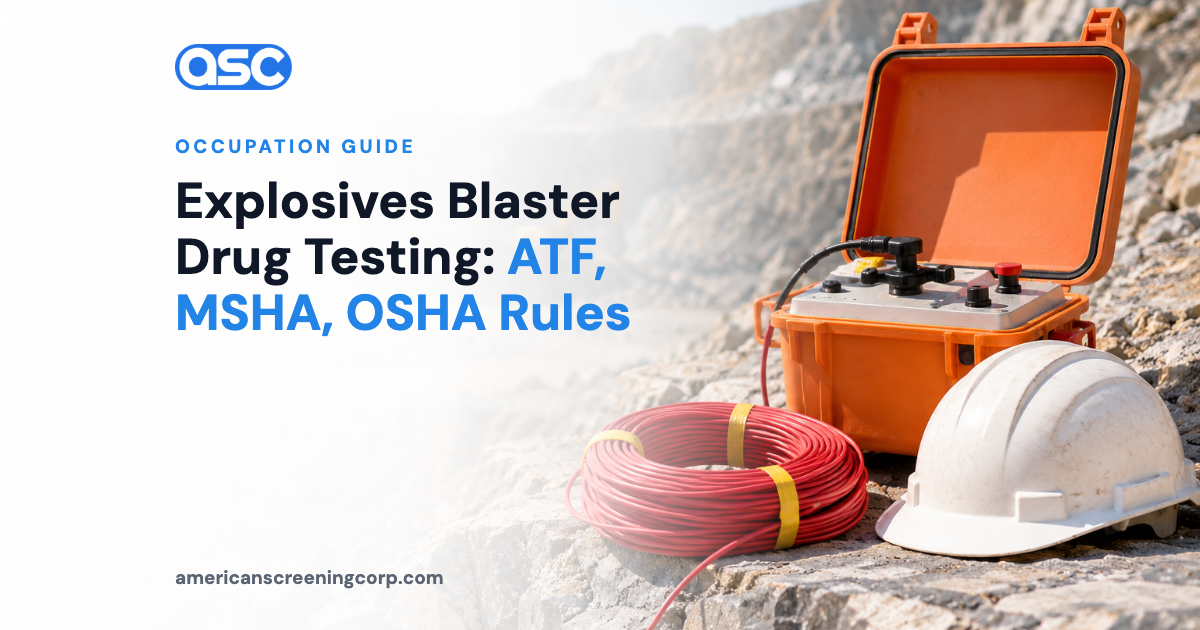
A licensed explosives blaster might work a surface coal mine, a highway rock cut, a demolition site, or a pipeline right of way, and the rules that reach that job change depending on where the work happens and who is paying the crew. There is no single federal law that requires drug testing for every person who handles explosives. Instead, a blaster's employer usually has to stack several narrower federal rules on top of each other, and in many cases add a state blaster license and its own conditions. Getting this wrong in either direction, assuming a federal testing mandate that does not exist or skipping a rule that does apply, creates real exposure for a quarry operator or a demolition contractor. This article walks through the layers one at a time: the federal explosives license, the mine safety standards, the surface coal certification program, the construction blasting standard, and the trucking rule that kicks in when a blaster also drives.
The Federal Explosives License and Who Cannot Hold One
Anyone who manufactures, imports, deals in, or uses explosive materials in interstate commerce generally needs a federal license or permit from the Bureau of Alcohol, Tobacco, Firearms and Explosives. The regulations governing that licensing system sit in 27 CFR Part 555, and that part lists the categories of people who are barred from receiving, possessing, transporting, shipping, or distributing explosive materials. One of those categories is a person who is an unlawful user of, or addicted to, a controlled substance. That is a possession and licensing restriction tied to federal explosives law, not a workplace drug testing mandate, and it applies whether or not the person's employer runs any testing program at all. A blasting company still needs its own written policy to decide how it screens employees before it lets them touch licensed material, because the federal explosives license rule tells an employer who legally cannot be in that role, not how to verify it day to day.
MSHA Rules at the Mine Site
When blasting happens at a site that the Mine Safety and Health Administration regulates, a different set of standards applies. Metal and nonmetal mines fall under 30 CFR Part 56, and underground metal and nonmetal mines fall under 30 CFR Part 57. Both parts prohibit intoxicating beverages and narcotics at the mine and bar anyone under the influence from working. That is a conduct standard, and it gives mine operators a clear basis to remove an impaired person from a blasting crew, but it does not spell out a required test panel, a testing frequency, or a federal drug testing program the way the Department of Transportation rules do for transportation workers. A coal or metal mine operator that wants pre-employment, random, or post incident testing has to build that program itself, using MSHA's conduct rule as the floor and its own policy to fill in the testing mechanics. MSHA's training and education resources cover hazard recognition and certification topics but do not publish a federally mandated drug test panel for blasting crews.
OSMRE Blaster Certification for Surface Coal Mining
Surface coal mining and reclamation work runs through a separate federal office, the Office of Surface Mining Reclamation and Enforcement, under authority that includes blaster certification standards found in 30 CFR Part 850. States with approved regulatory programs administer their own certification exams built around that federal framework, and a person generally cannot act as a certified blaster on a surface coal site without passing the applicable state exam. Certification under Part 850 tests competency in explosives handling, blast design, and safety procedure. It is not a drug testing requirement, and nothing in the certification framework substitutes for an employer's own fitness for duty policy. Some state certifying authorities attach their own conduct or substance conditions to holding the certificate, so a surface coal operator should confirm the specific state program's requirements rather than assume Part 850 covers that ground.
OSHA Rules for Blasting on Construction Sites
Construction blasting, including the kind used for highway rock removal, foundation work, and controlled demolition, falls under the Occupational Safety and Health Administration's construction standards. 29 CFR 1926 Subpart U sets requirements for the transportation, storage, handling, and use of explosives and blasting agents on a job site, covering things like magazine distances, loading procedures, and misfire handling. Subpart U does not establish a required drug test panel either. A general contractor or demolition firm that wants a testing program for its blasting crew is relying on its own safety management decisions and, where the general duty clause applies, a defensible basis for removing an impaired worker from a high consequence task. Employers in this position often build their construction industry testing program around a documented policy that names the triggers for testing, the panel used, and the chain of custody steps, since OSHA's standard focuses on the explosives handling itself rather than the screening mechanics around the crew.
When FMCSA Part 382 Adds a Layer
A blaster's job frequently overlaps with driving. Transporting placarded quantities of explosives, or simply holding a commercial driver's license and performing safety sensitive driving functions for the employer, can bring a person under the Federal Motor Carrier Safety Administration's testing rule at 49 CFR Part 382. That rule is the one federal program in this list that actually mandates drug and alcohol testing on a defined schedule: pre-employment, random at a federally set minimum rate, reasonable suspicion, post accident, return to duty, and follow-up, all tracked through the FMCSA Drug and Alcohol Clearinghouse. A quarry that has its own commercial fleet moving explosives between sites should treat its CDL holding blasters under the DOT transportation testing program for that part of their job, even if the rest of the crew that never drives is not covered by Part 382 at all. Mixing DOT covered and non covered employees under one blanket policy without naming which rule applies to which role is a common compliance gap.
State Blaster Licenses Add Their Own Conditions
Most states that allow commercial blasting require a separate state blaster license on top of the federal explosives license, and licensing boards vary widely in what they ask for. Some state programs fold in a fitness for duty attestation or a substance related disqualification; others leave that entirely to the employer. Because these requirements differ by state and change over time, an employer should check its own state's explosives or mining licensing board directly rather than assume any one state's rule applies elsewhere. The federal layers above set a floor; they do not promise that a state board has not added more.
Building a Defensible Employer Program
Because no single rule covers a blasting crew end to end, the practical approach for a quarry, demolition contractor, or pipeline blasting outfit is to write a policy that names which federal and state rules apply to which roles, then builds testing around that map. A pre-employment screen using a broad 12 panel drug test cup is a common starting point for crews that are not DOT covered, since it is not limited to the narrower DOT panel and can be set by employer policy. Because MSHA's standard specifically names intoxicating beverages alongside narcotics, a mine operator's program often includes an alcohol test alongside the drug panel rather than drug screening alone. For federally regulated contractors working on government sites, a federal agency drug testing kit lineup can help keep documentation aligned with contract requirements. Post blast incident testing deserves its own written trigger: the policy should state what counts as a reportable incident, who orders the test, how quickly the specimen is collected, and that any positive result goes through a medical review officer before the employer takes action, rather than being read directly off a rapid result. For remote blast sites without easy access to a collection facility, a dip card is easier to carry and store than a bulk cup supply, though the chain of custody and documentation steps still have to match whatever rule is driving the test.
| Rule or authority | Who it reaches | What it actually requires | Sets a federal drug testing mandate |
|---|---|---|---|
| 27 CFR Part 555 (ATF) | Anyone licensed to possess or use explosive materials | Bars unlawful controlled substance users from holding a license or possessing explosives | No, a possession restriction, not a testing program |
| 30 CFR Parts 56 and 57 (MSHA) | Workers at metal, nonmetal, and underground mines | Prohibits intoxicating beverages and narcotics at the mine site | No, a conduct standard only |
| 30 CFR Part 850 (OSMRE) | Certified blasters on surface coal operations | Sets blaster certification competency standards administered through state programs | No, a competency certification, not drug testing |
| 29 CFR 1926 Subpart U (OSHA) | Construction sites using explosives and blasting agents | Governs transport, storage, handling, and use of explosives on site | No, a handling and storage standard |
| 49 CFR Part 382 (FMCSA) | CDL holders performing safety sensitive driving duties | Requires pre-employment, random, reasonable suspicion, post accident, and return to duty testing | Yes, the only mandatory testing schedule in this group |
| State blaster license | Varies by state | Varies, some states add fitness for duty or substance conditions | Varies, check the state board directly |
Documentation matters as much as the testing itself. An employer that can point to a written policy naming the applicable rule for each role, the panel used, the collection method, and the MRO review step is in a far stronger position if a blast related incident is ever reviewed than one that tested a crew member without being able to explain which standard required it. Supervisors who make the call to pull a worker off a blasting crew for suspected impairment should have documented reasonable suspicion training, and that observation should be recorded the same day, before any test is requested.
Frequently asked questions
Does federal law require drug testing for every explosives blaster?
No single federal law mandates drug testing across the board for blasters. ATF licensing rules, MSHA conduct standards, OSMRE certification, and OSHA's construction blasting standard each address a different piece of the job, and only the FMCSA rule at 49 CFR Part 382 sets an actual testing schedule, and it only applies to blasters who also drive in a covered commercial role.
What federal rule keeps a drug user from holding explosives?
27 CFR Part 555 lists an unlawful user of or person addicted to a controlled substance among the categories barred from receiving, possessing, or distributing explosive materials under a federal license. That is a possession eligibility rule rather than a workplace testing program.
Does MSHA require a specific drug test panel at mine sites?
MSHA's standards at 30 CFR Parts 56 and 57 prohibit intoxicating beverages and narcotics at the mine and allow removal of an impaired worker, but they do not name a required panel, cutoff, or testing frequency. Mine operators build their own testing program on top of that conduct rule.
When does a DOT drug test apply to a blasting crew?
It applies to the members of the crew who hold a commercial driver's license and perform safety sensitive driving duties for the employer, such as transporting placarded explosives loads, under 49 CFR Part 382. Crew members who never drive in that capacity are generally not covered by this rule.
Can a state blaster license add its own drug testing condition?
Yes, this varies by state. Some state explosives or mining boards attach fitness for duty or substance related conditions to the blaster license, while others leave testing entirely to the employer. Check the specific state licensing board rather than assuming one state's rule applies elsewhere.
What specimen type works best for post blast incident testing at a remote site?
A dip card is often easier to transport and store at a remote quarry or pipeline site than a bulk supply of collection cups, though the chain of custody steps and documentation still need to match whichever rule, state license condition, or employer policy actually triggered the test.
Related reading: Mining Drug Testing Requirements: What MSHA Rules Say and How Mines Build a Program and Construction Industry Drug Testing: Building a Program That Holds Up on Site cover related ground for mine and construction employers building a policy around these same federal layers.
This article is general information for employers and program administrators, not legal advice. Consult qualified counsel and the primary federal and state sources cited above before adopting or changing a drug testing policy for explosives personnel.