
Anyone ordering testing supplies for a mine site hears a common question from safety managers: where is the federal rule that tells us how to drug test our crew? The honest answer is that there is no single federal testing mandate written for mining the way there is for trucking. The Mine Safety and Health Administration does not operate a regulation equivalent to the Department of Transportation's 49 CFR Part 40 testing procedures. That gap is exactly why most mine operators end up building their own program, borrowing cutoffs, collection steps, and confirmation rules from the federal model while fitting the formats to a remote, dirty, physically demanding worksite.
This guide lays out what the mining safety standards actually say about alcohol and drugs, what operators typically build on top of that baseline, and how to choose cup, dip card, or oral fluid formats for pre-employment, post-accident, reasonable suspicion, and random testing at a mine.
What MSHA rules actually require
The Federal Mine Safety and Health Act gives MSHA broad authority over health and safety conditions at mines, but the agency has never finalized a comprehensive drug and alcohol testing rule. MSHA proposed one in 2008, titled Alcohol- and Drug-Free Mines: Policy, Prohibitions, Testing, Training, and Assistance, which would have required written policies, testing categories, and training similar to the DOT model. That proposal was never adopted as a final rule, and operators should not assume any part of it is binding today. An earlier advance notice on the same subject, Use of or Impairment From Alcohol and Other Drugs on Mine Property, shows the agency has studied the issue for years without finishing it.
What does exist, and is enforceable, is a possession and impairment prohibition. The standards for metal and nonmetal mines and for surface areas of underground mines state that intoxicating beverages and narcotics, mind altering drugs, or other similar substances are not permitted at mines, and a person under the influence may not work or be permitted to work while in that condition. Read the exact text at 30 CFR 56.20001 and the parallel underground metal and nonmetal standard at 30 CFR 57.20001. Neither section tells an operator how to test, what panel to use, or what cutoff concentration counts as a violation. That part is left to the operator and, in many states, to state mining or workers compensation law, which varies by state. Check the mine safety and workers compensation statutes in the state where the mine operates before writing cutoffs or consequences into policy.
Because MSHA has not finished a testing rule, operators that want a defensible program generally adopt the structure the federal workplace testing system already uses. That means writing a policy that spells out which situations trigger a test, which lab science and cutoffs back up the test, and how a non negative screen gets confirmed before anyone takes action.
The four testing situations mines typically build a policy around
Pre-employment. A screen before a conditional job offer becomes final, usually using a multi panel cup that covers the substances most relevant to the region and job.
Post-accident. A test after an injury, a near miss, or equipment damage, done as close to the event as practical. Many mines are far from a clinic, so a point of care cup or an oral fluid device that a trained collector can use on site is often the practical choice, with a confirmation sample sent to a lab. The same timing and documentation issues that come up in OSHA enforcement of post accident testing policies apply here; see our post accident drug testing guide for how to avoid writing a policy that looks retaliatory.
Reasonable suspicion. A test triggered by specific, documented observations from a trained supervisor, such as slurred speech, odor, or erratic behavior on shift. This category depends entirely on supervisor training and contemporaneous documentation, not on the test format.
Random. A test pulled on an unannounced basis from an eligible pool, usually run on a fixed annual rate the operator sets in policy. Our guide to random testing selection walks through how to build a defensible pool and draw method, which applies whether or not an industry has a federal testing mandate.
Choosing a format for a mine site
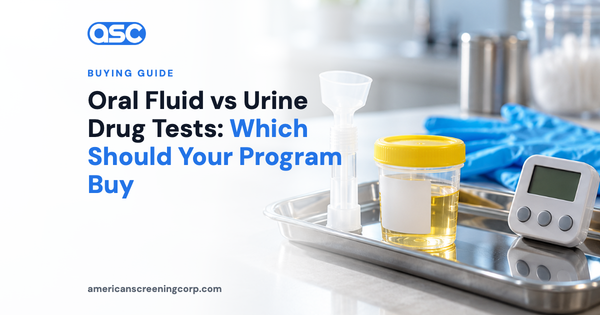
Mine sites complicate collection in ways an office building does not: limited restroom access, dusty or wet conditions, shift workers coming straight off equipment, and sites that may be an hour or more from the nearest lab. The table below lays out how the common product classes compare for mine use.
| Format | Best use at a mine | What to check before ordering | Typical labeling |
|---|---|---|---|
| Multi panel urine cup | Pre-employment, random, scheduled testing with restroom access | Panel count, cutoff concentrations, built in adulterant strips (pH, creatinine, oxidants), read time | CLIA waived for visual, point of care reading when the manufacturer's clearance supports it; forensic use only cups exist and are not for onsite pass or fail reading |
| Dip card | Backup or lower volume testing, clinics processing samples collected elsewhere | Panel configuration, whether adulterant testing is included as a separate strip | Same CLIA waived versus forensic use only distinction as cups; confirm the specific product's FDA clearance before relying on an onsite result |
| Oral fluid device | Post-accident and reasonable suspicion testing in the field, observed collection with no restroom needed | Donor eligibility (recent oral intake can affect results), cutoff levels, whether the device is validated against the federal oral fluid cutoffs | CLIA waived point of care devices exist; always confirm the specific device's current clearance status rather than assuming |
| Lab confirmation (GC/MS or LC/MS) | Confirming any non negative screen before a personnel decision | Turnaround time, chain of custody paperwork, whether the lab reports in a format your MRO process can use | Not a point of care format; this is the step that makes a screening result defensible |
On cutoffs, do not guess. The federal government publishes concentration cutoffs for both urine and oral fluid testing under the HHS mandatory guidelines, most recently the oral fluid mandatory guidelines published in the Federal Register and available through govinfo.gov. Mines are not required to use the federal cutoffs, but most occupational health programs anchor to them because the cutoffs are published, peer reviewed, and already tied to confirmation testing standards. For background on how SAMHSA runs federal workplace testing policy generally, see samhsa.gov/workplace.
CLIA waived versus forensic use only, and why it matters for a mine program
A drug test cup or card cleared for CLIA waived use can be read onsite by a trained non laboratory person as part of a point of care program, under the oversight the Clinical Laboratory Improvement Amendments require. A product labeled forensic use only is built for a different workflow, generally lab processing under controlled conditions, and should not be read onsite as a final pass or fail result. Before buying in bulk, check a given product's clearance status in the FDA's CLIA database search at accessdata.fda.gov, and confirm your clinic or site holds the correct CLIA certificate for the complexity of testing you are running; CMS maintains program information at cms.gov. Never describe a test as approved by FDA. The correct terms are FDA cleared or CLIA waived, and only when that is true for the specific product.
Kratom, novel substances, and the limits of a rapid panel
Mine safety teams increasingly ask about kratom and related compounds. A standard multi panel cup does not detect mitragynine or related kratom alkaloids unless it includes a dedicated KRA strip built for that analyte. Compounds like 7-OH or other emerging analogs are not covered by rapid immunoassay panels at all. If a mine has a specific concern about a substance, the only reliable path is lab confirmation, and the right move is to ask the confirming lab directly which analytes its testing menu covers rather than assuming a rapid panel caught it.
Buying for a mine program
Because collection conditions are harsher than a typical office and testing categories span pre-employment, post-accident, reasonable suspicion, and random draws, most mine safety departments standardize on one cup format with adulterant checks for scheduled testing and keep oral fluid devices on hand for field collection after an incident. Order a reviewable sample of both before committing to a bulk order, and request the product's current CLIA and FDA clearance documentation from the supplier rather than relying on packaging claims alone.
American Screening Corporation's drug test cup collection covers multi panel configurations with built in adulterant strips suited to scheduled mine site testing, and the oral fluid collection covers devices suited to field and post-accident use. Mine operators, staffing firms supplying crews to mines, and occupational health clinics running mine contracts that need recurring bulk orders can set up a business account on the wholesale portal, which supports net terms, purchase order checkout, and one click reordering so a safety department is not re-entering an order from scratch every cycle.
Frequently asked questions
Does MSHA require drug testing at mines?
No. MSHA has proposed testing rules in the past but has not finalized a comprehensive drug and alcohol testing regulation. The enforceable standard prohibits possession and impairment on mine property under 30 CFR 56.20001 and 57.20001; testing programs are built by the operator, often following the federal workplace testing model voluntarily.
What is the actual MSHA rule on alcohol and drugs?
The possession and impairment prohibition in 30 CFR 56.20001 and 57.20001 says intoxicating substances are not permitted at a mine and a person under the influence may not work. It does not set testing procedures, panels, or cutoffs.
Can a mine use DOT cutoffs and procedures even though mining is not a DOT regulated industry?
Yes, operators commonly adopt the federal cutoff concentrations and confirmation steps as a voluntary baseline because they are published and widely recognized, even though DOT's 49 CFR Part 40 legally applies to safety sensitive transportation functions, not general mining.
Is a drug test cup read onsite at a mine legally valid without lab confirmation?
A point of care screen is a preliminary result. Any non negative screen should be sent for laboratory confirmation before an employer makes a personnel decision, and the product used for the onsite read should be CLIA waived for that purpose, not labeled forensic use only.
Which test format works best for post-accident testing at a remote mine site?
Many operators use oral fluid collection for post-accident situations because it does not require a restroom and can be done quickly under observation in the field, followed by lab confirmation. Urine cups remain common where restroom access and timing allow.
Do state laws add drug testing requirements for mines?
State mining safety law and workers compensation law can add requirements or incentives around testing, and these vary by state. Check the specific state's mining and workers compensation statutes before finalizing a policy.
This article is general information about mining safety and drug testing rules, not legal advice. Mine operators should consult qualified counsel and the applicable state and federal statutes before adopting or changing a testing policy.