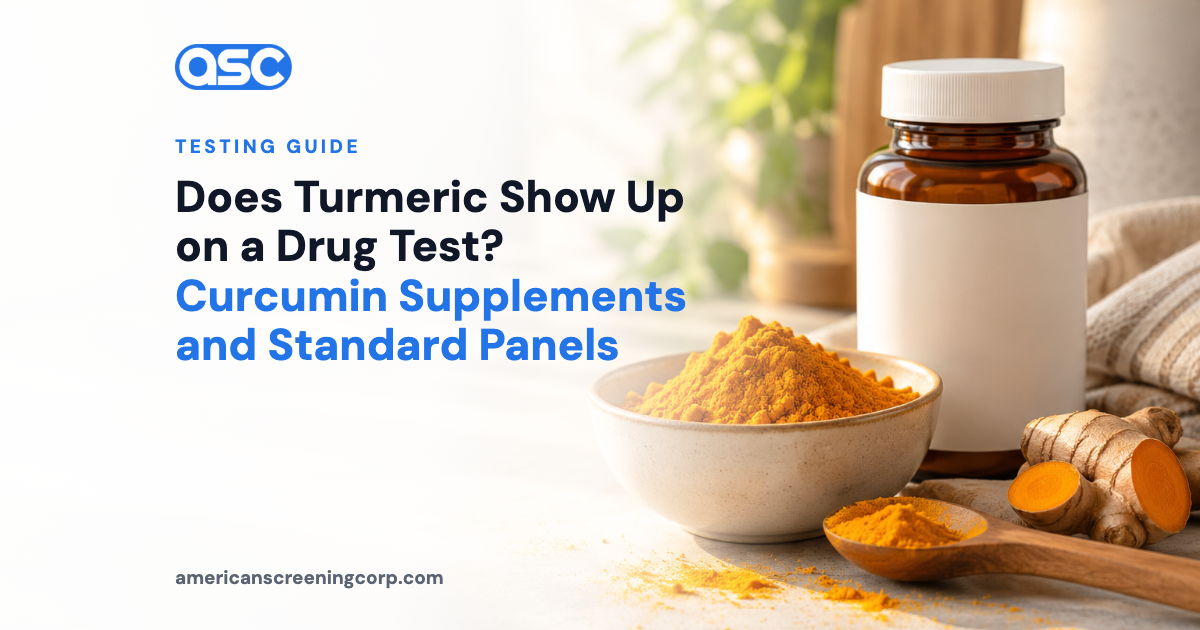
Turmeric is a spice and dietary supplement, not a controlled substance, and it is not a target analyte on any standard workplace or clinical drug test panel. The active compound in turmeric, curcumin, has no documented cross reactivity with the immunoassay screens used for THC, opiates, amphetamines, cocaine metabolite, PCP, or benzodiazepines in the published literature available through the National Institutes of Health. Employees and applicants sometimes ask about turmeric because supplement use is common and because online forums repeat the claim that "natural" products can trigger a false positive. For turmeric specifically, that claim is not supported by the evidence.
What a standard drug test panel actually screens for
A workplace drug test cup, dip card, or oral fluid device uses an immunoassay to screen a specimen for a defined set of drug classes, commonly THC, cocaine metabolite, opiates, amphetamines and methamphetamine, PCP, and sometimes benzodiazepines, barbiturates, or synthetic opioids depending on the panel configuration. The immunoassay is a presumptive screen. It works by detecting whether a compound binds to an antibody tuned to a specific drug class, and antibodies can sometimes bind to structurally similar molecules that are not the targeted drug, which is how a false positive from cross reactivity happens with certain decongestants, NSAIDs, or other medications. Turmeric and curcumin are not chemically related to any of the drug classes on a standard panel, so there is no structural basis for the antibody to cross react with them.
Any nonnegative immunoassay screen is confirmed, not finalized, at the point of the first test. A presumptive positive on a federally regulated test is sent to a certified laboratory for confirmation by gas chromatography mass spectrometry (GC/MS) or liquid chromatography tandem mass spectrometry (LC/MS/MS). These confirmation methods identify the exact molecule present rather than a broad chemical class, which is the step that would catch a false positive from an unrelated substance if one ever occurred.
What the research says about curcumin and drug metabolism
Curcumin, the primary bioactive compound in turmeric, has been studied for its effects on liver enzymes and for potential interactions with some prescription medications, documented in the NIH Bookshelf LiverTox entry on curcumin. That entry describes curcumin's pharmacology and documented hepatic effects at high supplement doses, but it does not describe any cross reactivity with drug test immunoassays. The National Center for Complementary and Integrative Health (NCCIH), part of NIH, publishes a consumer and clinician reference on turmeric that covers its studied uses, safety profile, and known drug interactions, and it likewise does not list drug test interference among turmeric's documented effects. Based on currently published literature, there is no credible cross reactivity evidence connecting curcumin or turmeric to a false positive on any standard screening panel.
That is a different statement from saying turmeric has zero effect on the body. High dose curcumin supplements, as distinct from culinary turmeric used in cooking, have been associated in case reports with liver enzyme changes and with interactions affecting how the body processes certain drugs, which is why anyone taking prescription medication should mention supplement use to a prescriber or pharmacist. That conversation is a medical safety issue, separate from drug test screening.
Dietary supplement labeling and contamination risk
Turmeric and curcumin products sold in the United States are regulated as dietary supplements, not as drugs, under the framework the Food and Drug Administration describes on its dietary supplements pages. Under that framework, supplement manufacturers are responsible for ensuring their products are safe and labeled accurately, but the FDA does not approve dietary supplements for safety or effectiveness before they reach the market the way it approves drugs. The FDA maintains a reference on specific ingredients, including botanicals, at its dietary supplement ingredients page.
The practical risk with any turmeric supplement is not the turmeric itself, it is what else might be in the bottle. Independent testing and FDA enforcement actions over the years have found some imported turmeric and other spice or supplement products adulterated with substances not listed on the label, including heavy metals or undisclosed fillers. A product that is mislabeled or blended with an undisclosed ingredient could theoretically introduce something that behaves differently than pure turmeric, which is one more reason a nonnegative screening result is never treated as final. If an employee reports turmeric use and a screen comes back nonnegative, the right move is documentation and laboratory confirmation, not an assumption in either direction.
Comparison: turmeric versus substances with real cross reactivity concerns
| Substance | Documented cross reactivity with standard panels | What to do if reported |
|---|---|---|
| Turmeric or curcumin supplement | No credible evidence in published NIH sources | Note it in the donor history; confirmation testing resolves any nonnegative result |
| Poppy seed food products | Documented opiate screen elevation at high consumption | MRO reviews timing and quantity against confirmation levels |
| Certain NSAIDs or decongestants | Documented immunoassay cross reactivity with some panels | MRO reviews prescription or OTC use against the confirmed result |
| Prescribed controlled substances | Expected to confirm positive for the prescribed drug class | Valid prescription documentation reviewed by the MRO |
The medical review officer process
For any regulated or employer drug testing program that uses a medical review officer, a nonnegative laboratory confirmation is reviewed before it is reported to the employer as positive. The MRO contacts the donor, reviews any medications or supplements disclosed, and evaluates whether a legitimate medical explanation accounts for the confirmed result. This process, along with the specimen collection, confirmation, and reporting procedures used in federally regulated testing, is set out in 49 CFR Part 40. A turmeric supplement would not produce a confirmed positive for THC, opiates, amphetamines, or any other panel drug in the first place, since confirmation testing identifies the specific molecule rather than a broad class, but disclosing any supplement or medication use to the MRO is still good practice for any employee asked to test.
The Substance Abuse and Mental Health Services Administration (SAMHSA) oversees the federal workplace drug testing guidelines that many non-DOT programs voluntarily model their collection and MRO procedures on. Employers building or updating a testing program should rely on these federal frameworks and on their MRO's clinical judgment rather than on anecdotal claims about specific foods or supplements.
What employers and employees should take away
If an employee mentions turmeric, curcumin, golden milk, or a turmeric supplement before or during a drug test, there is no basis in the published science to flag it as a testing risk. Employers should still document any disclosed medication or supplement use as a matter of routine practice, since that information helps the MRO move quickly if a different, unrelated issue arises with the result. Employees who take any supplement regularly, including turmeric, should mention it to their healthcare provider given the documented liver enzyme and drug interaction considerations at high doses, independent of any drug testing question.
American Screening Corporation supplies the cups, dip cards, and oral fluid devices many employers use for the initial screening step, along with lab confirmation services for any nonnegative result, available through the drug test cup collection. Pairing a reliable screening device with a confirmation pathway and an MRO review is what actually resolves questions like this one, rather than guessing based on what a supplement bottle happens to contain.
Frequently asked questions
Does turmeric or curcumin cause a false positive on a drug test?
No credible evidence in the published NIH literature links turmeric or curcumin to cross reactivity on any standard immunoassay panel for THC, opiates, amphetamines, cocaine metabolite, PCP, or benzodiazepines.
Is turmeric tested for on a drug test panel?
No. Turmeric and curcumin are not controlled substances and are not target analytes on any standard workplace, clinical, or DOT drug test panel.
Can taking a turmeric supplement affect a drug test result?
Based on current published research, there is no documented interference with screening or confirmation testing. High dose curcumin supplements have documented liver enzyme and drug interaction effects unrelated to drug testing, which is a reason to disclose supplement use to a healthcare provider.
What should an employee do if they take turmeric before a scheduled drug test?
There is no need to stop taking it for testing purposes based on current evidence. Disclosing any supplement or medication use to the collector or medical review officer is still good practice.
How does lab confirmation testing handle an unexpected drug test result?
Any nonnegative immunoassay screen is sent to a certified laboratory for confirmation by GC/MS or LC/MS/MS, which identifies the specific molecule present, and a medical review officer reviews the confirmed result against any disclosed medications or supplements before it is reported to the employer.
Are dietary supplements like turmeric regulated the same way as prescription drugs?
No. The FDA regulates dietary supplements under a different framework than drugs, and supplements are not approved for safety or effectiveness before sale the way prescription drugs are.
This article is general information, not medical or legal advice. Employers and employees should consult a qualified medical review officer, healthcare provider, or legal counsel for guidance specific to their situation.