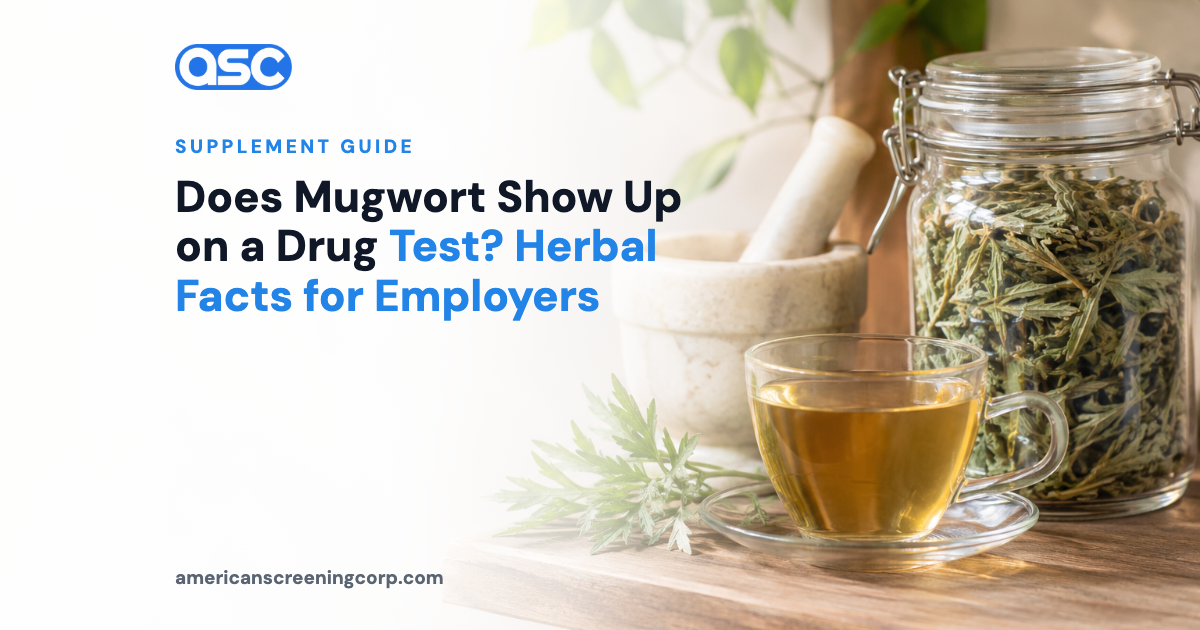
Mugwort, botanically Artemisia vulgaris, is a common garden and roadside plant used for centuries in teas, culinary seasoning, smoking blends, and topical folk preparations. It shows up in herbal shops, tea blends, and some smoking mixtures sold as tobacco alternatives. Employers and collectors sometimes ask whether an employee who drinks mugwort tea or uses an herbal smoking blend could trigger an unexpected result on a workplace drug screen. The short answer is no. Mugwort is not a controlled substance, it is not a target analyte on any standard immunoassay panel, and no credible pharmacology links it to a false positive for THC, opiates, amphetamines, or any other drug class covered by a typical cup, dip card, or oral fluid device.
That said, the herb is not risk free from a workplace testing standpoint. The real concern sits one step away from mugwort itself: herbal smoking blends and "herbal incense" products marketed as legal alternatives sometimes use mugwort, damiana, or other plant material as a carrier leaf that is then sprayed with synthetic cannabinoids. The plant is inert for testing purposes. What a lab or panel actually needs to catch is whatever was added to it. This article walks through what mugwort is, why it is not controlled, what a drug test panel can and cannot see, the thujone issue that sometimes comes up in herb discussions, and how employers should think about program design when an herbal blend is involved.
What Is Mugwort and Why Does It Come Up in Drug Testing Questions
Mugwort is a perennial plant in the Artemisia genus, related to wormwood. It has a long history of traditional use for digestive complaints, menstrual discomfort, and as a moxibustion herb in East Asian practice, and it is marketed today in teas and topical products. The National Center for Complementary and Integrative Health notes that very little clinical research exists on mugwort in people, that there is not enough evidence to establish its safety taken orally or applied to skin, and that it should not be used during pregnancy. None of that research or caution relates to drug testing. Mugwort has no documented pharmacological overlap with the substances that workplace and clinical panels are built to detect.
The reason the question comes up at all is packaging and context. Mugwort is sold loose, in tea bags, and as a component of smoking blends marketed under names that sound similar to cannabis products. A collector who sees a bag labeled "herbal smoking blend" in an employee's bag or car has no way to know from the label alone whether the contents are plain mugwort, a mugwort and damiana mix, or a blend someone has sprayed with a synthetic cannabinoid. That ambiguity, not any property of mugwort itself, is what drives the real workplace risk.
Is Mugwort a Controlled Substance
No. Mugwort is not scheduled under the federal Controlled Substances Act. The current federal schedules, maintained in the Code of Federal Regulations, list the specific plants, chemical classes, and cannabinoid analogs that are controlled, and Schedule I at 21 CFR 1308.11 does not include Artemisia vulgaris or mugwort by any name. For contrast, that same schedule is where marijuana, synthetic cannabinoid compounds, and other hallucinogenic substances are formally listed, which is useful context when an employer is trying to understand why a plain herb is legal to sell and possess while a sprayed or synthetic version of a similar-looking product may not be.
There is one regulatory note worth knowing, mostly because it occasionally gets mixed up with the drug testing question. Mugwort and its relative wormwood contain thujone, a compound that in high concentrations has its own toxicity profile and that food regulators have historically restricted. Under FDA food additive regulations at 21 CFR 172.510, Artemisia species used as natural flavoring in food must be thujone free. That rule is about food safety and flavoring additives, not about drug testing, and it has no bearing on whether a workplace panel will flag mugwort. It simply explains why thujone content is the one regulatory flag connected to this plant at all.
Does a Standard Drug Test Panel Detect Mugwort
No. Immunoassay strips, whether built into a cup, a dip card, or an oral fluid device, work by targeting specific drug classes and their metabolites with antibodies tuned to those molecules. A 5 panel or 10 panel screen is built to flag THC metabolite, amphetamines, cocaine metabolite, opiates, and PCP, among other classes depending on the configuration. Mugwort's chemical constituents, including thujone, are not chemically similar to any of those target analytes, and there is no published cross reactivity data showing mugwort triggers a false positive on any standard panel. An employer that wants broad coverage for a workforce where herbal product use is common should still rely on a configured drug test cup built for the drug classes that actually matter to the job, rather than treating an herb like mugwort as a testing target in its own right.
The same logic applies to oral fluid collection. Saliva based screening is increasingly used for its shorter detection window and observed collection process, and an oral fluid test configured for the standard drug classes will not react to mugwort consumption any more than a urine based device would. If a program needs documentation of what a donor reports using, that belongs in a chain of custody form and medical review officer interview, not in an assumption about what a strip will or will not show.
The Real Concern: Smoking Blends That Mix Mugwort With Cannabinoids
The brief for this topic flagged the issue correctly: the actual workplace risk is not mugwort, it is what mugwort gets mixed with. Herbal smoking blends marketed as legal alternatives have a documented history of being coated with synthetic cannabinoid compounds, sold under names like K2 or spice. The National Institute on Drug Abuse describes synthetic cannabinoids as human made chemicals sprayed on dried plant material and notes that the chemical composition of these products varies and is often unknown even to the person using them, which makes standard panel detection and consistent lab confirmation genuinely difficult. A bag of plant material that smells herbal and looks like a tea blend can carry a compound with no relationship at all to the plain mugwort or damiana leaf underneath it.
This is why collection staff should never assume a smoking blend is "just an herb" based on appearance or a vague label. It is also why a standard THC strip is the wrong tool for this concern. THC panels target the cannabis metabolite specifically; they are not built to catch the much larger and constantly shifting family of synthetic cannabinoid compounds. Programs that have a documented reason to suspect synthetic cannabinoid use, such as a workplace incident involving an herbal blend, should route the specimen to a laboratory that can run a dedicated synthetic cannabinoid confirmation panel rather than relying on a point of collection device that was never built to see that class. For general workplace coverage, a multi panel test configured with the drug classes relevant to the job remains the right starting point, with lab send out reserved for anything a strip cannot resolve.
Specimen Validity Testing: The Collector's Side of the Picture
Because mugwort and other herbal products are sometimes brought up by employees trying to explain an unusual specimen or an unusual odor, it is worth being clear about what specimen validity testing actually checks. Collectors are trained to look at temperature strips, creatinine, pH, and specific gravity built into a properly configured collection device, because those values indicate whether a specimen is consistent with normal human urine, not because any of them detect a specific herb. A device with built in validity checks, such as a configured urine dip card or a cup with integrated adulteration strips, flags substitution and dilution patterns regardless of what an employee claims to have consumed. None of this is a tool for guessing what herb was in a tea or a blend; it is strictly a check on whether the specimen itself is valid for testing, and any result that falls outside normal range should be handled by the laboratory and the medical review officer, not interpreted on site.
How Employers Should Think About Program Design
Because mugwort itself is legal, unscheduled, and not a target analyte, there is no reason to add a dedicated mugwort test to a drug testing program. The practical steps that actually matter are these. First, build panels around the drug classes relevant to the job and the regulatory framework that applies, using cassette based tests or cups that cover THC, synthetic cannabinoid risk when relevant to the population, and the other classes the program already screens for. Second, train collectors to treat any unidentified plant material, including anything labeled as an herbal blend, as a specimen validity and chain of custody question rather than something to evaluate visually. Third, when a program has a documented reason to suspect synthetic cannabinoid exposure, send the specimen to a laboratory equipped to run that specific confirmation rather than expecting a point of care strip to resolve it. A supply of urine test strips built for the classes the program actually targets, backed by a lab relationship for anything outside that scope, covers this situation without overbuilding the program around a single herb that carries no testing risk on its own.
| Substance or Product | Controlled Under Federal Schedules | Detected by a Standard THC or Multi Panel Strip | How It Is Actually Addressed |
|---|---|---|---|
| Mugwort (Artemisia vulgaris), plain tea or leaf | No | No, not a target analyte | No action needed; not a testing concern |
| Marijuana or THC | Yes, Schedule I | Yes, dedicated THC metabolite target | Standard panel configured for THC |
| Synthetic cannabinoids (K2, spice type compounds) | Yes, specific compounds listed as controlled analogs | Not reliably; chemistry differs from THC and varies by batch | Lab send out confirmation when exposure is suspected |
| Herbal smoking blend of unknown composition | Depends entirely on what, if anything, was sprayed on it | Not by appearance or by any single strip | Treat as unknown; document and consider lab confirmation |
Frequently asked questions
Does mugwort show up on a standard drug test?
No. Mugwort is not a target analyte on any standard immunoassay panel, including THC, opiate, amphetamine, or cocaine metabolite strips, and there is no published evidence that it cross reacts with those tests.
Is mugwort a controlled substance?
No. Mugwort is not listed under the federal Controlled Substances Act schedules, which cover marijuana, synthetic cannabinoid compounds, and other regulated substances by name.
Can drinking mugwort tea or using a mugwort smoking blend cause a false positive for THC?
There is no documented pharmacological basis for that. The real risk comes from blends that mix mugwort or similar leaf material with an added synthetic cannabinoid compound, which a standard THC strip is not built to detect.
What does the thujone note about mugwort mean?
Thujone is a naturally occurring compound in mugwort and related Artemisia species. Food safety regulations require that Artemisia used as a natural flavoring in food be thujone free. This is a food additive rule, not a drug testing rule, and it does not change how mugwort behaves on a workplace panel.
How should an employer handle an herbal smoking blend found at the worksite?
Treat it as an unknown substance rather than assuming it is harmless because it looks herbal. If there is a documented reason to suspect synthetic cannabinoid exposure, route the matter through the program's lab confirmation process rather than relying on a point of collection strip.
Should an employer add a mugwort specific screening step to its drug testing program?
Generally no. Because mugwort is not controlled and is not detected by any standard panel, program resources are better spent on panels configured for the substances actually relevant to the job and on specimen validity testing at collection.
Related Reading
For a closer look at the actual risk behind herbal smoking blends, see Does K2 or Spice Show Up on a Drug Test, which covers synthetic cannabinoid detection in detail. A similar herb question is addressed in Does Damiana Show Up on a Drug Test, which walks through another plant sometimes found in the same smoking blend category.
This article is general information for employers and collectors, not legal or medical advice. Program design decisions, panel selection, and any response to a suspected policy violation should involve qualified counsel and a medical review officer.