
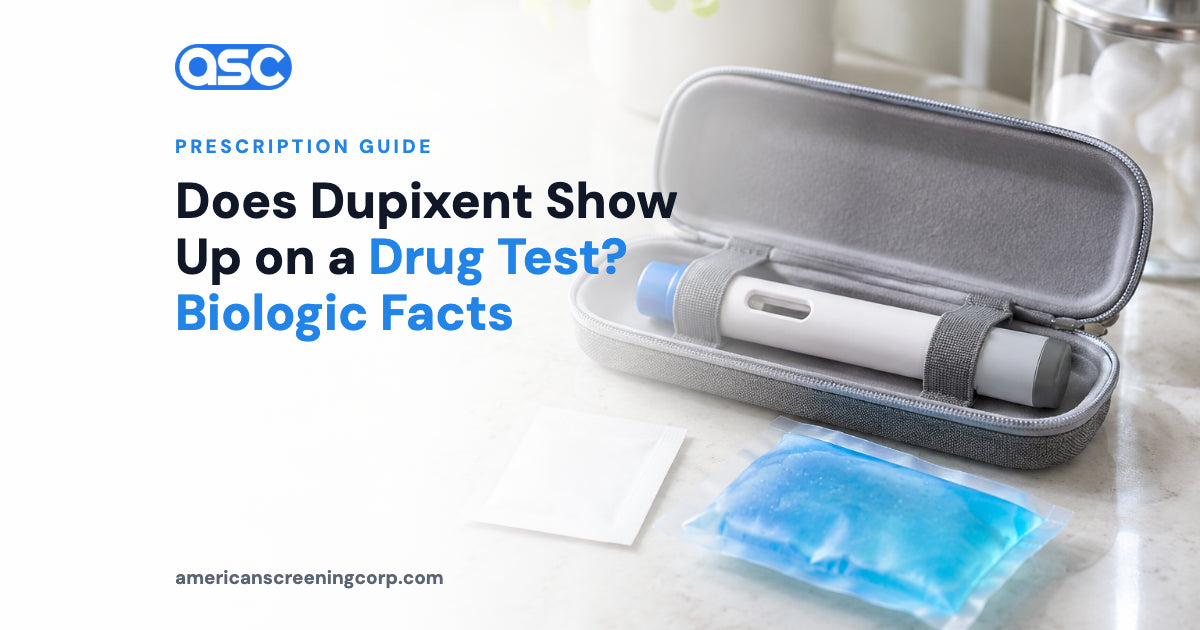
Patients starting an injectable biologic often ask the same question before a pre employment physical or a workplace screening: will this medication cause a problem on a drug test. For Dupixent, the short answer supported by its official labeling is no. Dupixent (dupilumab) is a monoclonal antibody biologic, not a controlled substance, and it is not an analyte that any standard urine, oral fluid, or hair testing panel is built to detect. This article explains what Dupixent is, how drug test panels are actually built, why a large injectable protein does not register on them, and what happens if a laboratory or a medical review officer ever has a question about a positive result while a patient is being treated with it.
What Dupixent Actually Is
Dupixent is the brand name for dupilumab, a prescription injectable biologic approved for several inflammatory conditions, including moderate to severe atopic dermatitis, asthma, chronic rhinosinusitis with nasal polyps, eosinophilic esophagitis, prurigo nodularis, and chronic obstructive pulmonary disease in certain patients. It works by blocking two signaling proteins, interleukin 4 and interleukin 13, that drive inflammation in these conditions. The current prescribing information and consumer drug summary for dupilumab are maintained through the National Institutes of Health. The MedlinePlus dupilumab drug information page describes it as an injection given under medical supervision and lists its approved uses, and the official prescribing label can be searched directly through the DailyMed label search for Dupixent, the government repository for official drug labeling. Neither source lists any interaction with drug screening, because dupilumab is a large protein molecule, not a small molecule drug of the type that urine or oral fluid immunoassays are designed around.
Dupixent is not a controlled substance under federal law. It has no abuse potential, no psychoactive effect, and no listing on any Drug Enforcement Administration schedule. The Food and Drug Administration's own drug approval database, searchable through Drugs@FDA for application number 761055, shows the regulatory history of the product as a biologic license application, which is the approval pathway used for monoclonal antibodies and other large molecule therapeutics rather than for controlled medications.
How Standard Drug Test Panels Are Actually Built
A drug test panel is not a general purpose scan for every substance in a person's system. Each panel, whether a 5 panel urine cup, a 10 panel dip card, or an oral fluid swab, is manufactured with antibodies that bind to a defined, limited list of drug classes such as THC metabolites, opiates, amphetamines, cocaine metabolites, PCP, benzodiazepines, and barbiturates. If a substance is not one of the specific analytes a given strip or cup is built to react to, the test simply does not respond to it, positive or negative. This is true regardless of how a medication is taken, injected, swallowed, or inhaled. Employers who need a broader net typically move up to a larger panel rather than assuming any single cup catches everything, which is why many safety sensitive employers choose a 10 panel drug test cup instead of a narrower configuration.
Laboratory confirmation testing, used whenever an initial screen is non negative, works the same way: it is targeted. Confirmation uses gas chromatography or liquid chromatography paired with mass spectrometry to identify a specific molecule by its exact chemical signature, which is the method described in the federal program standards at 49 CFR Part 40 Subpart C, the section of the Department of Transportation testing rule that sets laboratory analytical requirements. A monoclonal antibody like dupilumab is a large protein with a completely different chemical structure than the small molecule drugs these methods are calibrated to find, so there is nothing in the confirmation chemistry that would flag it even if a screening cup somehow produced an unexpected result.
Why a Biologic Like Dupixent Does Not Trigger a Positive
No cross reactivity between dupilumab and any standard drug of abuse panel has been documented in the product's official labeling or in published pharmacology references. This is consistent with how the drug behaves in the body. Dupixent is injected subcutaneously and is broken down through normal protein metabolism, the same general pathway the body uses for other large proteins, rather than through the liver enzyme pathways that produce the metabolites drug panels are designed to catch. Patients on Dupixent who are also taking other prescription or over the counter medications should still expect those other products, not the biologic itself, to be the thing that could theoretically affect a panel. For comparison, another widely prescribed injectable biologic faces the identical situation, which is covered in detail in our review of Humira and workplace drug panels.
Clinics and occupational health programs that collect specimens from patients on biologic therapy generally do not need any special protocol for Dupixent specifically. Standard chain of custody collection with a tamper evident drug test cup or a drug test dip card is sufficient, because the biologic is not an analyte on the panel in the first place and does not need to be flagged, excluded, or explained on the collection paperwork the way a prescribed opioid or amphetamine product would be.
What Happens if a Result Is Questioned Anyway
If a donor's screen comes back non negative for any reason unrelated to Dupixent, the review path is the same one used for every other case: the sample goes to confirmation testing, and if confirmation is also non negative, a qualified medical review officer contacts the employee to review current prescriptions before the result is reported to the employer. This process, including the MRO's duty to verify a legitimate medical explanation, is set out at 49 CFR Part 40 Subpart E, the subpart governing medical review officers and the verification process in federally regulated testing programs. A patient on Dupixent should be able to show their prescription and pharmacy documentation if ever asked, the same way any patient on any prescribed medication would, even though the biologic itself is not expected to generate the non negative result in the first place. The full MRO verification sequence, including how employers should and should not communicate with employees during that review, is covered in our explanation of the medical review officer process.
Employers that run their own on site screening for pre employment or random testing programs should keep a record that a qualified MRO or a reviewing clinician is available for any non negative result, not only for biologic patients but as a baseline practice. Programs built around DOT safety sensitive positions already require this under the federal rule, and many employers use the same standard for non regulated testing because it protects both the employer and the employee.
Dupixent Compared to Standard Panel Analytes
| Panel analyte | Drug class it targets | Does Dupixent (dupilumab) trigger it |
|---|---|---|
| THC metabolites | Cannabinoids | No, not a cannabinoid and not chemically related |
| Opiates | Opioid analgesics | No, dupilumab is not an opioid or opioid metabolite |
| Amphetamines | Stimulants | No, no stimulant activity or shared structure |
| Cocaine metabolites | Stimulants | No cross reactivity documented |
| PCP | Dissociatives | No cross reactivity documented |
| Benzodiazepines | Sedatives | No, different drug class entirely |
| Barbiturates | Sedatives | No cross reactivity documented |
What Dupixent Patients Should Know Before a Screening
A patient on Dupixent does not need to disclose the medication before a routine employment or program drug screen unless an intake form specifically asks for a full prescription list, which some clinics and treatment programs do for medical reasons unrelated to drug testing. There is no reason to expect the biologic to cause a false positive, and there is no documented interaction that would call for special handling of the specimen. Programs that collect oral fluid instead of urine follow the same logic. A saliva drug test is built around the same limited analyte list as a urine panel, so a large injectable protein has nothing to bind to in that format either.
Employers in regulated transportation roles should remember that Dupixent has no bearing on a Department of Transportation testing determination. The federal rule that governs who must be tested, which substances are covered, and how specimen validity is checked for dilution or substitution is laid out across 49 CFR Part 40 in its entirety, and none of it treats biologic therapies as a testing concern. Carriers building a DOT drug and alcohol testing program can proceed with standard federal panels without building any exception for drivers who disclose a biologic prescription.
General consumer background on how laboratory drug testing works, including specimen types and what a screening result does and does not mean, is also summarized in plain language by the National Library of Medicine's MedlinePlus overview of drug testing, a useful reference for patients who want to understand the process beyond any single medication.
Building a Compliant Screening Program
Employers that want a defensible program regardless of which prescription medications employees may be taking should standardize on a documented panel, a chain of custody collection device, and a clear confirmation and MRO pathway for every non negative screen. A pre employment drug testing kit built for corporate programs gives HR teams a consistent, documented process that holds up the same way whether or not a candidate happens to be on a biologic therapy like Dupixent. Consistency in the collection and review steps, not guesswork about any one brand name medication, is what keeps a program legally sound.
Frequently asked questions
Does Dupixent cause a false positive on a drug test?
No cross reactivity between dupilumab and standard drug of abuse panels has been documented in its official labeling. It is a large protein biologic, not a small molecule drug, so it does not match the chemistry that urine, oral fluid, or confirmation testing is built to detect.
Is Dupixent a controlled substance?
No. Dupixent is a prescription biologic with no federal controlled substance scheduling and no psychoactive or abuse potential.
Do I need to tell my employer I take Dupixent before a drug test?
Generally no, unless an intake form specifically requests a full prescription list for reasons unrelated to drug testing. Because Dupixent is not expected to affect any panel, there is typically no testing related reason to disclose it in advance.
What happens if my result is flagged while I am on Dupixent?
Any non negative screen goes through laboratory confirmation and medical review officer verification, the same process used for every donor. A patient can provide prescription documentation during that review, though the biologic itself is not expected to be the cause of a non negative result.
Can Dupixent affect a hair follicle or oral fluid test?
No documented interaction exists for either specimen type. Hair and oral fluid panels target the same limited list of drug classes as urine panels, and a large injectable protein does not match any of them.
Is Dupixent screened on a DOT drug test?
No. The federal testing panel used for DOT regulated positions covers specific drug classes and does not include biologic therapies.
This article is general information about how drug test panels and confirmation testing work. It is not medical or legal advice, and it does not replace guidance from a treating clinician, a medical review officer, or legal counsel on employment testing policy.