
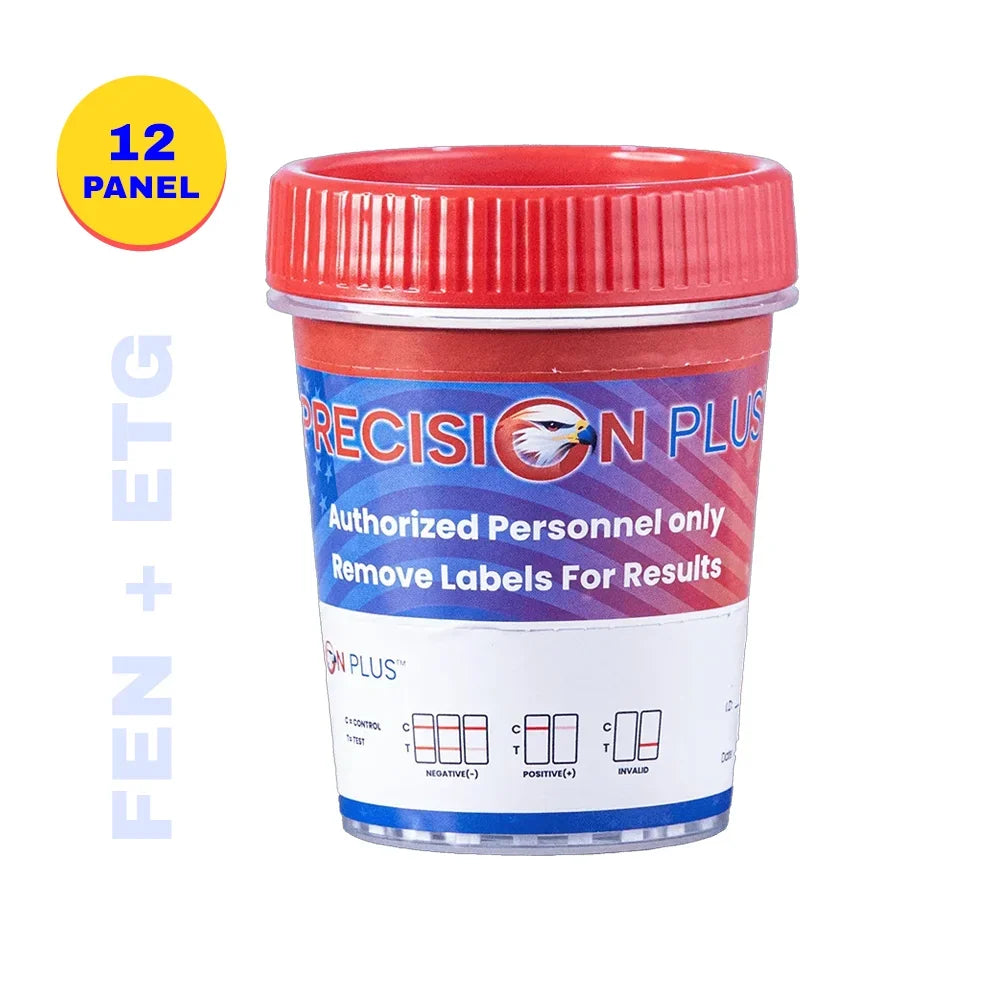
Quick answer: FDA-cleared 12-panel urine cups detect 12 drug classes at labeled ng/mL cutoffs. They are Class II devices under FDA 510(k); many are CLIA-waived. Positives are preliminary; confirm by GC/MS or LC-MS/MS. American Screening Corp supplies bulk cups to clinics, courts, employers, and labs.
- “FDA approved” is the wrong term for these devices. Require FDA 510(k) clearance and CLIA-waived status when non-laboratory staff will read the cup.
- A 12-panel cup is a preliminary immunoassay. Every positive screen must be confirmed by GC/MS or LC-MS/MS laboratory testing.
- American Screening Corp sells 12-panel drug test cups in bulk from Shreveport, Louisiana, with same-day nationwide shipping for clinics, courts, employers, and labs.
Reviewed by the American Screening Corp product team. Last updated November 2026. Buyers in support most often ask whether the box will say “FDA approved,” which 12 drugs are on the cup, and whether bulk cups can replace a DOT lab test.
What does “FDA approved” mean for a 12-panel cup?
The intent behind “fda approved 12 panel cups bulk” is a purchase, not a definition. A clinic, court, staffing firm, or employer wants volume pricing on a 12-drug urine cup that is lawfully marketed in the United States. Rapid urine cups are Class II in vitro diagnostic devices.
FDA clears most of them through the 510(k) premarket notification pathway when the manufacturer shows substantial equivalence to a predicate device (FDA, Premarket Notification 510(k), as of November 2026). That is not FDA approval. Approval is a different pathway, typically PMA. For a bulk purchase, collect the 510(k) number, the intended-use statement, and whether the cup is CLIA-waived if staff outside a certified laboratory will read it (FDA, Clinical Laboratory Improvement Amendments (CLIA), as of November 2026).
American Screening Corp (ASC) in Shreveport, Louisiana, supplies FDA-cleared, CLIA-waived urine cups and related drug and alcohol testing supplies. Forensic-use-only labeled devices must remain labeled as such. They are not a substitute for a CLIA-waived clinical cup.
What a 12-panel cup detects and typical ng/mL cutoffs
A 12-panel urine cup is one immunoassay device that screens 12 drug classes. The 12 analytes are the ones printed on that cup. They are not identical on every SKU. HHS Mandatory Guidelines set urine initial-test cutoffs for federal workplace programs (SAMHSA, Mandatory Guidelines for Federal Workplace Drug Testing Programs, as of November 2026). Cups often use those numbers where the analytes overlap, then add classes federal workplace urine testing does not require.
| Analyte class | Typical cup cutoff (ng/mL) | HHS urine initial cutoff (ng/mL) |
|---|---|---|
| Marijuana metabolites (THC-COOH) | 50 | 50 |
| Cocaine metabolites | 150 or 300 | 150 |
| Amphetamines | 500 or 1000 | 500 |
| Methamphetamine | 500 or 1000 | 500 |
| Opiates (morphine/codeine) | 2000 | 2000 |
| Oxycodone | 100 | 100 |
| Phencyclidine (PCP) | 25 | 25 |
| MDMA | 500 | 500 |
| Benzodiazepines | 300 | Not an HHS workplace analyte |
| Barbiturates | 300 | Not an HHS workplace analyte |
| Methadone | 300 | Not an HHS workplace analyte |
| Twelfth analyte (often buprenorphine, TCA, or similar) | Printed on the cup | Not standardized |
A line result at or above the labeled cutoff is a presumptive positive for that class. A result below the cutoff is negative on that device. Do not report a cup result as a confirmed concentration. Do not assume fentanyl, EtG, or alcohol are on a 12-panel urine cup unless those lines are printed on the device you order.
How long do drugs stay detectable on a 12-panel cup?
Detection window is not a single number on the cup. It depends on the drug, dose, frequency of use, metabolism, urine dilution, and the ng/mL cutoff. Many stimulants, cocaine, oxycodone, and short-acting opiates are often detectable for about 1 to 3 days. PCP and methadone often last longer. THC may be a few days after a single use and longer after repeated use. Some benzodiazepines and barbiturates persist for days to weeks.
Those ranges are program-planning figures only. They are not diagnostic guarantees and they are not a substitute for the IFU. If the program must detect alcohol, EtG, fentanyl, or saliva, specify those products. A standard 12-panel urine cup does not automatically include them.
Who should buy FDA-cleared 12-panel cups in bulk?
Bulk 12-panel cups fit non-DOT screening programs that need a broad on-site panel: addiction-treatment and behavioral-health clinics; courts, probation, and pretrial services; hospital and occupational-health clinics; staffing firms and employers running non-DOT workplace screens; independent labs that issue cups to clients; and other authorized programs under their own written policy.
Buyers choose bulk to lock one panel, one cutoff set, and U.S. inventory across sites. ASC ships same-day nationwide from Shreveport when stock and cutoff time allow. Review current drug test cups for cup formats. For panel mix, CLIA-waived paperwork, or case quantities, contact American Screening Corp.
DOT, FMCSA, FAA, FRA, FTA, PHMSA, and USCG testing must follow 49 CFR Part 40 (DOT, Procedures for Transportation Workplace Drug and Alcohol Testing Programs, as of November 2026). An instant 12-panel cup is not the DOT urine test of record.
How to collect, read, and confirm a 12-panel cup
Follow the IFU for the exact device. A typical CLIA-waived cup procedure is:
- Check expiration date, lot number, and that the pouch is intact.
- Identify the donor under your chain-of-custody or clinic protocol.
- Have the donor void into the cup to the marked volume line.
- Read the temperature strip if present, usually 90–100°F (32–38°C) shortly after the void.
- Recap and start the IFU timing window (often 5 minutes; never read after the stated maximum).
- Read control (C) lines first. No control line means invalid; retest with a new cup.
- For each drug, a line in the test (T) region is negative. No T line with a valid C line is presumptive positive.
- Record the result. Treat every positive screen as preliminary. Confirm by GC/MS or LC-MS/MS before employment, clinical, or court action.
Do not treat a faint line as a concentration. Do not read past the IFU window. Do not ignore a failed temperature or validity check. Adulteration and substitution rules belong in your written policy, not on the cup alone.
12-panel cup vs dip card vs a DOT laboratory test
| Factor | 12-panel urine cup | 12-panel dip card | DOT urine test (49 CFR Part 40) |
|---|---|---|---|
| Device | Integrated collector and immunoassay | Strip card dipped into a specimen | Collection kit; testing at an HHS-certified lab |
| Typical buyer use | On-site non-DOT screen | On-site or lab-received vials | Safety-sensitive transportation |
| FDA / rule status | Often 510(k) cleared; many CLIA-waived | Same immunoassay class | HHS/DOT laboratory procedures |
| Result type | Preliminary screen | Preliminary screen | Laboratory result under Part 40 |
| Positives | Confirm by GC/MS or LC-MS/MS | Confirm by GC/MS or LC-MS/MS | Certified lab process and split specimen |
Use a 12-panel cup when collector and screen must be one device. Use a dip card when urine arrives in a standard vial. Use an HHS-certified laboratory when the test is DOT-regulated or when the decision record must be a confirmed laboratory result.
Checklist before you place a bulk order
- The 12 analytes on the cup match the written policy by name.
- Cutoffs in ng/mL match that policy and any applicable state rule.
- The 510(k) number and CLIA-waived status are on file if the site needs them.
- The label is not forensic-use-only if the cup will be used in a clinical CLIA setting.
- Every positive is defined as preliminary; a GC/MS or LC-MS/MS confirmation lab is identified.
- Storage, expiration dating, and lot traceability cover the volume you will hold.
- Chain-of-custody, privacy, and employment disclosure/authorization steps are in place where they apply.
- The supplier is U.S.-based, can ship same-day, and can replenish the same SKU.
Sources
- FDA, Premarket Notification 510(k) — https://www.fda.gov/medical-devices/premarket-submissions-selecting-and-preparing-correct-submission/premarket-notification-510k
- SAMHSA, Drug-Free Workplace Drug Testing — https://www.samhsa.gov/substance-use/drug-free-workplace/drug-testing
- U.S. Department of Transportation, 49 CFR Part 40 — https://www.transportation.gov/odapc/part40
FAQ
Are 12-panel drug test cups FDA approved or FDA cleared?
Most U.S. 12-panel urine cups are FDA 510(k) cleared Class II devices, not FDA approved. Confirm the 510(k) number and CLIA-waived status on the label and IFU before a bulk buy.
What cutoff levels does a 12-panel cup use?
Cutoffs are printed on the cup in ng/mL. Common immunoassay cutoffs include THC 50, cocaine 150 or 300, opiates 2000, and PCP 25. Match the labeled cutoff to your policy; HHS federal initial cutoffs are set in the Mandatory Guidelines.
Can bulk 12-panel cups be used for DOT testing?
No. DOT-regulated tests must follow 49 CFR Part 40 and use HHS-certified laboratories. An instant 12-panel cup is not the DOT test of record. Non-DOT clinic, court, and workplace programs may use FDA-cleared cups under their own policies.
What should we do with a positive 12-panel cup?
Treat every positive screen as preliminary. Document the result and confirm with GC/MS or LC-MS/MS laboratory testing before employment, clinical, or court action. Read negatives only inside the device timing window in the IFU.
This page is general information, not medical or legal advice.