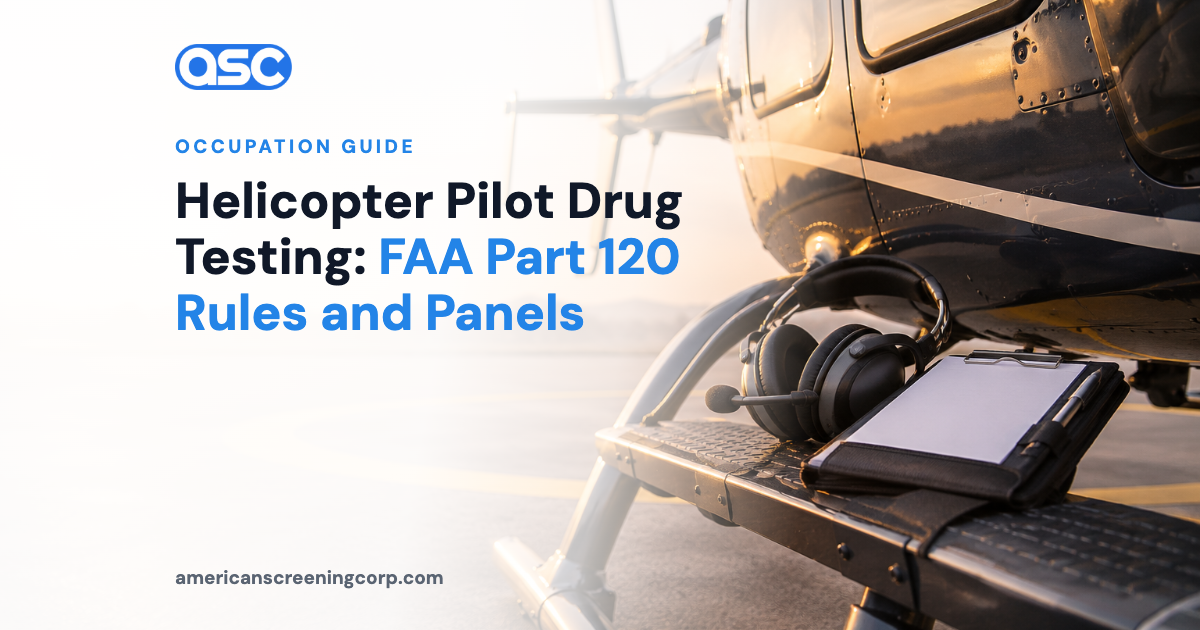
Helicopters operate across two very different regulatory worlds, and which one a pilot flies in decides whether a federal drug and alcohol testing program applies at all. A pilot flying an air ambulance under a Part 135 certificate is in a federally mandated program with random testing, post accident testing, and a defined drug panel. A pilot flying a privately owned helicopter for personal transportation, with no compensation involved, generally is not. This piece lays out which helicopter operations actually trigger FAA testing under 14 CFR Part 120, what the testing procedures look like under 49 CFR Part 40, what still applies to a private pilot who falls outside that program, and what a verified positive means for a medical certificate.
Who is actually covered
14 CFR Part 120 is the FAA rule that requires a drug and alcohol testing program. It applies to certificate holders operating under 14 CFR Part 135 (the on demand and commuter rule that covers most helicopter air ambulance, offshore, and charter operators), to Part 121 scheduled air carriers, and to commercial air tour operators flying under 14 CFR 91.147, even though the underlying flight rules for an air tour are technically Part 91. In other words, a helicopter tour company that carries paying passengers on sightseeing flights is brought into the Part 120 testing program by the compensation and passenger carrying nature of the operation, not by which flight rules apply to the flight itself.
A privately owned helicopter flown under Part 91 for personal transportation, with no compensation and no carriage of persons or property for hire, generally falls outside Part 120. That pilot is not enrolled in random testing, is not subject to post accident testing under the FAA program, and the operator has no DOT consortium obligation. Corporate flight departments that fly Part 91 Subpart F and do not carry passengers or cargo for compensation are usually in the same position, although some corporate operators voluntarily adopt a DOT style program anyway for risk management reasons, which is their choice rather than an FAA mandate.
| Operation type | Governing rule | FAA/DOT testing required | Panel or program |
|---|---|---|---|
| Part 135 air carrier (charter, offshore, air ambulance/HEMS) | 14 CFR Part 135, testing under Part 120 | Yes: pre employment, random, reasonable cause, post accident, return to duty | Five drug urine panel plus breath alcohol testing under Part 40 |
| Commercial air tour under 91.147 | 14 CFR 91.147, testing under Part 120 | Yes, same categories as above | Same federal panel and alcohol testing |
| Part 121 scheduled carrier helicopter operations | 14 CFR Part 121, testing under Part 120 | Yes, same categories as above | Same federal panel and alcohol testing |
| Private or personal flying, no compensation | 14 CFR Part 91, general operating rules | No FAA mandated program; 91.17 and 91.19 still apply | None required federally; employer may run a voluntary program |
| Corporate flight department, Part 91 Subpart F | 14 CFR Part 91 Subpart F | Not required unless voluntarily adopted | Employer discretion |
What still applies even outside Part 120
Falling outside the Part 120 testing mandate does not mean a pilot is free of federal drug and alcohol rules. 14 CFR 91.17 prohibits acting as a crewmember within eight hours of consuming alcohol, while under the influence of alcohol, with a blood alcohol concentration of 0.04 or greater, or while using any drug that affects the person's faculties in a way contrary to safety. It also requires a pilot to submit to a test for alcohol or drugs if requested by a law enforcement officer or the FAA. 14 CFR 91.19 separately restricts carrying narcotic drugs, marijuana, and depressant or stimulant drugs aboard an aircraft, outside of limited exceptions. Both sections apply to every flight under Part 91, including a purely private helicopter flight with no passengers for hire, regardless of whether a formal testing program exists for that operation.
Because 91.17 and 91.19 are self reporting and enforcement based rather than a scheduled testing program, an operator that wants documented assurance, for insurance, liability, or internal policy reasons, generally needs to build its own voluntary program. A flight department in that position can still use a federal style five drug urine panel and an alcohol test as the basis for pre employment and periodic screening, modeled on the DOT panel even though DOT consortium rules do not technically apply.
The testing categories and the panel
For operators inside Part 120, the required testing events mirror the rest of DOT regulated transportation: pre employment testing before a new pilot performs a safety sensitive function, unannounced random testing at a minimum annual rate that DOT publishes and that operators must meet, reasonable cause and reasonable suspicion testing when a trained supervisor observes specific, documented signs, post accident testing following an accident that meets the criteria defined in the rule, and return to duty and follow up testing for a pilot who has already violated the program. All of these use the same federal five drug urine panel, covering marijuana, cocaine, phencyclidine, amphetamines, and opioids, with the opioid category expanded beyond morphine and codeine to include additional semi synthetic opioids. Operators building or restocking a compliant collection kit for these events typically start from a DOT pre employment drug screen kit configured to that panel, rather than a generic workplace cup.
Alcohol testing under Part 40 uses a breath alcohol technician and an evidential breath testing device, not a urine test, since alcohol clears the body too quickly for urine to be a reliable indicator at the testing point. Employers setting up a compliant alcohol program for flight crews need a device from DOT's approved conforming products list, and many aviation employers keep a DOT approved breathalyzer on hand at the testing site rather than relying on a saliva screen alone for the regulated event.
For the urine portion, operators have a choice between an integrated cup and a dip card format, and the choice is about workflow rather than compliance, since either can be built to the same five drug federal panel. A base that runs its own on site collection for random and post accident events often standardizes on a federal panel urine drug test cup for a single step collection and read, while a smaller operation or a mobile collector sometimes prefers a drug test dip card that can be used with a separate specimen cup. Either way, the specimen still goes to a certified laboratory for confirmation before any result becomes final.
Reasonable cause, post accident testing, and the MRO
A nonnegative rapid result on a regulated specimen is never the final word. Every regulated specimen collected under Part 120 and Part 40 that screens positive goes to a certified laboratory for confirmation, and a Medical Review Officer reviews any confirmed positive before it is reported to the employer. The MRO gives the pilot an opportunity to provide a legitimate medical explanation, such as a valid prescription, and only reports a verified positive once that review is complete. This process exists specifically so that a pilot taking a prescribed medication under a physician's care is not automatically treated as a program violation; the determination depends on the medication, the dose, and whether the pilot was fit to perform safety sensitive duties, not on the presence of the substance alone.
Post accident testing has its own trigger and timing rules under the regulation, and a certificate holder that is unsure whether a given event meets the threshold should treat it as triggering the requirement rather than guess, since missing the window is itself a program failure independent of the test result. Operators building a post accident response kit generally want an expanded or supplemental option on hand in addition to the standard federal panel, since a hair follicle drug test can support a longer look back window during an investigation when the employer or investigating body wants history beyond what a urine specimen can show.
HIMS and the medical certificate
A verified positive drug test or a documented refusal under Part 40 triggers immediate removal from safety sensitive duties and a substance abuse professional evaluation before any return to duty testing can happen. Separately, and sometimes concurrently, a pilot's underlying diagnosis of substance abuse or dependence is itself a disqualifying condition for an FAA airman medical certificate. The route back to flying status on the medical side generally runs through the FAA's Human Intervention Motivation Study program, commonly called HIMS, a peer based monitoring and treatment framework that works with specially trained Aviation Medical Examiners so a pilot can be considered for a special issuance medical certificate after treatment and a period of documented monitoring. The FAA medical certification process and the DOT return to duty testing process are related but separate tracks, and a pilot can clear one without automatically clearing the other. Neither process is something a certificate holder, an employer, or this article can shortcut; both require the pilot's own documented participation.
Building a program that fits the operation
Operators that run a Part 135 helicopter certificate, a 91.147 air tour operation, or any other activity captured by Part 120 need a written drug and alcohol testing policy, a consortium or third party administrator relationship for random selection, trained supervisors for reasonable cause determinations, and a collection process that matches the federal panel exactly, since a non conforming panel does not satisfy the rule even if a screen is run. Operators that sit outside Part 120, including most private and many corporate flight departments, are not required to run any of this, but many choose a scaled down version anyway, often centered on pre employment and post accident screening with a DOT style drug and alcohol testing program as the template even where DOT enforcement does not reach. Either way, a program should be documented in writing before it is enforced, and specific legal questions about coverage, consortium membership, or medical certificate consequences for a particular operation belong with aviation counsel or the operator's HIMS trained AME rather than a general reference article.
For additional background on how this program works for fixed wing crews, see our related coverage of airline pilot drug testing requirements and FAA aviation drug and alcohol testing, both of which cover the same Part 120 and Part 40 framework from the fixed wing employer side.
Frequently asked questions
Does every helicopter pilot have to take a drug test?
No. Only pilots performing a safety sensitive function for an operator covered by 14 CFR Part 120, which generally means Part 135 air carriers, Part 121 carriers, and commercial air tour operators under 91.147. A private pilot flying a personally owned helicopter with no compensation is not enrolled in that federal program, though 91.17 and 91.19 still apply to that flight.
What drug panel do FAA regulated helicopter operators use?
The federal five drug urine panel defined under 49 CFR Part 40, covering marijuana, cocaine, phencyclidine, amphetamines, and an expanded opioid category. Alcohol testing is a separate breath test under Part 40, not part of the urine panel.
Does a positive drug test automatically end a pilot's medical certificate?
A confirmed, MRO verified positive triggers removal from safety sensitive duty and a substance abuse professional evaluation. Whether the pilot's medical certificate is affected depends on the FAA's separate medical certification review and often runs through the HIMS program; the testing violation and the medical certificate action are related but distinct processes.
Are private helicopter owners required to run drug testing?
Generally no, if the flying is personal and not for compensation. 14 CFR 91.17 and 91.19 still apply to every flight, but there is no FAA mandated testing program for that activity. Some owners and corporate flight departments adopt a voluntary program anyway.
What happens after a helicopter accident for a covered operator?
An operator covered by Part 120 must conduct post accident drug and alcohol testing on required crewmembers when the event meets the criteria in the regulation, within the timing windows the rule specifies. The specimen still goes through laboratory confirmation and MRO review like any other regulated test.
What is the HIMS program?
HIMS, the Human Intervention Motivation Study, is the FAA's peer based identification, treatment, and monitoring framework for pilots and other certificated airmen with substance abuse or dependence issues, run with specially trained Aviation Medical Examiners so a pilot can work toward a special issuance medical certificate after treatment.
This article is general information for employers and operators, not legal or medical advice. Coverage under FAA and DOT rules, medical certification decisions, and HIMS program participation depend on individual facts and should be reviewed with aviation counsel, an Aviation Medical Examiner, or the FAA directly.