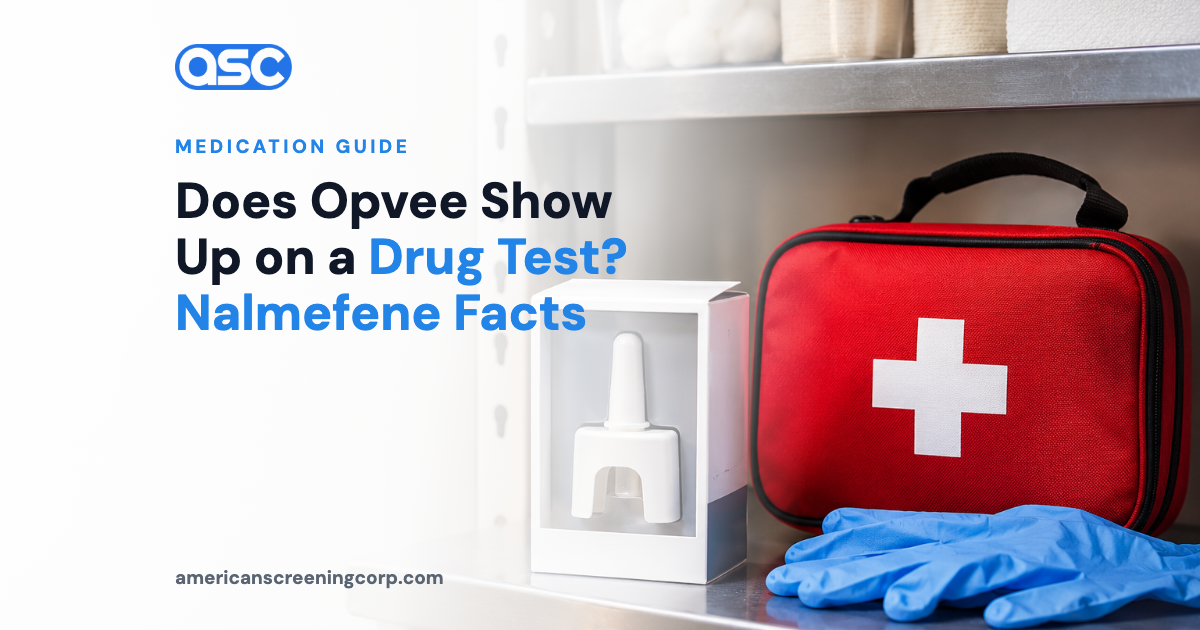
Opvee is the brand name for nalmefene hydrochloride nasal spray, a medicine carried by first responders, treatment programs, and increasingly by workplaces and families to reverse a known or suspected opioid overdose. Because it is sprayed into the nose during an emergency, employers and safety officers often ask whether Opvee itself will trigger a positive result on a workplace drug test. The short answer is that nalmefene is an opioid antagonist, not an opioid, and standard opiate and fentanyl immunoassay panels are not built to detect it. This article explains the pharmacology behind that answer, what a positive opiate or fentanyl result after an overdose event actually reflects, and how confirmation testing and the medical review officer process fit in.
What Opvee is and how it works
Nalmefene belongs to the same drug class as naloxone and naltrexone. All three are opioid antagonists, meaning they attach to opioid receptors in the brain and block them rather than activating them. An opioid agonist such as morphine, oxycodone, heroin, or fentanyl binds those same receptors and turns them on, producing pain relief or euphoria and, at high doses, the respiratory depression that causes an overdose. An antagonist like nalmefene occupies the receptor without turning it on, which displaces the opioid and can restore breathing during an overdose. The product label and prescribing information for Opvee are published on DailyMed, the National Library of Medicine's repository of official drug labeling, and the agency's own review record for the application sits in the FDA Drugs@FDA database under application number 216215.
This distinction between agonist and antagonist is the whole story. Workplace and clinical opiate panels, including the strips and cups employers buy for a drug test cup program, are designed and validated against opioid agonists and their metabolites. They are not formulated to cross react with nalmefene, naloxone, or naltrexone, because those molecules are not the substances a workplace program is trying to find.
Is nalmefene a controlled substance?
Nalmefene is not a federally controlled substance. The Drug Enforcement Administration maintains the current schedules of controlled substances, and opioid antagonists approved for overdose reversal, including naloxone, naltrexone, and nalmefene, do not appear on those schedules because they have no opioid agonist activity and no recognized potential for misuse in the way scheduled opioids do. The current federal schedules are published by the DEA Office of Diversion Control. Because Opvee is not scheduled, an employer does not need to treat a documented administration of it the way it would treat an unexplained positive for a scheduled opioid, and a safety sensitive employee who received Opvee during a medical emergency is not reporting use of a controlled drug.
Why an opiate or fentanyl panel will not flag Opvee
Rapid immunoassay strips and cups work by using antibodies that recognize a specific chemical shape. The opiate antibody family on most panels targets the morphine and codeine group, and a separate expanded opiate or fentanyl specific strip targets synthetic opioids like fentanyl and some of its analogs. Nalmefene's structure is built on a different chemical backbone than those target opioids, and no cross reactivity with standard opiate or fentanyl immunoassays has been reported for it. A program that wants broader opioid coverage, including fentanyl, should choose a fentanyl specific drug test rather than assume a basic opiate strip covers every synthetic opioid, but adding that strip does not change the fact that nalmefene itself is not what either strip is looking for.
This also means that administering Opvee to someone else does not create a positive result for the person who gave it. The rescuer is not exposed to an opioid by handling or spraying the nasal device, and nalmefene does not metabolize into a compound that an opiate panel would flag. If a drug test panel comes back positive for opiates or fentanyl after an overdose event, that result reflects the opioid or opioids that were in the person's system before the reversal agent was given, not the nalmefene used to reverse the overdose.
Confirmation testing and the MRO path
Any nonnegative screen on a regulated or safety sensitive test should go to laboratory confirmation using gas chromatography or liquid chromatography with mass spectrometry, which identifies the exact opioid present rather than just flagging a drug class. For DOT regulated testing, the governing rule is 49 CFR Part 40, which sets the cutoffs, the confirmation method, and the role of the medical review officer. The MRO reviews every confirmed positive before it is reported to the employer, contacts the employee, and considers legitimate medical explanations, including prescription records or documentation that overdose reversal medication was administered during a medical event. A program that collects specimens in the field, including a dip card after a post incident event, should route any nonnegative result through the same confirmation and MRO chain rather than relying on the screening result alone.
A site that prefers a noninvasive collection for that same post incident check can look at an oral fluid test instead, as long as the same confirmation and MRO steps follow. This article explains detection science only; it is not a substitute for the MRO process or for legal guidance on how to apply a specific result to an employment decision.
Opioid antagonists at a glance
| Medication | DEA schedule | Typical use | Reacts on opiate or fentanyl panels |
|---|---|---|---|
| Naloxone (Narcan and others) | Not scheduled | Emergency opioid overdose reversal, community and clinical use | No cross reactivity reported |
| Naltrexone (oral and extended release injectable) | Not scheduled | Maintenance treatment to block opioid or alcohol effects after detox | No cross reactivity reported |
| Nalmefene (Opvee nasal spray) | Not scheduled | Emergency opioid overdose reversal | No cross reactivity reported |
Workplace and treatment program context
A growing number of employers stock an overdose reversal medication, whether naloxone or nalmefene, as part of a general workplace emergency response plan, separate from the drug testing program itself. The Substance Abuse and Mental Health Services Administration publishes current guidance on these medications and how community, employer, and treatment settings use them, available through its opioid overdose reversal resource page. Treatment programs that monitor clients for opioid use, including programs using a rehabilitation and addiction treatment center testing kit, should document any overdose reversal event separately from a screening result and let the confirmation and clinical review process, not the immunoassay alone, determine what the result means.
A program designing a post incident testing policy around a safety event should work with counsel and its MRO to decide which panel, including a DOT pre employment and post incident drug screen kit where applicable, fits the situation, and should never treat the administration of a documented, legitimate overdose reversal medication the same as an unexplained illicit drug positive.
What this means for employers
An employer that learns an employee received Opvee during a medical emergency is not learning that the employee tested positive for a controlled substance, because nalmefene itself is not controlled and is not detected by the panels used in workplace testing. What the employer may still need to address is whatever opioid caused the overdose in the first place, and that is a separate question that only laboratory confirmation and the MRO process can answer. Employers should also remember that FCRA style background screening and drug testing are different processes with different documentation duties, and that a safety sensitive employer generally may want to lean on its MRO and legal counsel, rather than the screen result alone, before taking any employment action tied to an overdose event.
Frequently asked questions
Does Opvee show up as an opiate on a drug test?
No cross reactivity with standard opiate or fentanyl immunoassays has been reported for nalmefene. Opvee is an opioid antagonist, not an opioid agonist, and the panels used in workplace and clinical testing are built to detect agonists like morphine, oxycodone, heroin, and fentanyl.
Is nalmefene a controlled substance?
No. Nalmefene does not appear on the DEA's schedules of controlled substances, consistent with the other opioid antagonists used for overdose reversal, naloxone and naltrexone.
If I give someone Opvee, will I test positive?
No. Administering Opvee to another person during an overdose emergency does not expose the rescuer to an opioid, and nalmefene itself is not a target analyte on opiate or fentanyl panels.
Why did someone test positive for opiates or fentanyl after receiving Opvee?
A positive result after an overdose event reflects the opioid that was in the person's system before the reversal medication was given, not the nalmefene used to reverse the overdose. Laboratory confirmation identifies which specific opioid was present.
What should an employer do if a positive result follows an overdose event?
Send any nonnegative screen to laboratory confirmation and let the medical review officer review the result, contact the employee, and consider legitimate medical explanations before the result is reported to the employer.
Does a basic opiate strip also catch fentanyl?
Not reliably. A basic opiate strip targets the morphine and codeine group, so programs that need to detect fentanyl and its analogs should add a dedicated fentanyl specific strip rather than assume one panel covers both.
Related reading: Does Narcan Show Up on a Drug Test? and Does Naltrexone Show Up on a Drug Test? cover the other two opioid antagonists discussed above in more detail.
This article is general information about drug test science and panel design. It is not medical advice, legal advice, or a substitute for guidance from a medical review officer, treatment provider, or employment counsel.