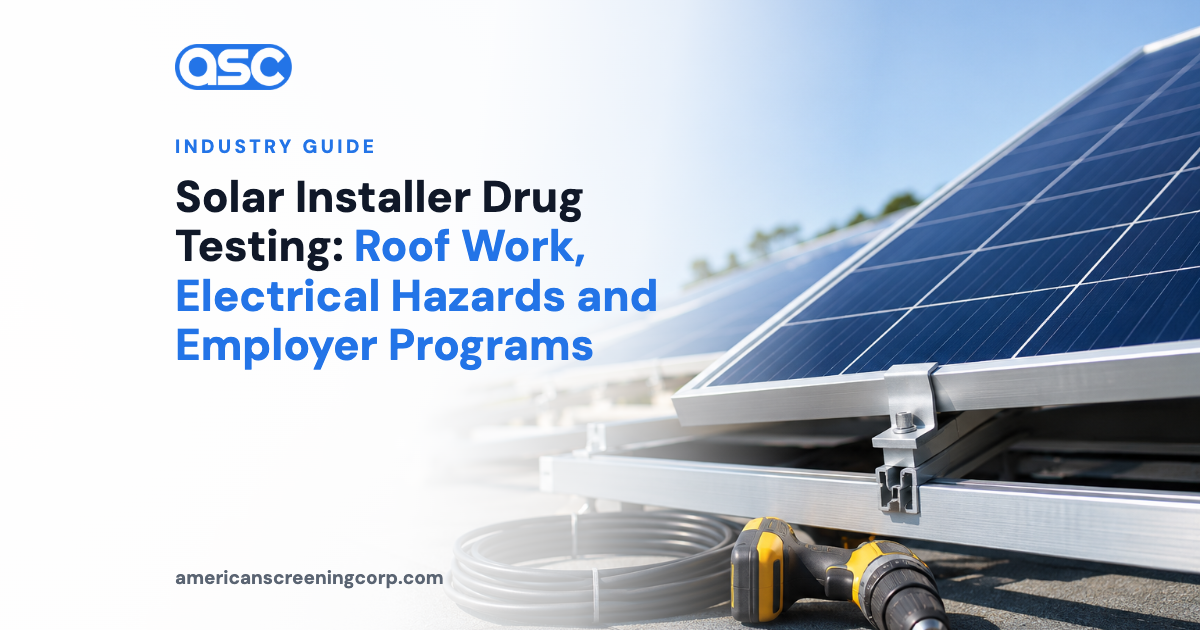
Photovoltaic installers spend much of the workday on sloped roofs, ground mount racking, or rooftop edges, often while connecting live direct current wiring. That combination of height work and electrical exposure is why many solar contractors build a drug testing program even though no single federal rule requires one for this trade. This guide walks through the hazards that drive the policy, what federal law actually requires, where state law fills the gap, and how a residential or commercial solar installer sets up a workable testing program.
Why the job itself drives the policy
Solar installation combines two hazard categories that the Occupational Safety and Health Administration regulates closely in construction. The first is fall exposure. Installers routinely work at heights that trigger fall protection duties under the construction standard, and OSHA's fall protection rules at 29 CFR 1926.501 set the duty to provide protection, with specific system requirements in 1926.502 and training duties in 1926.503. OSHA's general fall protection topic page notes that falls remain one of the leading causes of death in construction work generally.
The second hazard is electrical. Module strings carry live direct current voltage that does not behave like household alternating current and cannot simply be shut off at a breaker the way some circuits can. OSHA's construction electrical requirements sit in 1926 Subpart K, with specific duties for working near energized parts described at 1926.416. Employers in this trade generally reason that someone cutting, crimping, and landing live conductors at the edge of a roof needs to be clear headed, and that reasoning, not a specific statute naming solar installers, is what pushes most contractors toward a testing policy.
Is drug testing federally required for solar installers?
No general federal law requires private employers to drug test construction trades, and that includes solar installation crews. The main exception is driving. If an installer also operates a commercial motor vehicle that requires a commercial driver's license under the Federal Motor Carrier Safety Administration's thresholds, pre-employment, random, reasonable suspicion, post-accident, and return to duty testing become mandatory under the Department of Transportation testing program described in 49 CFR Part 40. A roofer who never drives a covered vehicle is not swept into that program just because the company also employs CDL drivers elsewhere in the business.
A second limited federal angle applies to installers employed by a company holding certain federal contracts or grants. The Drug-Free Workplace Act framework, implemented at 2 CFR Part 182, requires covered federal contractors and grantees to maintain a drug free workplace policy and notify employees of it, but it does not itself mandate chemical testing of every worker. Outside DOT covered driving and these contractor and grantee obligations, solar employers who test are doing so as a matter of company policy and, where applicable, state program participation, not because a federal statute names the trade.
State law varies
Whether an employer may test, must test, or gets a benefit for testing (such as a workers compensation premium credit) depends on the state where the crew works, and the rules differ meaningfully from one state to the next. The Substance Abuse and Mental Health Services Administration's drug free workplace resource is a useful starting point for program design, but it is not a substitute for checking the specific state program where a company operates. Some states run a formal voluntary Drug-Free Workplace Program that ties a discount to following a defined policy, collection, and reporting process, while others simply allow at will testing with fewer procedural strings attached. Solar contractors that work across several states should confirm the applicable rule in each one rather than assuming a single company policy covers every jurisdiction identically, and should route the comparison through counsel rather than guesswork.
Building the program: panels, timing, and documentation
Most solar installation employers that test build the program around a handful of recognized testing events rather than testing at random intervals with no structure. The table below outlines how these typically map to this trade.
| Testing event | When it is used | Federally required for this trade |
|---|---|---|
| Pre employment | Before a new installer starts working at height or near live circuits | No, company policy |
| Reasonable suspicion | A supervisor observes specific, documented signs of impairment on site | No, but widely used; requires trained observation |
| Post incident | After a fall, near miss, or injury where impairment could be a contributing factor | No federal mandate for this trade; OSHA recordkeeping rules limit blanket, automatic post incident testing used to discourage injury reporting |
| Random | Unannounced selection during the work term, by company policy | No, except DOT covered CDL drivers under 49 CFR Part 40 |
| Return to duty | Before resuming safety sensitive work after a positive result or refusal | No for this trade generally; mandatory for DOT covered drivers |
On the post incident row, employers should know that OSHA's injury and illness recordkeeping rule at 29 CFR 1904.35 protects an employee's right to report a work related injury, and OSHA has stated that blanket post accident testing policies that are not limited to situations where drug use could plausibly have contributed to the incident may be viewed as a disincentive to reporting. A program that ties post incident testing to a documented, incident specific reason, applied consistently, fits more comfortably within that framework than an automatic test after every reported injury regardless of cause. OSHA's recordkeeping guidance page and the related 2016 rule discussion are the primary references for that distinction.
Panel selection for this trade is a company decision. Many solar contractors use a standard five panel configuration (amphetamines, cocaine, marijuana metabolite, opiates, and phencyclidine) similar to the federal workplace panel, while others expand it to cover additional opioids or synthetic cannabinoids depending on regional drug trends. Oral fluid and urine cup formats both see use in field construction settings; oral fluid collection can be easier to administer on a job site without a dedicated restroom, while urine cups remain the most common format for a wider detection window. Whatever panel and format a contractor chooses, the policy should be written down, applied the same way across the crew, and reviewed by counsel for the states where work is performed.
Reasonable suspicion still needs a documented process
Because random and blanket post incident testing carry more legal risk for non DOT trades, a documented reasonable suspicion procedure is often the backbone of a solar employer's program. That means training the people who supervise crews, usually foremen or site leads, to recognize and write down specific, observable signs before a test is requested, rather than acting on a hunch. A short written account of what was observed, who observed it, and when, protects both the worker and the employer if the decision is ever questioned.
Internal links and where to source testing supplies
Solar installation sits within the broader construction trades, and much of the program design overlaps with how general contractors structure their own policies; see our overview of building a construction industry drug testing program for a fuller walkthrough of panel choice and vendor selection. For the post incident testing question specifically, our piece on post accident drug testing and the OSHA rules employers get wrong goes deeper into the recordkeeping interaction described above.
Employers setting up or restocking a program can review cup and panel options in our drug test cup collection, and distributors and larger accounts can review case pricing through the wholesale portal.
Frequently asked questions
Does federal law require solar installers to be drug tested?
No general federal law requires it for this trade. The main federal testing mandate, under 49 CFR Part 40, applies to employees who operate a commercial motor vehicle requiring a commercial driver's license, not to roof or electrical work itself.
Can an employer require a drug test before sending someone up on a roof?
Generally yes, as company policy, subject to the state's testing law where the work happens. State rules on notice, consent, and procedure vary, so the policy should be reviewed against the specific state.
Can a solar company test every worker after a fall or near miss?
A policy limited to incidents where drug use could plausibly be a contributing factor, applied consistently, fits more comfortably within OSHA's recordkeeping framework at 1904.35 than an automatic test after every reported injury regardless of cause.
What panel do most solar contractors use?
Many use a standard five panel configuration similar to the federal workplace panel, though some expand it. Panel and format are company decisions, not a specific federal requirement for this trade.
Does working on a federally funded solar project change the rules?
It can bring in Drug-Free Workplace Act obligations under 2 CFR Part 182 for the contractor or grantee, mainly a written policy and employee notice, but that is a separate question from mandatory chemical testing of every worker.
Where should an employer start if it operates in several states?
Start with SAMHSA's drug free workplace resource for program structure, then confirm the specific testing law in each state where crews work, ideally with counsel, since the rules are not uniform.
This article is general information, not legal or medical advice. Employers should confirm requirements with qualified counsel before adopting or changing a testing policy.