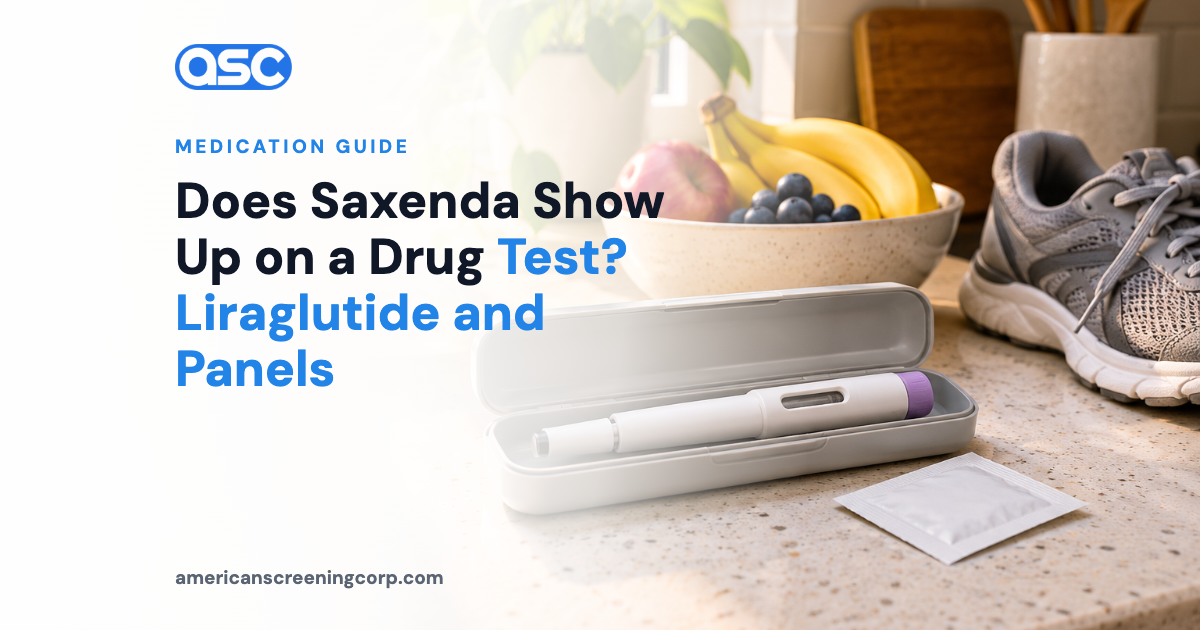
Saxenda is the brand name for liraglutide, an injectable medication approved for chronic weight management. It belongs to a class of medicines called GLP 1 receptor agonists, the same family that includes several widely known diabetes and weight loss drugs. Employers, treatment programs, and safety managers who see this medication listed on a worker's intake form often ask one direct question: will it cause a positive drug test result. The short answer is no. Liraglutide is not a controlled substance and it is not a chemical target on any standard workplace drug test panel.
This article explains why that is true, how it differs from an older generation of prescription weight loss drugs that genuinely can affect a drug test, and what an employer or medical review officer should do if a worker discloses a GLP 1 prescription during a testing program.
What Saxenda actually is
Liraglutide is a peptide, a chain of amino acids engineered to mimic a naturally occurring gut hormone called glucagon like peptide 1. It is delivered by subcutaneous injection and works on receptors that slow stomach emptying and increase feelings of fullness. The current prescribing information is published on DailyMed, the National Library of Medicine's official repository for official drug labeling, and it describes liraglutide 3 mg as an adjunct to diet and exercise for chronic weight management in appropriate adult and pediatric patients. You can read the full Saxenda prescribing label on DailyMed for dosing, warnings, and the complete list of ingredients.
Nothing in that labeling classifies liraglutide as a controlled substance, and nothing in its mechanism of action resembles the stimulant, opioid, cannabinoid, or sedative chemistry that workplace drug panels are built to detect.
Saxenda and federal drug scheduling
The Drug Enforcement Administration maintains the controlled substance schedules under the Controlled Substances Act. Liraglutide does not appear on Schedule I, II, III, IV, or V. You can confirm current federal scheduling status directly through the DEA Office of Diversion Control schedules page, and the agency's own reference list, the DEA Orange Book controlled substances list, which does not include liraglutide or any GLP 1 receptor agonist. Because it carries no federal scheduling, there is no legal or regulatory reason for a laboratory to build liraglutide into a standard panel, and no manufacturer of rapid test cups, dip cards, or oral fluid devices has added it as an analyte.
Why standard panels do not react to liraglutide
Rapid drug test devices use immunoassay chemistry. A strip contains antibodies trained to bind to a specific small molecule drug or its metabolite, such as THC, cocaine's metabolite benzoylecgonine, amphetamine, or an opioid structure. The strip turns a visible line when that antibody binds its target. For a drug to show up on a panel, two conditions have to be true: the panel has to include an antibody built for that chemical, and the chemical has to be present at or above the manufacturer's cutoff concentration.
Liraglutide fails the first condition entirely. It is a large peptide molecule, structurally nothing like the small molecule drugs of abuse that immunoassay antibodies are designed around. No commercial rapid test manufacturer, including the panels used in standard workplace programs, has built an antibody strip for liraglutide or any other GLP 1 peptide, because there has never been a clinical or regulatory reason to screen for it. A standard drug test cup used for a typical five or ten panel workplace screen looks for entirely different drug classes and will not react to a GLP 1 injection in any way, whether the test is a cup, a dip card, or an oral fluid swab.
If a laboratory wanted to specifically confirm the presence of liraglutide in a specimen for some clinical research reason, it would need a dedicated chromatography based assay such as LC MS/MS tuned to that exact peptide. That is not something ordered in a pre employment or random workplace testing program, and no cutoff level for it exists in federal workplace testing guidance.
Specimen validity is unaffected
Some employers also worry about specimen validity testing, the checks a lab runs for creatinine, specific gravity, pH, and oxidants to catch diluted or substituted urine. Liraglutide's pharmacology, appetite suppression and slowed gastric emptying, has no documented effect on those validity markers. A worker taking Saxenda should produce a specimen that reads normally on validity testing, the same as any other prescription medication with no urinary excretion effect relevant to those parameters.
The real contrast: older weight loss drugs and the amphetamine panel
The reason this question comes up so often is that weight loss medicine used to mean something very different. For decades the most commonly prescribed weight loss drug was phentermine, a sympathomimetic amine that the DEA places in Schedule IV because of its stimulant profile and potential for misuse. You can verify that classification directly in the Code of Federal Regulations at 21 CFR 1308.14, the Schedule IV substances list, where phentermine is named.
Phentermine is chemically related to amphetamine, close enough that it can produce a presumptive positive on an amphetamine class immunoassay strip, the kind of strip built into most 10 panel drug test kits and comparable panel sizes. That presumptive result is not proof of illicit amphetamine or methamphetamine use. It reflects the chemical similarity between phentermine and the amphetamine class molecules the antibody is designed to catch. A combination product built around phentermine, paired with the anticonvulsant topiramate, carries the same amphetamine screening consideration for the phentermine component, while topiramate itself is not controlled and is not a target of any standard panel.
When a presumptive amphetamine positive comes back on a worker who discloses a phentermine prescription, the sample should go to confirmation testing, typically gas chromatography mass spectrometry or LC MS/MS, which can distinguish phentermine from amphetamine and methamphetamine at the molecular level. That confirmation and the surrounding prescription documentation review belongs to the medical review officer, not the collection site or the employer directly.
Saxenda versus phentermine type drugs, side by side
| Medication | Active ingredient | DEA schedule | Reacts on a standard panel | Why |
|---|---|---|---|---|
| Saxenda | Liraglutide | Not controlled | No | Peptide hormone analog, no antibody strip built for it |
| Wegovy, Ozempic | Semaglutide | Not controlled | No | Same GLP 1 peptide class as liraglutide |
| Qsymia | Phentermine and topiramate | Phentermine is Schedule IV, topiramate is not controlled | Phentermine portion may trigger a presumptive amphetamine positive | Phentermine is structurally related to amphetamine |
| Generic phentermine products | Phentermine | Schedule IV | May trigger a presumptive amphetamine positive | Same sympathomimetic amine chemistry as above |
What the medical review officer process looks like
Any time a non negative screening result comes back, trained medical review officers follow a documented verification process rather than letting an employer interpret a raw test strip. The officer contacts the employee, reviews current prescriptions, and determines whether a legitimate medical explanation accounts for the result. The federal framework that governs this process for regulated transportation employers appears in 49 CFR Part 40, which lays out specimen collection, laboratory, and MRO verification procedures that many non regulated employer programs also use as a model. A worker who reports taking Saxenda should simply note the prescription during the standard review; because liraglutide is not a tested analyte, it has no bearing on the outcome at all. A worker on a phentermine based product should provide prescription documentation so the MRO can match a confirmed phentermine finding to a legitimate source.
Employers building or updating a drug free workplace policy, whether for a pre employment screening program or a DOT regulated transportation testing program, generally should rely on the SAMHSA workplace resources for program design guidance rather than guessing at how a given prescription interacts with a panel. SAMHSA's workplace employer resources cover drug free workplace policy structure, and the main SAMHSA workplace program page is the starting point for federal guidance on panel design and employer responsibilities.
What employers should and should not do
An employer that learns a worker takes Saxenda should treat it the same as any other disclosed prescription medication with no bearing on the test result: there is nothing to document because there is no analyte to explain. Employers generally should not ask employees to justify why they are on a weight management medication, and any inquiry into an employee's medical condition should go through counsel and comply with applicable disability and privacy law. A comprehensive workplace drug testing program should be built around clear written policy, consistent panel selection, and a trained MRO relationship, not case by case guessing about individual prescriptions.
For related reading on how an older generation of appetite suppressant interacts with amphetamine panels, see our articles on phentermine and amphetamine false positives and whether Wegovy shows up on a drug test, which covers the same GLP 1 peptide question for semaglutide.
Frequently asked questions
Does Saxenda cause a positive drug test?
No. Saxenda (liraglutide) is not a controlled substance and is not a target of any standard immunoassay drug test panel, so it has no mechanism to cause a positive result.
Is liraglutide a controlled substance?
No. Liraglutide does not appear on any DEA controlled substance schedule, which you can confirm on the DEA diversion control schedules page and the Orange Book controlled substances list.
Will a lab test specifically for Saxenda if asked?
Standard workplace panels do not include liraglutide as an analyte, and routine employer drug testing programs have no reason to order one. A specialized LC MS/MS assay could theoretically detect the peptide in a research or clinical setting, but that is outside standard employer testing.
Why do some older weight loss drugs show up on a drug test when Saxenda does not?
Older weight loss medications such as phentermine, including the phentermine component in Qsymia, are sympathomimetic amines structurally related to amphetamine and are Schedule IV controlled substances. That chemical similarity can trigger a presumptive positive on an amphetamine class immunoassay strip, which confirmation testing can then clarify. Liraglutide is a peptide hormone analog with no such structural relationship to any panel target.
What should an employee do if they are taking Saxenda and get tested?
There is generally nothing specific to disclose for testing purposes, since liraglutide does not affect any panel result. As with any medication, keeping documentation available for a medical review officer is good practice if any other disclosed prescription needs review.
What should an employer do if a worker on Saxenda tests positive for something else?
Treat it like any other non negative result: route it to the medical review officer for verification. A positive result on an unrelated panel analyte is not explained or caused by a GLP 1 weight management medication and should be reviewed on its own merits with appropriate prescription documentation.
This article is general information for employers and program administrators, not legal or medical advice. Program decisions involving prescription medications, disability law, or confirmed laboratory results should involve qualified counsel, a medical review officer, or both.