
Post-accident testing supplies, stocked where the incident happens.
On a construction site, the window between an incident and a defensible post-accident test matters. ASC supplies are stocked in the trailer, the safety officer's truck, and the GC's central office, using the same lot family across all three, so the test happens without a supply-chain delay.
Recordkeeping documentation Multi-site
Ships to every job-site address Subscription
Auto-restock before depletion

Trailer-Grade Breath Alcohol Tester
One supply chain: every trailer, every site, every shift.
Construction testing fails when the supplies aren't on site when an incident happens. ASC's subscription model ships sized kits to each job-site address, restocks before depletion, and keeps every trailer holding the same lot family for consistent documentation across sites.
Fast Post-Accident Response
Alcohol exits the system fast. Testing supplies stocked at the trailer mean the test can run promptly after the incident, not after the shift bus has already left.
Return-to-Duty Documentation
For workers cleared after a positive: RTD test, follow-up testing schedule, MRO interview log. The paperwork that supports a documented return-to-duty process.
Subcontractor Pre-Qual
Subs hired through prequal portals must show testing-program evidence. We supply the documentation packet GCs hand subs as a hiring requirement.
OSHA Recordkeeping
Test results linked to 300 Log entries for OSHA recordables. Audit-ready documentation when an incident triggers a focused inspection.
The trailer-stocked testing stack.
Sized for individual trailers and central GC offices. Subscription cadence ships to each job-site address with restock cycles synced to project phases.

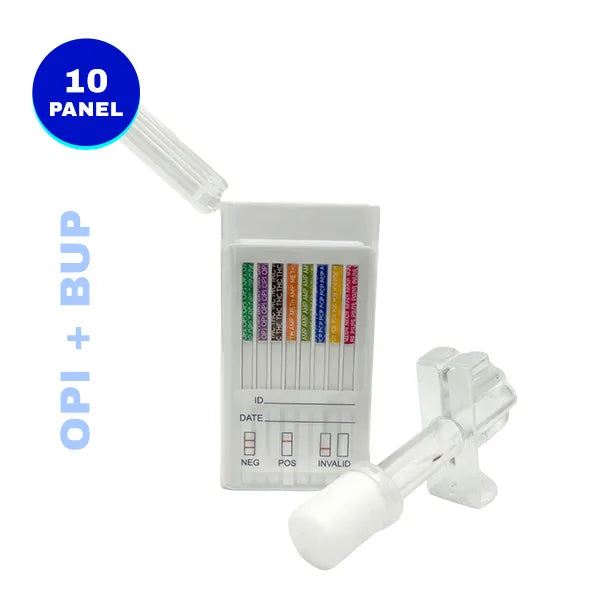
10-Panel CLIA-Waived Cup
Standard post-accident panel. THC, COC, OPI, AMP, MET, BAR, BZO, MTD, MDMA, OXY. Adulterant strip and temperature window.

Trailer-Grade Breath Alcohol Tester
Rugged EBT designed for site conditions. Operates 32 to 104°F, with a 6-month battery and single-use mouthpieces sized for trailer storage.
Oral Fluid Backup Swab
For workers who can't produce urine within the window, observed oral fluid collection eliminates the shy-bladder accommodation delay.
Post-Accident COC Forms (50-pk)
5-part carbonless COC with post-accident-specific notation: incident date/time, OSHA reportable flag, supervisor witness signature.
Job-Site Trailer Kit
25 × 10-panel cups, 25 × COC forms, 1 × EBT with 50 mouthpieces, 10 × oral fluid backup, 25 × tamper-evident bags. One kit per trailer.
Multi-Site Quarterly Subscription
Auto-restocks every trailer kit every 90 days. Adjustable per project phase. Multi-address shipping with single-PO billing.
Four moments construction testing fires.
Every construction-industry test maps to one of these four trigger events. ASC supplies are pre-positioned to handle all four without supply-chain lag.
Pre-Employment
Every new hire and sub crew lead tested before badge issuance. Documented in subcontractor prequal packet.
Post-Accident
OSHA recordable incident triggers same-shift testing, prioritizing breath alcohol first and drug screening as soon as practical.
Reasonable Suspicion
Supervisor-trained behavioral observation triggers a test under documented reasonable-suspicion protocol.
Return-to-Duty
Worker cleared after a positive returns through an MRO-cleared RTD test plus a documented follow-up testing schedule.
Sized to the project, not the calendar year.
Three ways to buy, from single-project evaluation orders to multi-site accounts.
Standard Order
For single-project GCs and small subs without an ongoing program yet.
- Pay by card
- Direct-to-job-site delivery
Subscribe & Save
Quarterly auto-ship to each trailer address. Single billing across all sites.
- Discounted recurring pricing
- Multi-address shipping
- Phase-synced cadence
- Pause when site demobs
PO & Multi-Site Terms
For ENR-ranked GCs and multi-state construction managers with formal procurement.
- Submit purchase orders for multi-site accounts
- ISN/Avetta documentation packets
- Dedicated account manager
- Workers' comp audit packets
Common questions from safety directors
What's the OSHA stance on post-accident testing right now?
Can subs use the GC's testing program?
How do we handle workers crossing state lines mid-project?
What's the workers' comp premium credit for construction?
Can we do "split specimen" for high-stakes positives?
What if the worker's union has a separate testing protocol?
How do you handle the test if the worker is being transported to ED?
Can a construction worker refuse a drug test?
Two ways to start.
Whether you're a single-project sub or a multi-state GC managing many sites, we'll configure trailer kits, ship to every site address, and bill on one PO.
- Direct-to-job-site delivery
- ISN/Avetta documentation packets
- Workers' comp audit-ready