
A job offer that comes with a drug test condition follows a fairly predictable sequence almost everywhere in the country. The specifics change depending on whether the employer is regulated by the Department of Transportation, what specimen type the program uses, and which state the candidate lives in, but the core steps are consistent. Knowing the sequence ahead of time removes most of the anxiety candidates feel walking into a collection site, and it helps employers set expectations correctly when they roll out a testing program.
The typical sequence from offer to result
Most pre employment programs follow this order:
- Conditional offer. The employer extends a job offer contingent on a negative drug screen. Making the offer conditional first, rather than testing during the interview process, is the standard approach employers use to avoid drug testing becoming a pre-offer medical inquiry. The Equal Employment Opportunity Commission draws a line between questions and exams an employer can ask before an offer and what can only happen after one, and drug tests for illegal drug use generally fall outside that pre-offer restriction, but the safest and most common practice is still to test after the offer is made, contingent on a negative result.
- Consent and paperwork. The candidate signs a consent form authorizing the collection and release of results, along with a chain of custody form if the specimen is urine or hair. The chain of custody form documents every person who handles the specimen from collection to disposal, which is what makes a result defensible if it is ever challenged.
- Collection. The candidate goes to a collection site, an occupational health clinic, or provides a specimen at an onsite testing station the employer sets up directly at the workplace. Onsite cup testing has become common for non-DOT employers because it avoids scheduling a separate clinic visit.
- Identification. The collector checks a photo ID against the paperwork before the collection begins. This step exists specifically to prevent a substitute donor from providing a specimen on someone else's behalf.
- Specimen collection and initial checks. For urine specimens, the collector checks the temperature strip on the cup within four minutes of receiving the specimen, since a temperature outside the expected range signals possible substitution or dilution. Under the federal collection procedure that regulated programs follow, the acceptable range is 90 to 100 degrees Fahrenheit, and anything outside that window triggers a second, directly observed collection.
- Screening and, if needed, lab confirmation. An instant cup or cassette gives a preliminary negative or non-negative result in minutes. A non-negative screen does not mean a failed test. It means the specimen goes to a certified laboratory for confirmation testing, which takes longer and uses a more precise method.
- MRO review for any non-negative result. A Medical Review Officer, a licensed physician trained in substance testing, reviews any non-negative laboratory result and gives the donor a chance to explain it with a valid prescription before it is reported to the employer as positive.
- Result reported to the employer. The employer typically only receives a negative, positive, refusal to test, or cancelled result, not the underlying drug names or levels unless state law requires more detail.
Urine, oral fluid, and hair: what's different
Employers choose a specimen type based on the detection window they need, how fast they need results, and whether observed collection is a concern.
| Specimen | Detection window | Collection privacy | Typical turnaround |
|---|---|---|---|
| Urine | Roughly 1 to 4 days for most drugs, longer for heavy chronic use | Private, unobserved unless a temperature or tampering flag triggers a direct observation | Minutes for a negative screen; several days if sent for lab confirmation |
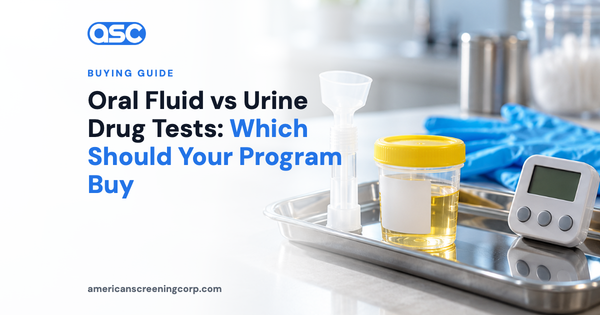
| Oral fluid (mouth swab) | Shorter window, generally hours up to about 1 to 2 days, reflects more recent use | Collected in view of the collector, harder to substitute or adulterate | Minutes for a negative screen; lab confirmation if non-negative |
| Hair | Roughly 90 days for a standard head hair sample | Collected in view of the collector | No instant screen; results come only from the lab |
Urine remains the specimen used for federally regulated DOT testing. The Department of Health and Human Services has also issued Mandatory Guidelines allowing oral fluid for federal workplace drug testing programs, which is part of why more employers outside the DOT space have shifted toward oral fluid for its faster, observed collection. Hair testing is not part of the federal regulated testing panel but is used by some employers for its longer look-back window.
How panels work: 5 panel vs 10 panel and beyond
A "panel" refers to how many drug classes the test screens for. A 5 panel test, the historical federal standard, checks for marijuana, cocaine, opiates, amphetamines, and PCP. A 10 panel adds drugs like benzodiazepines, barbiturates, methadone, propoxyphene, and methaqualone or similar substances depending on the exact configuration a vendor sells. Employers select a panel size based on their industry risk, state law, and whether they are subject to DOT rules, which specify their own required drug list rather than leaving panel choice to the employer.
How long results take
An instant cup or cassette test at the collection site or a clinic gives a negative result in minutes for most drug classes. That negative result is typically final. A non-negative screening result is not final. It goes to a certified laboratory for confirmation using a more specific testing method, and that confirmation step, plus the MRO review that follows, is what adds the extra time between a non-negative screen and a final reported result.
The MRO call about prescriptions
If the lab confirms a non-negative result, the Medical Review Officer contacts the candidate directly, usually by phone, before anything is reported to the employer as positive. The MRO asks about current prescriptions and medical explanations for the result. A verified, legitimate prescription for the substance detected typically results in the test being reported as negative to the employer, since the MRO's job under the federal verification process is to determine whether there is a legitimate medical explanation, not just to relay a lab number. Candidates who are taking a prescribed medication that could affect a screen should have that prescription information ready, since the MRO will ask for the prescribing provider's information to verify it.
Dilute results and shy bladder situations
A dilute specimen is one where the creatinine and specific gravity readings are lower than expected, usually because the donor drank a large amount of fluid before the test. Federal rules distinguish a dilute negative from a dilute positive, and what happens next depends on which one occurred and how dilute the specimen is. A substantially dilute negative in a non-DOT program often just gets reported as negative, while some employer policies require a recollection. A dilute positive is still reported as positive, since dilution does not erase a confirmed drug result.
A "shy bladder" situation happens when a candidate cannot provide enough urine for the test within the collection window. Federal collection procedure gives the donor up to three hours and requires they be encouraged to drink fluids reasonably during that time. If the donor still cannot produce a sufficient specimen, the case is typically referred for a medical evaluation to determine whether a legitimate medical condition explains the shortfall, and that evaluation can result in the test being processed as a refusal in some circumstances, or excused if a real medical condition is documented.
Split specimens and DOT testing
DOT-regulated urine collections split the specimen into two bottles at the time of collection. One is sent for the primary test, and the second stays sealed in storage. If a donor disputes a confirmed positive result, they can request the split specimen be sent to a different certified laboratory for an independent retest. This split specimen requirement is a core part of what makes DOT-regulated testing more procedurally rigorous than most non-regulated employer testing, and it exists specifically to give donors a documented way to challenge a result rather than just accepting the first lab's finding.
State law and marijuana
State laws on marijuana and employment testing vary widely and change over time. Some states with legal recreational or medical marijuana have passed protections limiting how an employer can act on an off-duty marijuana test result for non-safety-sensitive roles, while other states allow employers to enforce a zero-tolerance policy regardless of state legalization. None of these state protections apply to DOT-regulated safety-sensitive positions, where marijuana remains prohibited under federal transportation testing rules regardless of state law. Employers building or updating a testing policy should confirm current state requirements before acting on a marijuana result, since this is one of the fastest-moving areas of employment drug testing law.
Employer checklist before rolling out pre employment testing
- Written policy that states the panel, specimen type, and consequences of a positive, refusal, or dilute result, distributed to candidates before the offer stage.
- Consent and chain of custody forms ready for every collection, signed before the specimen is collected.
- A collection method decided in advance, onsite cup, oral fluid, or a clinic referral, based on turnaround needs and workforce size.
- A relationship with a certified laboratory and MRO for confirmation and review of non-negative results.
- A documented process for dilute results and shy bladder cases so collectors and HR are not improvising in the moment.
- Current state law review for marijuana and other substances, updated at least annually.
- Reliable supplies on hand, since a collection site running out of cups or dip cards on a high-volume hiring day creates delays and inconsistent testing across candidates. A dependable source for drug testing cups, dip cards, and oral fluid kits keeps a pre employment program running without gaps.
For a full walkthrough of each procedural step from an employer's side, see this pre employment drug testing step-by-step procedural guide. For more detail on how a non-negative result gets reviewed before it becomes final, see the Medical Review Officer process explained for employers.
Frequently asked questions
Can an employer test before making a job offer?
Most employers test after extending a conditional offer rather than before it, since testing at the pre-offer stage raises more legal complexity around medical inquiries. The Equal Employment Opportunity Commission outlines what employers can and cannot ask before an offer is made, and conditioning the offer on a negative drug screen is the standard, lower-risk approach most employers follow.
What happens if I can't produce enough urine for the test?
This is called a shy bladder situation. Federal collection procedure gives the donor up to three hours to produce a sufficient specimen and requires the collector to encourage reasonable fluid intake during that time. If the donor still cannot provide enough, the case is typically referred for a medical evaluation to determine whether a legitimate medical explanation applies.
Does a dilute result mean I failed?
Not necessarily. A dilute negative result usually still counts as negative, though some employer policies require a recollection. A dilute positive is still reported as positive, since dilution affects the concentration reading, not the fact that a drug was confirmed present.
Will my prescription medication show up as a failed test?
A prescribed medication can trigger a non-negative screen at the lab level, but the Medical Review Officer reviews any non-negative result and contacts the candidate to ask about current prescriptions before anything is reported to the employer as positive. A verified, legitimate prescription typically results in a negative report to the employer.
How long does it take to get pre employment drug test results?
A negative result from an instant cup or oral fluid screen is usually available within minutes at the collection site. A non-negative screen takes longer because it goes to a certified laboratory for confirmation testing, followed by Medical Review Officer review before a final result is reported.
Related reading
This article is general information, not legal or medical advice. Drug testing laws and procedures vary by state and by regulatory program, and employers and candidates should confirm current requirements for their specific situation.