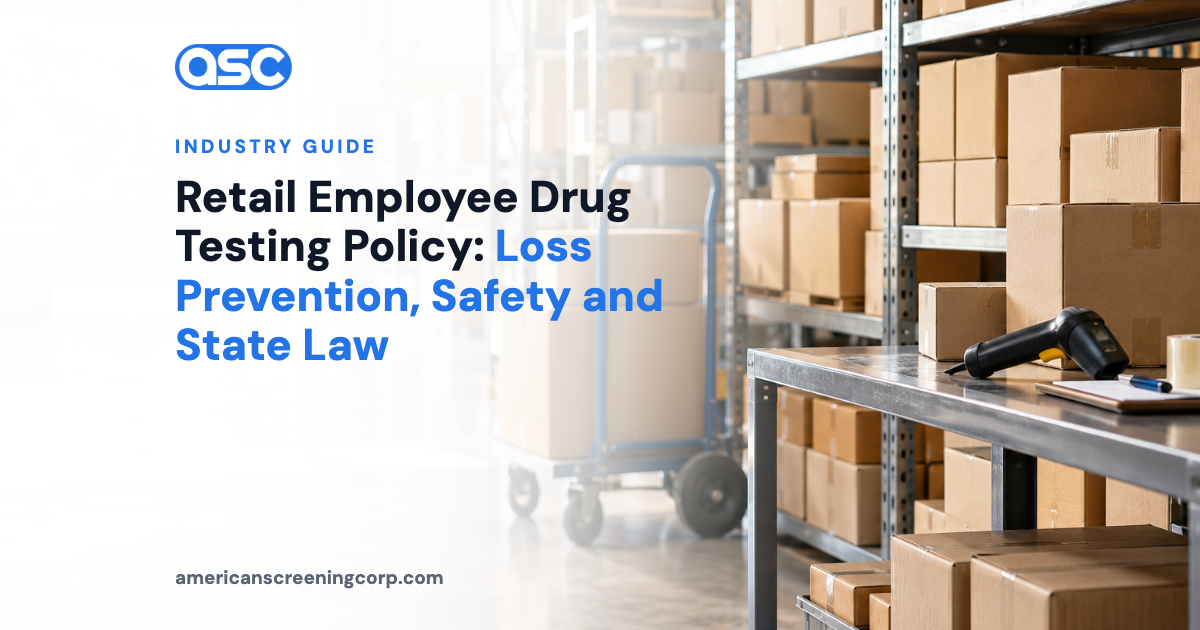
Most retail employers are not required by federal law to drug test anyone. That surprises store owners and HR leads who assume a baseline rule exists somewhere. There usually is not, unless a specific employee's duties pull them into a federal testing program. This guide covers when federal rules apply to retail, what state law typically allows or restricts, common program designs, and the policy and training steps that make a program defensible.
Is retail drug testing required by federal law
For the large majority of retail staff, cashiers, stock associates, sales floor workers, shift leads, there is no federal mandate to drug test. Federal testing requirements generally attach to specific jobs, not to an industry. The clearest example is 49 CFR Part 40, the Department of Transportation's drug and alcohol testing procedures, which apply to employees who hold a commercial driver's license and perform safety sensitive functions, such as a retailer's own commercial delivery drivers. A store running its own fleet of delivery trucks and employing CDL holders falls under that framework for those drivers. A cashier, stocker, or assistant manager who never touches a CDL regulated vehicle is not covered by Part 40 just because they work for the same company.
Outside that narrow DOT lane, retail employers that choose to test are generally doing so under their own policy, their state's laws, and ordinary employment principles, not a federal requirement. If unsure whether a role triggers a federal testing duty, the safest move is to review the actual job functions against the DOT modal rules referenced in Part 40, not to assume testing is either required or forbidden.
What state law allows and restricts
State law is where most of the real variation lives, and it varies enough that a policy written for one state will not necessarily work in another. Some states are permissive and let private employers test at will with few procedural hoops. Others require specific notice, written policies, confirmation testing, or an employee's right to explain a positive result before any adverse action. A growing number of states also give some protection to employees who use marijuana legally off duty, which changes how a positive THC result can be handled even where testing itself is allowed.
Nevada is a useful example of how specific this gets. Nevada Revised Statutes Chapter 613 addresses the use of marijuana by an employee away from the employer's premises and limits when an employer may act on a positive marijuana test, with exceptions for certain safety sensitive and federally regulated positions. A retailer operating in Nevada cannot treat a positive THC screen the same way it might in a state without that protection. Because this kind of rule differs by state and changes over time, a multi state retail chain should confirm the current rule in each state where it has stores, using the state's own legislature or labor department site as the source, not a vendor summary.
Why retailers test at all
Retail employers that choose to test usually point to reasons specific to the retail environment:
- Safety in the back of house. Stockrooms, box cutters, compactors, forklifts and pallet jacks, loading docks, and ladders create real injury risk, and impairment raises that risk.
- Loss prevention and diversion. Internal theft and inventory shrink are persistent retail problems, and some employers view testing as one part of a broader loss prevention program alongside cash handling controls and camera coverage.
- Workers compensation premium programs. Some states run a drug free workplace program that gives participating employers a discount on workers compensation premiums, with its own notice, policy, and testing requirements. Whether this applies is state specific and should be confirmed with the state's own workers compensation agency.
Common program designs for retail
Retail programs usually draw from the same menu of testing situations used across industries, but not every retailer uses every one. A table of the common elements is below.
| Program element | What it means in a retail setting | Typical consideration |
|---|---|---|
| Pre employment | Testing a candidate after a conditional offer, before the first shift | Must be applied consistently to avoid disparate treatment claims |
| Reasonable suspicion | Testing triggered by specific, documented observations from a trained supervisor, such as slurred speech or an on shift odor of alcohol | Supervisor training and written documentation of the observed behavior matter more than the test result alone |
| Post accident | Testing after a workplace injury, typically limited to situations where drug use could plausibly have contributed | OSHA notes blanket testing used to punish reporting raises retaliation concerns; target situations with plausible contribution, not every injury automatically |
| Random | Testing a subset selected by a neutral method, where state law allows it for non federally regulated private employees | More legally sensitive than in DOT covered jobs; review against state law before adoption |
On post accident testing, OSHA's injury and illness recordkeeping rule discusses how testing after an incident interacts with an employee's right to report injuries without fear of retaliation. OSHA's standard interpretation from October 2018 clarifies that most workplace drug testing, including testing to evaluate the root cause of an incident, is permissible, so long as the employer has an objectively reasonable basis and is not using testing as a pretext to punish reporting. OSHA's injury and illness recordkeeping page has the underlying rule. A post accident policy should apply based on the nature of the incident, not automatically to every reported injury.
Choosing a panel and collection method
Retail employers that test typically choose among a 5, 10, or 12 panel configuration, and between urine cup collection and oral fluid collection. Oral fluid testing is often attractive for store level collection because it is observed by design, needs no restroom setup, and is easier to run consistently across many small locations. Urine testing with an integrated cup can include adulterant checks such as pH, specific gravity, creatinine, and oxidant strips, which help flag an invalid or substituted specimen for follow up. Whatever panel and method a retailer selects, any nonnegative screening result should go through confirmation testing and medical review officer review before it is treated as final, since an immunoassay screen is preliminary, not a confirmed finding on its own.
Policy, training and the MRO step
A defensible retail drug testing program generally rests on four things working together, not on the test alone:
- A written policy stating what is tested for, when testing occurs, how specimens are collected, and what happens with results, distributed and acknowledged in writing.
- Supervisor training so anyone authorized to send an employee for reasonable suspicion testing can describe specific, observable behavior rather than a vague impression. DOT's own reasonable suspicion training framework under Part 40 is a reasonable model to borrow even for a non DOT program.
- A medical review officer who reviews any nonnegative result, gives the employee a chance to disclose a legitimate prescription, and only reports a verified result to the employer.
- Confirmation testing by a certified lab for any nonnegative screen, since a point of collection screen is preliminary and can be affected by cross reacting substances.
SAMHSA's Division of Workplace Programs maintains guidance on workplace drug testing program design, a useful reference even for employers not subject to federal testing rules.
Internal links and sourcing for retail programs
Retailers evaluating a random testing component should see how random drug testing selection works for how a defensible, neutral selection pool and rate are typically structured. Retailers considering whether a state workers compensation discount program applies to them should see workers comp drug testing premium discounts for how those state specific programs are generally set up.
Retail chains and multi location operators that need testing supplies in volume, cups, dip cards, or oral fluid devices, can review options through our drug test cup collection or our oral fluid test collection, and multi store or distributor volume accounts can set up ordering through the wholesale portal.
Frequently asked questions
Does federal law require retail stores to drug test employees
No, not as a general rule. Federal testing requirements generally apply to specific safety sensitive roles such as commercial drivers covered by DOT rules under 49 CFR Part 40, not to retail jobs broadly. A retailer should confirm whether any specific role actually falls under a federal program rather than assuming either way.
Can a retail employer fire someone for a positive marijuana test in a state with legal use
This depends entirely on the state. Some states give off duty legal marijuana users specific employment protections, with exceptions for safety sensitive or federally regulated roles, while other states give employers broad discretion. An employer may be able to act on a confirmed positive result depending on state law and the role involved, and should confirm the current rule with the state's own statutes rather than assuming a single national standard applies.
What drug panel do most retail employers use
There is no single standard. Retailers commonly choose a 5, 10, or 12 panel configuration based on the substances most relevant to their workforce and state, using either a urine cup or an oral fluid device, and send any nonnegative screen to confirmation testing.
Is post accident testing after every workplace injury allowed
OSHA guidance states that most drug testing conducted to investigate the cause of a workplace incident is permissible, but a policy that automatically tests after every reported injury regardless of circumstances, in a way that could be seen as retaliation for reporting, raises concerns under OSHA's recordkeeping rule. A policy tied to the specific facts of the incident is the safer design.
Do retail employers get a workers compensation discount for drug testing
Some states run a drug free workplace program that offers a premium credit or discount to employers who meet its specific policy, notice, and testing requirements. Whether this exists and what it requires varies by state, so a retailer should confirm directly with its state's workers compensation or labor agency.
Does a positive screening result mean an employee used drugs
Not by itself. A screening result is preliminary and can be affected by cross reacting substances or legitimate prescriptions. A nonnegative screen should go to laboratory confirmation and medical review officer review, which gives the employee a chance to provide a medical explanation, before any employment action is based on it.
This article is general information for employers and program administrators, not legal advice. Retailers should consult qualified counsel familiar with their state's laws before adopting or changing a drug testing policy.