
Anyone who orders drug testing supplies for a clinic, treatment program, staffing firm, court program or workplace eventually runs into the same question. Do you buy point of collection instant tests, send everything to a laboratory, or run a hybrid program that uses both. The right answer depends on what the result needs to do once you have it: hire someone fast, satisfy a federal regulation, hold up in a probation hearing, or support a clinical decision.
This guide breaks down what actually varies between instant and lab based testing, when a lab step is required rather than optional, and how to think about cost and staffing before you place a bulk order.
What "instant" actually means
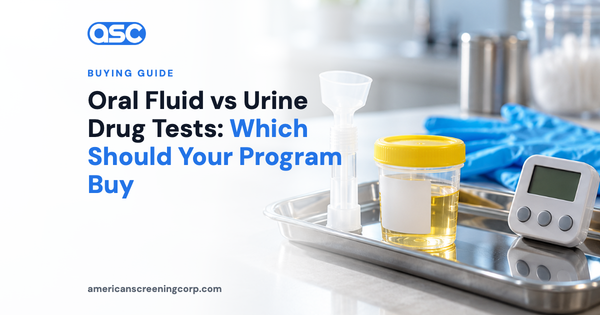
An instant, or point of collection, drug test is an immunoassay screen read at the collection site, typically in 5 to 10 minutes. These are sold as urine cups, dip cards, or oral fluid devices. Most products marketed for in house use in a clinic or workplace setting carry a CLIA waived categorization from the FDA, which means a non laboratory operator can run the test under relatively simple conditions. Some devices are labeled for forensic or professional use only, which signals a different quality control and documentation expectation, not a different read time.
Instant tests are screens. A screen tells you whether a specimen is presumptively positive or negative at a set cutoff concentration for each drug class. It does not identify the exact substance or confirm the finding chemically. That distinction matters for every decision below.
What "lab based" actually means
Lab based testing starts with a collection, often at a dedicated collection site with chain of custody paperwork, and the specimen is shipped to a laboratory. The lab runs an initial immunoassay screen and then confirms any non negative result with a more specific method such as gas chromatography mass spectrometry or liquid chromatography mass spectrometry. For federally regulated testing, a certified Medical Review Officer reviews every confirmed positive before it is reported to the employer, and the donor gets a chance to explain a legitimate medical explanation such as a valid prescription.
Turnaround for a lab result is typically measured in business days rather than minutes, because the specimen has to travel and the confirmation chemistry takes longer to run than an immunoassay strip.
When a lab step is not optional
Some testing is required to go through a laboratory and MRO process regardless of how fast an instant screen might be. The clearest example is U.S. Department of Transportation safety sensitive testing under 49 CFR Part 40, which sets the collection, laboratory, and MRO review requirements for DOT regulated employers. The current text of 49 CFR Part 40 is published on eCFR, and it specifies urine and, for some programs, oral fluid collection methods with laboratory confirmation and MRO verification built into the process.
Federal workplace programs more broadly, including testing tied to the Department of Health and Human Services mandatory guidelines, also route through certified laboratories. The 2017 Mandatory Guidelines for Federal Workplace Drug Testing Programs and the 2023 Mandatory Guidelines for oral fluid testing, both published in the Federal Register, describe the certified laboratory and review officer structure these programs rely on.
Beyond federal rules, some state laws and union or court program contracts set their own requirements for confirmation testing, chain of custody, or MRO review before a result can be used for an employment or compliance decision. State requirements vary, so a program that touches a state drug and alcohol testing statute, a collective bargaining agreement, or a court mandated testing order should have its legal or compliance counsel confirm what that specific authority requires before supplies are chosen.
The hybrid model most programs actually run
Many clinics, staffing firms, and treatment programs do not choose one or the other. They run an instant screen at intake or on a random testing day, and only specimens that come back non negative get sent out for laboratory confirmation. This keeps negative results fast and keeps non negative results defensible, because a definitive identification only happens when there is something to confirm.
The tradeoff is operational. A hybrid program needs a documented procedure for what happens the moment a screen reads non negative: how the specimen is secured, how chain of custody is preserved from that point forward, and who ships it to a laboratory. If that handoff is not written down and trained, a non negative screen can become a weak link instead of a safeguard. For the laboratory side of that handoff, a related post on what lab confirmation does after a non negative screen walks through what happens once a specimen leaves the collection site.
Comparison table: instant screen vs lab based testing
| Factor | Instant point of collection test | Lab based test |
|---|---|---|
| Result type | Presumptive screen only | Screen plus GC/MS or LC/MS confirmation on non negatives |
| Typical turnaround | 5 to 10 minutes on site | 1 to 3 business days after specimen receipt, longer if confirmation or MRO contact is needed |
| Who reads the result | Trained staff at the collection point | Certified laboratory, then a Medical Review Officer for non negatives |
| Regulatory classification | CLIA waived for most in house devices, some forensic use only | Laboratory operates under its own CLIA and SAMHSA or state certification |
| Required for DOT safety sensitive testing | No, DOT testing is defined in 49 CFR Part 40 and routes through certified labs and an MRO | Yes |
| Best fit | Pre employment speed, random testing days, intake triage, budget sensitive high volume programs | DOT and other federally mandated testing, union or court ordered testing with confirmation requirements, any result likely to be disputed or used in a hearing |
| Staff training need | Device specific read training and documentation of adulterant checks | Chain of custody and collection procedure training, plus coordination with the lab and MRO |
Cost drivers to think through before ordering
Price per device is only part of the real cost of a testing program. A few drivers tend to matter more over a full order cycle.
- Panel size and configuration. A device that screens for more drug classes costs more per unit but can reduce the number of non negatives that need a second, separate device or a lab add on panel.
- Adulterant and specimen validity checks. Cups and cards with built in creatine, pH, specific gravity or oxidant strips add a small per unit cost but catch substituted or diluted specimens before they reach a lab, which protects the integrity of the whole program.
- Confirmation volume. In a hybrid model, your real cost per completed result includes however many screens come back non negative and need lab confirmation. A higher non negative rate in a given population raises the effective cost of an instant first program.
- Staff time. Reading, documenting, and storing results at the collection site has a labor cost that a pure send out lab model avoids, but a pure lab model adds collection site fees and courier or shipping costs instead.
- Reorder friction. Running out of cups or cards mid program creates downstream costs in delayed hires or missed testing windows, which is where a standing business account with net terms and one click reordering through a wholesale portal, such as the one American Screening runs at wholesale.americanscreeningcorp.com, tends to pay for itself for higher volume buyers.
Documentation and defensibility
Whichever model you run, the paper trail is what makes a result usable later. For a program that may need to defend a decision in a grievance, hearing, or court proceeding, document the device lot number, read time, reader initials, any adulterant check result, and what happened to any non negative specimen from that point forward. A related post on the difference between DOT and non DOT drug testing covers how documentation expectations shift once a program is federally regulated versus a company policy program.
For programs that need forensic use only devices because results may be challenged, confirm the product packaging and FDA clearance status match that use case. A device cleared and labeled CLIA waived for professional in house screening is not automatically appropriate for every court or legal context, and the manufacturer's labeling is the source to check, not a sales description.
Buying guide: matching product class to program type
As a starting point for most non DOT programs, urine cups with an integrated adulterant strip cover the broadest range of use cases at a reasonable cost per test, and American Screening's drug test cup collection lists panel configurations by drug class. Programs that need observed, less invasive collection, such as some treatment or outpatient settings, often move to oral fluid devices, listed in the oral fluid collection. Dip cards remain a lower cost option for programs running high volume screening where a card format fits the workflow better than a cup, available in the dip card collection. Whichever format fits, confirm with your laboratory partner or MRO which analytes a given panel actually covers before you rely on it for anything beyond a basic five or ten panel screen. Newer substances, including kratom's mitragynine, generally require a dedicated test strip rather than a standard opiate panel, and the lab is the right place to ask which analytes its confirmation menu includes.
Frequently asked questions
Can an instant test result be used to make a final hiring or termination decision?
That depends on your program's policy and any applicable state law or union contract, which vary. Many employers treat a non negative instant screen as presumptive only and require lab confirmation before taking final action, since a screen alone has not been chemically confirmed. Employers should consult counsel about what their specific policy and jurisdiction require.
Does every instant drug test cup carry a CLIA waived classification?
No. Some devices are labeled for professional or forensic use only rather than CLIA waived in house use. The classification is specific to the product and its FDA clearance, and buyers should check the product listing and insert rather than assume.
Is lab confirmation required for every non negative instant screen?
For DOT regulated testing under 49 CFR Part 40, yes, confirmation and MRO review are part of the required process. For non regulated workplace programs, it depends on the employer's own policy, and many programs choose to confirm every non negative as a matter of practice to support a defensible result.
How much faster is an instant test than a lab test?
An instant screen typically reads in 5 to 10 minutes at the collection site. A lab based result, including shipping and confirmation if needed, typically takes 1 to 3 business days, and longer if the Medical Review Officer needs to reach the donor.
What is the main reason a program would skip instant testing entirely?
Federal safety sensitive testing under DOT rules, along with some state laws and union or court program contracts, requires the certified laboratory and MRO process regardless of how an initial screen is run, so some programs go straight to a lab based collection to keep the workflow aligned with that requirement.
Can a hybrid program mix instant cups with lab confirmation for the same specimen?
Yes, this is the hybrid model many clinics and employers use. The collection site runs an instant screen, and only non negative results get forwarded to a laboratory for confirmation, provided the chain of custody for that specimen is maintained from the moment the screen reads non negative.
This article is general information for program planning and purchasing decisions, not legal or medical advice. Employers should consult qualified counsel and their Medical Review Officer about specific policy, state law, and contract requirements.