
Anyone ordering testing supplies for a clinic, treatment program, staffing desk, or workplace eventually hits the same question: how many panels do we actually need. The honest answer is that it depends on the population being tested, the setting, and the budget per test, not on which number sounds the most thorough. This guide lines up the three most common configurations, 5 panel, 10 panel, and 12 panel, so the person placing the order can match the product to the program instead of guessing.
Panel counts describe how many drug classes a single immunoassay device screens for. A 5 panel test strip, cup, or dip card checks for five drug classes at once. A 10 panel checks for ten. The exact analyte list is set by the manufacturer for commercial products, so two products both labeled 12 panel can still test for a slightly different mix. Before ordering in volume, always pull the package insert or product specification sheet for the specific item and confirm the analyte list and cutoff levels match the program's policy.
Where the panel numbers come from
The federal government does not set a single universal civilian panel standard. What exists is the Mandatory Guidelines for Federal Workplace Drug Testing Programs, issued by the Department of Health and Human Services through the Substance Abuse and Mental Health Services Administration, which governs testing for federal agencies and federally regulated transportation employees under 49 CFR Part 40. Those guidelines define specific analytes and cutoff concentrations for the drug classes regulated employers must test, including marijuana metabolite, cocaine metabolite, opioids, phencyclidine, and amphetamines, and they have been expanded over time to add semi synthetic opioids. The current rule text is published through the Federal Register, and the Department of Transportation's own testing procedures sit in 49 CFR Part 40 on eCFR.
Commercial 5, 10, and 12 panel products sold for pre employment, staffing, treatment, and probation use are not the same as the federal regulated panel, even when they screen for overlapping drug classes. SAMHSA publishes general workplace testing program background on its own site, including guidance for non regulated employers, at samhsa.gov/workplace. The practical takeaway for a buyer is that "12 panel" on a box is a manufacturer's labeling convention, not a federal category, so the specific analyte list on that product's documentation is what actually governs what gets detected.
Typical configurations by panel count
Configurations vary between manufacturers and even between product lines from the same manufacturer, so treat the table below as a starting point for comparison shopping, not a universal spec. Always confirm the analyte list and cutoff on the specific product listing before ordering a case.
| Panel count | Typical drug classes added | Typical primary use | Adulterant check | Common format |
|---|---|---|---|---|
| 5 panel | Marijuana (THC), cocaine (COC), amphetamines (AMP), opiates (OPI), phencyclidine (PCP) | General pre employment screening, DOT look alike panels, basic staffing checks | Usually not included, sold separately | Dip card, cassette, cup |
| 10 panel | Adds benzodiazepines (BZO), barbiturates (BAR), methadone (MTD), methaqualone or propoxyphene depending on manufacturer, and often MDMA | Most general employers, staffing agencies, broader pre employment and random programs | Sometimes integrated (pH, creatinine, specific gravity) | Cup with integrated strip, dip card panel |
| 12 panel | Adds expanded opioids such as oxycodone (OXY) and buprenorphine (BUP), plus integrated adulterant strips in most clinical formats | Treatment programs, probation and court programs, clinical monitoring, employers wanting broader opioid coverage | Typically integrated as standard | Multi panel cup with built in adulterant strip |
Within opiate and opioid screening specifically, buyers should not assume a 5 or 10 panel automatically covers oxycodone, buprenorphine, or fentanyl. Older style opiate panels were built around morphine, codeine, and 6 acetylmorphine, and semi synthetic and synthetic opioids often require a separate analyte or an expanded panel. The same caution applies to emerging substances such as kratom: a standard panel does not detect mitragynine unless the product specifically includes a KRA strip, and rapid panels do not resolve newer kratom related compounds at all. Lab confirmation is the only way to identify analytes outside what a given rapid panel targets, and the ordering clinic or program should ask the confirmation lab directly which analytes its menu covers.
CLIA waived versus forensic use only
Every rapid drug test device sold in the United States carries one of two labeling statuses tied to its FDA clearance: CLIA waived, meaning it can be used in a point of care setting such as a clinic, treatment program, or employer health unit without a high complexity laboratory certificate, or forensic use only (sometimes labeled FUO), meaning results are intended for a controlled, legally defensible chain of custody process rather than point of care medical decisions. Products are not interchangeable across these categories. A buyer should confirm the CLIA status printed on the specific product's FDA listing before using it for employment decisions or court reporting. The FDA maintains a searchable CLIA database at accessdata.fda.gov, and the agency's own CLIA program overview is at fda.gov. The Centers for Medicare and Medicaid Services administers the underlying CLIA certification program and publishes current requirements at cms.gov/clia. No test should be described as approved by FDA; the accurate terms are FDA cleared or CLIA waived, and only when that status is documented for the exact product.
Who typically orders each panel
5 panel
General pre employment screening and lower budget programs often start with a 5 panel because it covers the drug classes most commonly associated with safety sensitive impairment at the lowest per unit cost. Some employers use a 5 panel configuration that mirrors the drug classes in the DOT regulated panel as a baseline, even though the product itself is not a DOT test unless it is used under a full Part 40 collection and chain of custody process.
10 panel
Most general employers and staffing firms land on a 10 panel because it adds benzodiazepines and other commonly prescribed or misused sedatives without the added adulterant hardware that drives up cost in clinical formats. It is a reasonable middle option when the hiring population includes safety sensitive roles but the program is not clinical in nature.
12 panel
Treatment programs, probation and court supervised testing, and clinical monitoring settings tend to order 12 panel configurations because they need broader opioid coverage and because integrated adulterant detection (checking for diluted, substituted, or tampered specimens) is close to a requirement in that setting. A court or probation program's compliance exposure is different from a retail employer's, so the extra analytes and adulterant strip are usually worth the added per unit cost for that buyer.
Prescription drugs and the gap between a screen and a confirmed result
A rapid panel is a screening tool. It returns a preliminary positive or negative based on an immunoassay cutoff concentration, not a confirmed identification of a specific drug. Many legitimate prescriptions, including benzodiazepines, certain opioids, and some other medications, can trigger a preliminary positive on the relevant panel. That is expected and is exactly why the process does not stop at the screening device. A non negative screening result should go to a laboratory for confirmation testing, typically by gas chromatography mass spectrometry or liquid chromatography mass spectrometry, and in regulated DOT testing the specimen collection, screening, and confirmation process is reviewed by a Medical Review Officer who contacts the individual about any legitimate prescription before a result is reported as verified positive. The MRO review and verification process is defined in 49 CFR Part 40, Subpart G. Programs should never treat a screening cup or card result alone as a final employment or clinical decision; it is a trigger for confirmation, not a verdict.
Picking within a budget
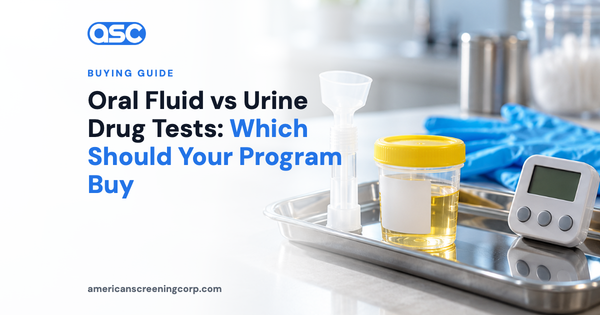
A practical way to decide is to separate the question of panel count from the question of adulterant checking and format. A high volume staffing program running thousands of pre employment screens a month may be better served by a reliable 5 or 10 panel cup without integrated adulterant strips, saving the extra analytes for a smaller population flagged for follow up. A treatment or probation program testing a smaller, higher risk population repeatedly over time generally gets more value from a 12 panel cup with built in adulterant detection, even at a higher per unit cost, because the cost of a missed dilution or substitution is higher in that setting. Oral fluid devices are worth comparing for observed, same day collection use cases where chain of custody and privacy are harder to manage with a urine cup; a relevant comparison for clinics and treatment settings is the 12 vs 14 vs 18 panel drug test cup comparison, and employers deciding between a leaner and a broader commercial panel may also want the 6 panel vs 10 panel comparison for a narrower budget tier.
American Screening Corporation supplies drug test cups, dip cards, and oral fluid devices across these panel configurations for clinics, treatment programs, staffing firms, court and probation programs, and employers; the current cup lineup is browsable at the drug test cups collection. Business accounts ordering by the case, including clinics and programs that reorder on a routine schedule, can set up net terms and purchase order checkout through the wholesale portal, which also supports one click reordering once an account is on file.
Frequently asked questions
Is a 12 panel test always more accurate than a 5 panel test?
No. Panel count reflects how many drug classes a device screens for, not how accurate the screen is for the classes it does include. A 5 panel and a 12 panel product can use the same immunoassay technology and the same cutoff reliability for the drug classes they share; the 12 panel simply adds coverage for additional classes.
Can a rapid panel test tell the difference between a prescription and illegal use?
No. A screening device returns a preliminary result based on a cutoff concentration. It cannot distinguish a prescribed medication from unauthorized use. That distinction is made during laboratory confirmation and, in regulated testing, during Medical Review Officer review of prescription documentation.
Does a 10 panel or 12 panel test detect kratom?
Not unless the product specifically includes a dedicated KRA strip for mitragynine. Standard panels do not detect kratom compounds, and rapid panels in general do not resolve related compounds such as 7-OH. A program that needs to screen for kratom should ask the lab which analytes its confirmation menu covers.
What does CLIA waived mean on a drug test cup or card?
CLIA waived means the FDA has cleared the specific device for use in a point of care setting without requiring a high complexity laboratory certificate. The status applies to the exact product and configuration listed in the FDA's CLIA database, not to panel counts in general.
Should a probation or treatment program use the same panel as a general employer?
Not necessarily. Programs with repeated testing of a known population and higher compliance stakes, such as probation, court, and treatment settings, commonly choose a 12 panel configuration with integrated adulterant checking, while general pre employment programs often use a leaner 5 or 10 panel for cost efficiency.
This article is general information for buyers choosing drug testing supplies. It is not legal or medical advice. Employers and programs should consult qualified counsel or a Medical Review Officer for decisions specific to their policy or jurisdiction.