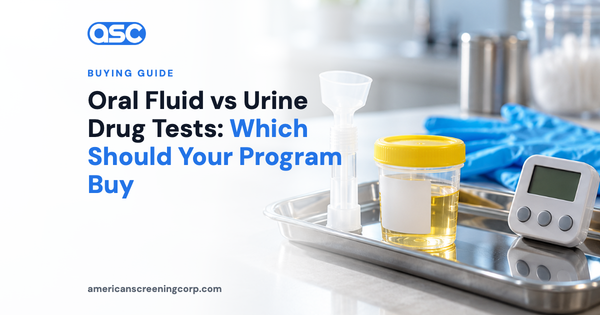

Una prueba de drogas de hisopo bucal, o de fluido oral, tiene un período de detección mucho más corto que una prueba de orina o de cabello. Está diseñada para detectar el uso reciente, generalmente el último día o dos, no el consumo de drogas de semanas antes. Esa ventana corta no es un defecto en la tecnología. Es la razón por la que los empleadores, los tribunales y los programas de tratamiento eligen el fluido oral en primer lugar: un resultado positivo apunta a algo que sucedió cerca de la prueba, lo que facilita la conexión del resultado con un turno, incidente o referencia de sospecha razonable específicos.
Por qué el período es mucho más corto que el de la orina
Las pruebas de orina detectan principalmente metabolitos de drogas, los subproductos que el cuerpo crea después de procesar una sustancia y que los riñones filtran con el tiempo. El fluido oral funciona de manera diferente. Según los Institutos Nacionales de Salud, las concentraciones de fluido oral se correlacionan estrechamente con los niveles plasmáticos, y las pruebas de fluido oral tienen más probabilidades de identificar la droga original en sí misma en lugar de un metabolito secundario, a diferencia de las pruebas de orina, que detectan principalmente metabolitos (NIH Bookshelf, Drug Testing). Una droga y su concentración en la saliva suelen alcanzar su punto máximo poco después del consumo y disminuyen a medida que el cuerpo la elimina del torrente sanguíneo, por lo que una vez que la droga original sale de la circulación, también sale del fluido oral. La orina, por el contrario, sigue acumulando metabolitos que los riñones ya han filtrado de la sangre, lo que es parte de por qué la orina puede permanecer positiva durante días o más después de que el fluido oral ya se haya eliminado.
Los reguladores federales han señalado lo mismo directamente. Cuando el Departamento de Transporte finalizó su norma que agrega las pruebas de fluido oral, declaró que las pruebas de fluido oral pueden detectar el uso reciente de algunas drogas, incluida la marihuana y la cocaína, mientras que las pruebas de drogas en orina tienen un período de detección más largo (DOT final rule, Federal Register). Esa es la compensación en una oración: el fluido oral cambia un período de retrospectiva más largo por una conexión más estrecha con el uso reciente.
Ventanas de detección generales por droga
Qué tan atrás puede detectar un hisopo bucal una droga específica depende de la dosis, la frecuencia con la que la persona la usa, el metabolismo individual y la química específica de la droga. Por esta razón, los reguladores han sido cautelosos al publicar una tabla fija de recuentos de días exactos. Cuando el DOT distribuyó una tabla de ventanas de detección durante su propia elaboración de normas, los comentaristas se opusieron enérgicamente, y el DOT finalmente eliminó la tabla de la norma final, acordando que cualquier tabla de este tipo podría quedar rápidamente desactualizada o ser engañosa dado lo mucho que varían los tiempos de detección según la dosis, la vía de administración y la tasa metabólica individual (DOT final rule, Federal Register).
Con esa precaución en mente, los rangos generales a continuación reflejan el patrón bien establecido en la toxicología del fluido oral: una ventana medida en horas a unos pocos días, no semanas.
| Droga o clase de droga | Período de detección típico en fluidos orales | Por qué |
|---|---|---|
| THC (marihuana) | Aproximadamente un día para uso ocasional; hasta unos dos o tres días con uso frecuente o intenso | El THC original se elimina rápidamente de la saliva después de fumar o vapear; los comestibles y el uso crónico intenso prolongan un poco el período |
| Cocaína | Aproximadamente uno o dos días | La cocaína original y su metabolito benzoilecgonina se eliminan del fluido oral en un corto período |
| Opiáceos (codeína, morfina, marcador de heroína 6-AM) | Aproximadamente uno o dos días | Refleja la dosificación reciente en lugar de los metabolitos urinarios acumulados |
| Anfetaminas / metanfetamina | Aproximadamente uno o dos días | Los estimulantes se eliminan de la saliva en un período de tiempo similar al de la sangre |
| Benzodiazepinas | Aproximadamente uno o dos días, más variable según la droga específica | Las benzodiazepinas de acción corta versus las de acción prolongada se eliminan a diferentes velocidades |
| Alcohol | Varias horas | Las pruebas de alcohol en fluidos orales rastrean el consumo muy reciente, similar a las pruebas de alcohol en aliento |
Estos son rangos generales, no garantías para ningún caso individual. Una sola dosis ligera puede eliminarse más rápido de lo que sugieren estos rangos, y el uso intenso y frecuente puede acercar un resultado al extremo superior. Esta es también la razón por la que los resultados de fluidos orales se tratan como evidencia de uso reciente en lugar de prueba de deterioro. El DOT fue explícito en este punto: si bien las pruebas de fluidos orales pueden proporcionar un mejor indicador del uso reciente de una droga por parte de un empleado, eso no es lo mismo que una prueba de deterioro, y el fluido oral también detecta a los usuarios frecuentes, no solo a las personas que consumieron poco antes de la prueba (DOT final rule, Federal Register).
Los niveles de corte detrás de un resultado positivo
El período de detección y el nivel de corte son dos cosas diferentes. El corte es la concentración que una muestra debe alcanzar antes de que se informe un resultado positivo, y se establece por separado de la cuestión de cuántas horas o días persistirá esa concentración. El Departamento de Salud y Servicios Humanos (HHS) publica los cortes oficiales para los programas federales en el lugar de trabajo en las Directrices Obligatorias para los Programas Federales de Pruebas de Drogas en el Lugar de Trabajo Utilizando Fluido Oral, a menudo llamadas OFMG. Las directrices actuales entraron en vigor el 10 de octubre de 2023 (SAMHSA Mandatory Guidelines for Oral Fluid, Federal Register). Los cortes federales para las pruebas iniciales y de confirmación son:
| Analito de prueba inicial | Corte de prueba inicial | Analito confirmatorio | Corte confirmatorio |
|---|---|---|---|
| Marihuana (THC) | 4 ng/mL | THC | 2 ng/mL |
| Cocaína/Benzoilecgonina | 15 ng/mL | Cocaína / Benzoilecgonina | 8 ng/mL cada uno |
| Codeína/Morfina | 30 ng/mL | Codeína / Morfina | 15 ng/mL cada uno |
| Hidrocodona/Hidromorfona | 30 ng/mL | Hidrocodona / Hidromorfona | 15 ng/mL cada uno |
| Oxicodona/Oximorfona | 30 ng/mL | Oxicodona / Oximorfona | 15 ng/mL cada uno |
| 6-Acetilmorfina (marcador de heroína) | 4 ng/mL | 6-Acetilmorfina | 2 ng/mL |
| Fenciclidina (PCP) | 10 ng/mL | Fenciclidina | 10 ng/mL |
| Anfetamina/Metanfetamina | 50 ng/mL | Anfetamina / Metanfetamina | 25 ng/mL cada uno |
| MDMA/MDA | 50 ng/mL | MDMA / MDA | 25 ng/mL cada uno |
Este es el panel federal de cinco drogas más los opioides adicionales, las drogas y los niveles de corte requeridos en los programas federales en el lugar de trabajo. Los paneles clínicos y de empleadores no federales pueden agregar analitos como las benzodiazepinas, pero esas adiciones son establecidas por el programa individual, no por las directrices federales.
¿Ya está autorizada la prueba de fluidos orales para los empleadores regulados por el DOT?
El DOT finalizó una norma que permite las pruebas de fluidos orales en todas sus industrias reguladas, con fecha de entrada en vigor del 1 de junio de 2023 (DOT final rule, Federal Register). Sin embargo, esa norma contiene una condición: antes de que cualquier empleador regulado por el DOT pueda usar fluidos orales para satisfacer una prueba federal obligatoria, el HHS debe certificar al menos dos laboratorios para realizar pruebas de drogas y de validez de muestras de fluidos orales. Según el aviso más reciente del HHS que enumera los laboratorios certificados, eso no ha sucedido. El HHS declara claramente que, en este momento, no hay laboratorios certificados para realizar pruebas de drogas y de validez de muestras en especímenes de fluidos orales (HHS-certified laboratories notice, Federal Register). Los procedimientos completos para las pruebas de drogas y alcohol reguladas por el DOT, incluida la forma en que el fluido oral encaja junto con la orina una vez que esté disponible, están codificados en 49 CFR Parte 40.
En términos prácticos, eso significa que los empleadores de transporte por carretera, aviación, ferrocarril y otros cubiertos por el DOT aún no pueden sustituir el fluido oral por una prueba federal requerida. Los programas laborales no DOT, la detección previa al empleo, la libertad condicional y las pruebas ordenadas por la corte, y los entornos clínicos no están sujetos a ese requisito de certificación de laboratorio y han sido libres de adoptar las pruebas de fluidos orales según sus propios términos, lo cual es una gran parte de por qué las pruebas de saliva se han expandido más rápido fuera del espacio regulado por el DOT.
Qué sucede durante la recolección
El procedimiento de recolección federal da una buena imagen de cómo se supone que debe funcionar una recolección de fluido oral conforme a la normativa, y la mayoría de los protocolos de programas privados siguen una secuencia similar. Antes de usar el hisopo, el recolector inspecciona la boca del donante en busca de cualquier cosa que pueda interferir con la muestra, como comida, chicle, dulces o tabaco. Si la boca del donante parece seca o hay algo que necesita ser enjuagado, el recolector puede ofrecer hasta unos cuatro onzas de agua, y se permite al donante beberla. Después de esa inspección, el recolector inicia un período de espera obligatorio de diez minutos antes de que se recoja la muestra, durante el cual el recolector explica el procedimiento y responde preguntas mientras mantiene al donante en el lugar de recolección (SAMHSA Mandatory Guidelines for Oral Fluid, Federal Register). Ese período de espera, más la revisión de la boca de antemano, es la respuesta práctica a la pregunta común sobre comer o beber antes de una prueba de hisopo bucal: la comida, el chicle o el enjuague bucal recientes se abordan al comienzo de la recolección, no se dejan al azar.
Por qué la recolección de fluidos orales es más difícil de falsificar
A diferencia de una recolección de orina, que puede hacerse en privado a menos que se active específicamente la observación directa, una recolección de fluido oral se observa inherentemente. El recolector observa cómo el hisopo entra en la boca del donante y cómo sale. Durante la elaboración de la normativa de las OFMG, el HHS estuvo de acuerdo con los comentaristas en que, debido a que las recolecciones de fluido oral son observadas y los dispositivos de recolección deben tener indicadores de volumen, no existen productos de subversión efectivos conocidos para las muestras de fluido oral en este momento (SAMHSA Mandatory Guidelines for Oral Fluid, Federal Register). Esa observación incorporada es una de las ventajas prácticas más claras que el fluido oral tiene sobre la recolección de orina, donde las pausas de privacidad, la sustitución y los intentos de dilución son problemas recurrentes contra los que los recolectores deben protegerse.
Cuando los empleadores eligen el fluido oral sobre la orina
Dada la corta ventana de detección, el fluido oral tiende a encajar mejor donde el uso reciente es exactamente lo que el programa quiere saber: pruebas posteriores a accidentes, derivaciones por sospecha razonable y programas de pruebas aleatorias donde una recolección rápida, observada y difícil de engañar importa más que un largo período de retrospectiva. La orina todavía tiene una ventaja para los programas que desean una ventana de detección más larga, como algunas pruebas de preempleo donde el objetivo es un historial de uso más amplio en lugar de una instantánea del último día o dos. Muchos programas ahora tienen ambos formatos y dejan que la situación decida qué tipo de muestra usar, que es una de las razones por las que los empleadores que sopesan las pruebas de fluido oral frente a las pruebas de orina a menudo terminan realizando ambas en lugar de elegir una exclusivamente. Para una visión más amplia de por qué más programas en el lugar de trabajo han agregado las pruebas de saliva a su conjunto de herramientas, consulte esta descripción general de las tendencias de las pruebas de drogas en fluidos orales. Los empleadores que desarrollan un programa pueden obtener kits de fluidos orales y vasos de orina a través de la colección de pruebas de drogas de American Screening Corp.
Preguntas frecuentes
¿Un hisopo bucal muestra el consumo de drogas de hace semanas?
No. Las pruebas de fluidos orales se basan en el uso reciente, generalmente el último día o dos, según la droga, la dosis y la frecuencia de uso de la persona. No se remontan a semanas como las pruebas de cabello, y normalmente no permanecen positivas tanto tiempo como las pruebas de orina.
¿Por qué la ventana de detección de fluidos orales es más corta que la de la orina?
Las concentraciones de fluidos orales se correlacionan estrechamente con los niveles plasmáticos sanguíneos y reflejan en gran medida la droga original, mientras que las pruebas de orina detectan principalmente metabolitos que los riñones ya han filtrado con el tiempo. Una vez que una droga se elimina del torrente sanguíneo, también se elimina del fluido oral, mientras que la orina puede seguir mostrando metabolitos durante más tiempo.
¿Comer o beber antes de la prueba puede afectar el resultado?
El procedimiento de recolección está diseñado para tener esto en cuenta. Los recolectores inspeccionan la boca del donante antes de tomar la muestra y pueden ofrecer agua para enjuagar si es necesario, luego ejecutan un período de espera requerido antes de que se recolecte la muestra.
¿El DOT ya permite las pruebas de drogas en fluidos orales?
El DOT finalizó una norma que permite las pruebas de fluidos orales, pero la implementación depende de que el HHS certifique al menos dos laboratorios para las pruebas de fluidos orales. Según el aviso federal más reciente, no se han certificado laboratorios, por lo que los empleadores regulados por el DOT aún no pueden usar fluidos orales para satisfacer una prueba requerida federalmente.
¿Un resultado positivo en una prueba de fluidos orales significa que alguien está actualmente afectado?
No. Los reguladores han sido claros en que las pruebas de fluidos orales indican uso reciente, no deterioro. No existe una prueba de deterioro definitiva incorporada en los paneles estándar de pruebas de drogas, y un resultado positivo refleja que la droga se usó lo suficientemente recientemente como para estar presente, no una medida del efecto actual.
Lecturas relacionadas
Este artículo es información general, no asesoramiento legal o médico. Las ventanas de detección varían según el individuo, la dosis, la frecuencia de uso y el programa de pruebas, y los empleadores y los programas de pruebas deben confirmar los requisitos actuales con las reglas federales, estatales o específicas del programa aplicables antes de tomar decisiones sobre las pruebas.