
Every drug test cup, dip card, or oral fluid device is built around a panel, the set of drug classes a single device screens at once. Picking the wrong panel size is a common and costly mistake when setting up a testing program. Too narrow, and the device misses substances the population actually uses. Too broad, and the buyer pays for analytes that never apply and generates confirmation costs that were not budgeted. This guide covers what a panel is, the federal five analytes, why programs add more, and how to match a panel to a use case before ordering supplies.
What a panel number actually means
The number in "5 panel" or "12 panel" refers to the count of drug classes a single screening device is manufactured to detect, not the number of specific drugs. A single panel for opiates can flag several related substances at once because the immunoassay reacts to a class of structurally similar molecules, not one named chemical. The configuration is printed on the box and package insert as a list of abbreviations, commonly AMP (amphetamine), COC (cocaine), THC (marijuana metabolite), OPI (opiates), PCP (phencyclidine), BZO (benzodiazepines), BAR (barbiturates), MTD (methadone), OXY (oxycodone), BUP (buprenorphine), PPX (propoxyphene), TCA (tricyclic antidepressants), FEN (fentanyl), ETG (ethyl glucuronide, an alcohol metabolite used in abstinence monitoring), K2 (synthetic cannabinoids), KRA (kratom/mitragynine), and TRA (tramadol). Each abbreviation corresponds to a specific antibody and cutoff, so a device that does not list it will not reliably flag that substance.
This matters most for emerging substances. A standard opiate or synthetic cannabinoid panel does not automatically cover kratom. Detecting mitragynine requires a dedicated KRA strip, and even then rapid screens generally do not separately flag related compounds such as 7-hydroxymitragynine. If a program needs to confirm exposure to an analyte that is not a named panel component, the correct step is lab based confirmation, and the ordering clinic or employer should ask the lab directly which analytes its method covers rather than assume a rapid panel caught it.
The federal five and where it came from
The baseline most workplace programs still reference traces back to the Mandatory Guidelines for Federal Workplace Drug Testing Programs, first issued by the Department of Health and Human Services and expanded over time to cover urine and, more recently, oral fluid specimens. The historical "federal five" screened for marijuana metabolites, cocaine metabolites, amphetamines, opiates, and phencyclidine, with methodologies, cutoffs, and confirmation requirements set out in Federal Register notices that HHS updates periodically. Employers subject to DOT testing rules under 49 CFR Part 40 must use panels and procedures that track these federal guidelines exactly, including collection, laboratory certification, and medical review officer verification of any non-negative result. Non-DOT employers are not bound by Part 40, but many choose a "DOT look alike" panel anyway because it is a well documented, defensible baseline.
The Substance Abuse and Mental Health Services Administration maintains current information on the certified laboratory program and the mandatory guidelines that govern federal specimen testing, including the shift to allow oral fluid alongside urine. Programs that are not federally mandated can add panel positions beyond the federal five to match their population, but a panel broader than necessary for the job can raise questions in a dispute, and a panel narrower than the risk being managed may fail to catch what it was meant to catch.
Cutoffs, screening and confirmation
Every panel position has a cutoff concentration, the minimum level of drug or metabolite that must be present for the device to flag a presumptive positive. A rapid cup, dip card, or oral fluid device is an immunoassay screen. It is fast and inexpensive, but a non-negative screen is a presumptive result, not a confirmed one. Federal guidelines and most defensible programs require that any non-negative go to a certified laboratory for confirmation by a more specific method, typically gas or liquid chromatography combined with mass spectrometry, before anyone acts on the result. Confirmation runs at a different, usually lower, cutoff than the initial screen, and a medical review officer reviews any confirmed non-negative to rule out a legitimate medical explanation, such as a valid prescription. Buying a panel with the right cutoffs matters less than having a plan for where every non-negative screen goes next; screening without a confirmation and MRO pathway is not a defensible program.
CLIA waived versus forensic use only
The label on a drug test device will say either that it is CLIA waived or that it is for forensic use only (sometimes labeled prescription or professional use). This distinction controls who can run the test and under what conditions, and it is separate from panel size. CLIA waived devices meet the simplicity and low error risk standard under the Clinical Laboratory Improvement Amendments, administered by the Centers for Medicare and Medicaid Services, and can be run in a broader range of settings, including some physician office and point of care locations, under a certificate of waiver. Devices marked forensic use only or professional use are intended for trained collectors following a defined chain of custody and are not necessarily appropriate for a clinical point of care setting. Before ordering, check a specific device's current CLIA categorization in the FDA's CLIA database rather than relying on marketing language, and never describe a product as "approved by FDA," since drug test devices go through FDA clearance or CLIA waiver categorization, not an approval pathway.
Decision guide by use case
| Setting | Typical panel approach | Why |
|---|---|---|
| DOT regulated employer | DOT panel under 49 CFR Part 40 procedures, lab based with MRO review | Required specimen types, cutoffs, and chain of custody are set by federal rule, not employer choice |
| Non-DOT employer wanting a defensible baseline | "DOT look alike" 5 to 7 panel | Uses a well documented federal cutoff set without being bound by Part 40 collection rules |
| Staffing and light industrial | 5 to 10 panel | Covers common safety sensitive concerns (THC, cocaine, amphetamines, opiates, PCP) without paying for panel positions irrelevant to the role |
| Treatment and medication assisted treatment programs | Expanded panel adding BUP, MTD, FEN, ETG as clinically appropriate | Needs to track prescribed medication compliance and relapse risk, not just illicit use, and often monitors alcohol abstinence via ETG |
| Probation, courts, and diversion programs | Broad panel (10 to 14+) with adulterant and specimen validity checks | Higher incentive to tamper with a specimen, so programs add creatinine, pH, oxidant, and specific gravity checks alongside more drug classes |
| Schools and athletics | Narrow, clearly scoped panel set by district or association policy | Programs are typically policy driven with specific substances named in advance, and legal exposure favors a tightly defined scope |
State marijuana laws and panel configuration
Whether a program should include THC in its panel at all is increasingly a state by state question, not just a policy preference. A growing number of states limit how employers can use a positive marijuana test, or distinguish "cannabis testing" from general drug and alcohol testing in statute. Minnesota, for example, defines "cannabis testing" as a separate category from standard drug and alcohol testing in its state labor statutes, with its own rules layered on top of the general drug testing law. Because this area changes by state and sometimes by local ordinance, treat it as a rule that varies: confirm current law through your state's official statute portal or labor agency before finalizing whether THC stays in your standard panel, and loop in counsel for any policy touching adverse action based on a marijuana result.
Collection setting and read time
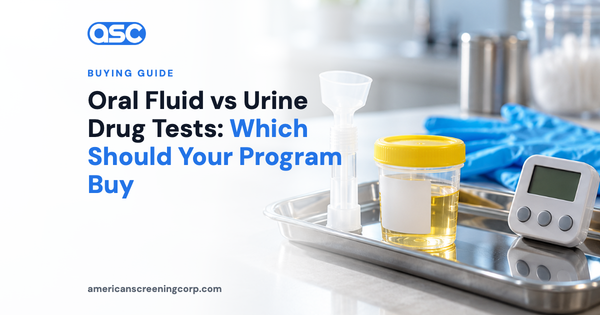
Panel size is one variable. Device format is another, and the two interact. Urine cups and dip cards require a restroom collection and typically read in 5 to 10 minutes. Oral fluid devices are collected under direct observation without a restroom, which many programs prefer for reducing substitution or dilution risk, and they generally have a shorter detection window than urine, which matters if the goal is recent use versus a longer look back. The Federal Register notice establishing mandatory guidelines for oral fluid testing and SAMHSA's published guidance both set cutoff levels specific to the oral fluid matrix, which differ from urine cutoffs for the same drug class. A program moving between formats should not assume the cutoffs line up, and should check the package insert and the applicable federal or HHS cutoff table for the specimen type in use.
Buying guide: matching supplies to your program
Once panel size and specimen type are settled, the practical task is sourcing consistent supplies. Look for a package insert stating panel configuration, cutoffs, CLIA status, and intended use population. American Screening's drug test cups and dip cards come in a range of panel configurations, and the oral fluid tests collection covers saliva based screening. Clinics, treatment centers, staffing firms, and court programs ordering on a recurring basis can set up a business account through the wholesale portal, which supports net terms, purchase order checkout, and one click reorder so the same validated configuration ships every time.
Frequently asked questions
What is the difference between a 5 panel and a 12 panel drug test?
The number is how many drug classes the device screens in one pass. A 5 panel typically covers the historical federal baseline (commonly marijuana, cocaine, amphetamines, opiates, and PCP), while a 12 panel adds classes such as benzodiazepines, barbiturates, methadone, oxycodone, buprenorphine, or tricyclic antidepressants, depending on the manufacturer. More panel positions mean broader coverage but also more presumptive positives to confirm.
Do I need a DOT panel if my company is not regulated by DOT?
No. Only employers and safety sensitive positions covered by U.S. Department of Transportation rules under 49 CFR Part 40 are required to use the DOT specified panel and collection procedures. Non-DOT employers may choose a similar "look alike" panel for consistency, but they set their own policy and are not bound by Part 40's specific collection and laboratory requirements.
Does a standard panel detect kratom or 7-OH?
Not unless the device specifically includes a KRA (mitragynine) position. Standard opiate or synthetic drug panels are not built to flag kratom's active compound, and rapid panels generally do not separately detect 7-hydroxymitragynine. Programs concerned about kratom should ask a confirmation laboratory which specific analytes its method can detect.
What does CLIA waived mean on a drug test label?
CLIA waived means the device has been categorized under the Clinical Laboratory Improvement Amendments as simple enough and low risk enough for use outside a full certified laboratory setting, under a CLIA certificate of waiver. It does not mean the device is "approved by FDA," since FDA clearance and CLIA categorization are separate, specific designations that should be verified for the exact product, not assumed from marketing copy.
Should my panel include THC?
That depends on current state law and organizational policy, and it varies enough to confirm before finalizing a panel. Some states separate cannabis testing from general drug and alcohol testing in statute or restrict how an employer may act on a positive marijuana result. Check the state's official statute portal or labor agency and involve counsel before setting policy on THC inclusion or adverse action.
What happens after a panel screen comes back non-negative?
A non-negative rapid screen is presumptive, not confirmed. The specimen should go to a certified laboratory for confirmation by a more specific method, and a medical review officer should review any confirmed non-negative to check for a legitimate medical explanation, such as a valid prescription, before it is reported as a verified positive.
For related reading, see 11 Panel Drug Test: What It Screens, Typical Cutoffs and When Employers Choose It and Oral Fluid Drug Test Cutoff Levels: HHS, DOT, and Rapid Test Reference.
This article is general information for program planning purposes, not legal or medical advice. Confirm current federal and state requirements with the applicable agency or statute and consult qualified counsel before finalizing a testing policy.